
Deciphering Social Ties: A Generative Approach to Tripartite Graphs in Recommendation
Exploring generative models of tripartite graphs for recommendation in social media
This paper investigates three generative probabilistic models—User-Concept (UC), User-Resource (UR), and User-Resource-Concept (URC)—to model tripartite graphs in social media for recommendation tasks. Specifically, the URC model jointly captures the interactions between users, resources, and tags to uncover latent topics and predict social ties.
In the era of social media, the explosion of user-generated content has created a "tagging wilderness." Users annotate artists, photos, and videos with an unrestricted vocabulary, leading to a complex web of interactions known as tripartite graphs.
This research, authored by Charalampos Chelmis and Viktor K. Prasanna, dives deep into how we can model these interactions to not only understand what users like but also to predict who they will connect with.
TL;DR
The paper introduces the User-Resource-Concept (URC) model, a generative probabilistic framework that uncovers latent music genres and user interests. By combining these latent "topics" with social network features (like how many friends you have in common), the authors developed a system that predicts social links with significantly higher accuracy than traditional metadata-based methods.
The Problem: The Chaos of Folksonomies
Social tagging (folksonomies) suffers from three main issues:
- Synonymy: Different tags for the same thing (e.g., "lac" vs "laclippers").
- Polysemy: The same word having different meanings (e.g., "apple" as a fruit vs. "apple" as a tech brand).
- Sparseness: Most users only tag a few items, making the connection matrix mostly empty.
Existing methods often treat tags or resources in isolation, ignoring the "collaborative" signal where multiple users contribute to the characterization of a single resource.
Methodology: The URC Model
The heart of the paper lies in comparing three graphical models. While the User-Concept (UC) and User-Resource (UR) models are adaptations of Latent Dirichlet Allocation (LDA), the URC model is the most sophisticated.
Architecture Breakdown
The URC model assumes that:
- Every user has a distribution over Latent Topics (e.g., 80% Jazz, 20% Rock).
- For every social interaction, a user acts on a resource, a topic is chosen based on the user's "tastes," and a tag is generated from that topic.
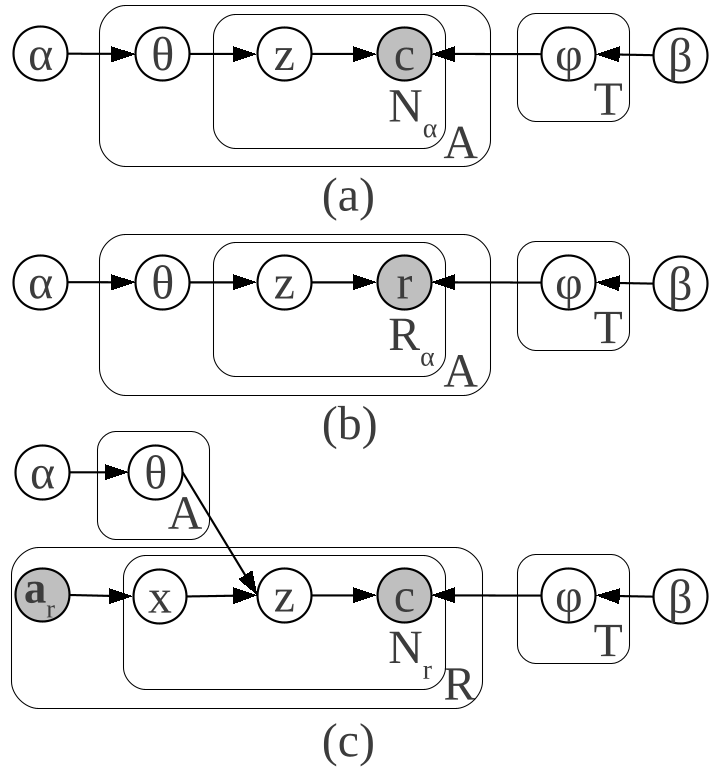
This allows the model to map users, tags, and artists into the same low-dimensional Latent Space.
Recommendation via Semantic-Structural Fusion
The authors didn't stop at modeling; they used the output for Social Link Recommendation. They proposed an ensemble of four classification schemes using Support Vector Machines (SVM).
The most effective scheme, Scheme A, combines:
- Latent Similarity: How similar are your musical tastes in the latent space?
- Local Structure: How many common neighbors do you share in the social graph?
Experimental Results: Precision and Perplexity
Testing on a real-world dataset from Last.fm (2,000 users, 18,000 artists, 12,000 tags), the results were telling:
- Perplexity: The URC model achieved lower perplexity scores than UC or UR, proving it is better at "predicting" unseen data.
- Link Prediction: The Ensemble scheme reached nearly 90% precision.
- Lift: Compared to the state-of-the-art "Maximal Information Path" (MIP) baseline, the URC-based classifiers showed a consistent performance "lift."
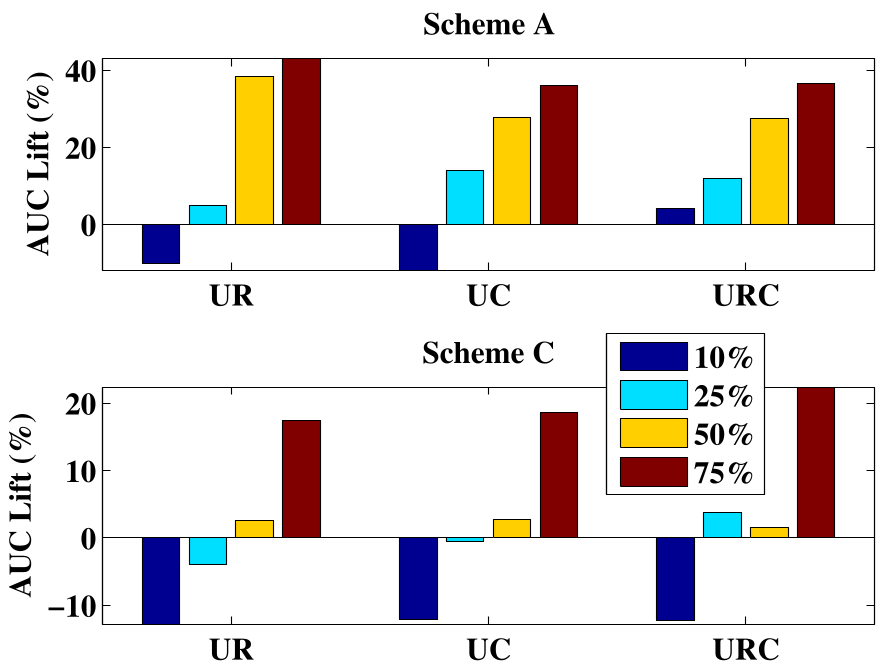
Critical Insights & Takeaways
This work highlights that latent interests are not enough. While knowing two people like "Post-Punk" suggests a social tie, the existence of mutual friends (local structure) is the catalyst that makes that tie likely to form.
Key Implications:
- Product Design: Social platforms should suggest friends by combining "what you do" (behavioral topics) with "who you know" (graph proximity).
- Scalability: The paper utilizes collapsed Gibbs sampling and SMO for SVMs, ensuring the methodology can scale to larger datasets.
Limitations: The model assumes topics are independent, whereas, in reality, music genres often overlap (e.g., "Blues" and "Jazz"). Future iterations incorporating Topic Correlation could provide even finer-grained recommendations.
Conclusion
By treating social media as a tripartite ecosystem rather than a simple set of tags, Chelmis and Prasanna have provided a robust roadmap for the next generation of semantically-aware recommendation engines.