
GSR: Solving Data Sparsity in Software Crowdsourcing via Generative Latent Spaces
Generative Ranking based Sequential Recommendation in Soware Crowdsourcing
The paper introduces the Generative Ranking based Sequential Recommendation (GSR) model, designed specifically for software crowdsourcing platforms. It integrates a generative layer into a translation-based recommendation framework to address data sparsity and dynamic item lists, achieving SOTA results on Kaggle and Topcoder datasets.
TL;DR
In the world of software crowdsourcing (Kaggle, Topcoder, Stackoverflow), matching the right developer to the right task is notoriously difficult due to "swiss-cheese" datasets—extreme sparsity. The Generative Ranking based Sequential Recommendation (GSR) model solves this by replacing rigid embedding vectors with a Generative Layer that samples from Gaussian distributions. This ensures the model learns a continuous, dense representation of developer interests, boosting ranking accuracy (AUC) by up to 21% over traditional translation-based models.
Background: The Sparsity Trap in Crowdsourcing
Software crowdsourcing isn't like Amazon or Netflix. A developer might only participate in 3-4 specialized challenges a year. When you map this data into a latent space (the mathematical "map" of user interests), you don't get a smooth landscape; you get isolated islands.
Current SOTA models like TransFM (Translation-based Factorization Machines) try to model user movements as "translations" in this space. However, because the space is mostly empty, these models fail to generalize—they can't effectively predict where a user will move if they haven't seen a nearly identical previous path.
Methodology: The Generative Insight
The core contribution of GSR is the Generative Layer. Instead of mapping a feature to a single point , the model learns a mean () and variance ().
- Probabilistic Latent Space: By sampling , the model forces the latent space to be continuous. This acts as a powerful form of regularization, preventing the model from "memorizing" specific sparse pairs.
- Sequential BPR (S-BPR): The authors modified the standard Bayesian Personalized Ranking. In crowdsourcing, the "item list" (available tasks) changes daily. GSR's optimizer samples negative items from the same time window as the positive interaction, making the training signal much more relevant to real-world platform constraints.
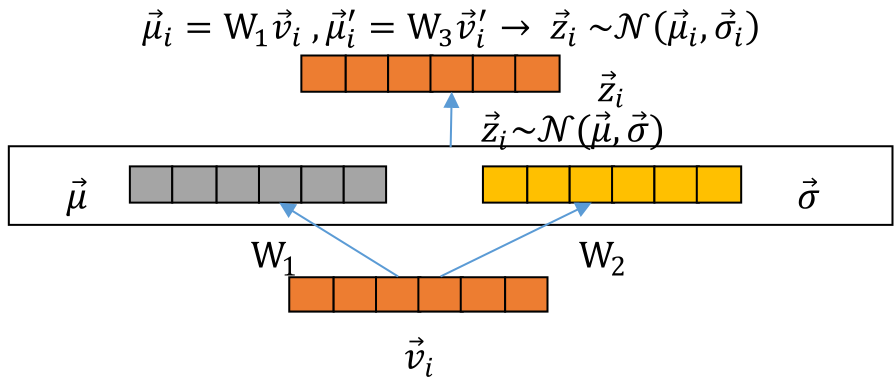 Figure: The architecture of GSR, showcasing the flow from Embedding to Generative and finally the Translation/Scoring layer.
Quantitative Performance
The researchers benchmarked GSR against four heavyweights: FM, PRME, HRM, and TransFM across three massive datasets (Kaggle, Stackoverflow, Topcoder).
Key Results:
- Topcoder: GSR achieved a 0.7653 AUC, significantly silencing TransFM (0.63) and PRME (0.62). This suggests that the generative approach is most effective when the metadata is rich but the interactions are sparse.
- The "Deep" Boost: By adding GELU (Gaussian Error Linear Units) and ResNet blocks, the model reached a peak of 0.8704 AUC on Stackoverflow.
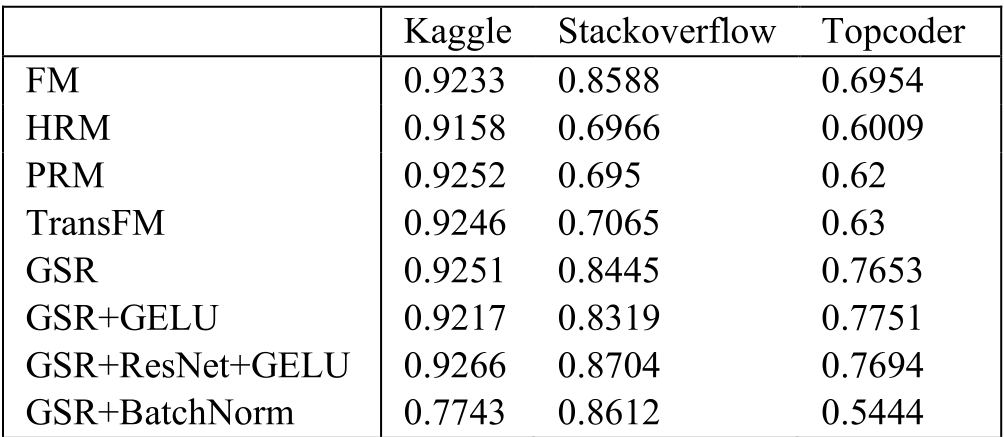 Table: Experimental results showing GSR's superiority, especially when augmented with modern Deep Learning "tricks" like ResNet and GELU.
Critical Analysis: Why it Works
The "magic" isn't just the math—it's the alignment with the domain. Software development is skill-driven. A developer who likes "Python" and "Data Visualization" exists in a semantic cluster. By using a generative layer, GSR effectively "fills in the gaps" between these clusters.
However, there is a limitation: The introduction of Batch Normalization actually decreased performance in some tests. This is a common pitfall in recommendation systems where the distribution of items is highly long-tailed (Zipfian); normalizing the variance can sometimes wash out the unique "signals" of niche skills.
Conclusion
GSR moves sequential recommendation away from static point-mapping toward probabilistic manifold learning. For platforms like Topcoder or Kaggle, this means better task matching, higher developer retention, and ultimately higher quality software submissions. Future work will likely see these generative layers combined with Graph Neural Networks (GNNs) to capture the complex relationships between libraries and developers even more deeply.