
GRAM: Breaking the Deterministic Ceiling of Recursive Reasoning via Stochastic Latent Trajectories
Generative Recursive Reasoning
This paper introduces Generative Recursive reAsoning Models (GRAM), a framework that transforms deterministic recursive architectures into probabilistic generative models via stochastic latent trajectories. GRAM achieves SOTA results among recursive models on Sudoku-Extreme (97.0% accuracy) and the ARC-AGI challenge by enabling multi-path exploration and parallel inference-time scaling.
TL;DR
Recursive Reasoning Models (RRMs) have long promised the efficiency of "tiny networks" that think longer rather than getting bigger. However, they have been limited by a core flaw: they are deterministic "one-track" thinkers. GRAM (Generative Recursive reAsoning Models) solves this by turning the reasoning process into a probabilistic generative task. By adding "Stochastic Guidance" to latent updates, GRAM can explore multiple solution paths simultaneously, enabling it to solve complex puzzles like Sudoku-Extreme and ARC-AGI with unprecedented reliability.
Problem: The "One-Track Mind" of Current RRMs
Traditional RRMs (like HRM or TRM) use shared transition functions to refine a latent state. While efficient, they are trapped in a single latent trajectory. If the first few "thoughts" are wrong, the model often cannot escape the local minima.
This is particularly problematic for:
- Ambiguous Inputs: Where multiple valid reasoning paths exist.
- Constraint Satisfaction: Like N-Queens or Graph Coloring, where a solver needs to backtrack and explore different branches.
- Mode Collapse: Deterministic models often fail to capture the diversity of valid outcomes, reaching only one solution even when hundreds exist.
Methodology: Reason as Generation
The core insight of GRAM is to treat the reasoning trajectory as a stochastic process. Instead of a deterministic update , GRAM introduces Stochastic Guidance ():
This formulation allows GRAM to function as a latent-variable generative model. Using amortized variational inference, the model learns a prior that explores the reasoning space and a posterior (during training) that is guided by the ground truth.
Hierarchical Stochasticity
GRAM splits its state into a high-level abstract "thought" () and a low-level "worker" (). Stochasticity is injected only at the high level, allowing the model to steer its "strategy" while maintaining stable, deterministic fine-grained computation.
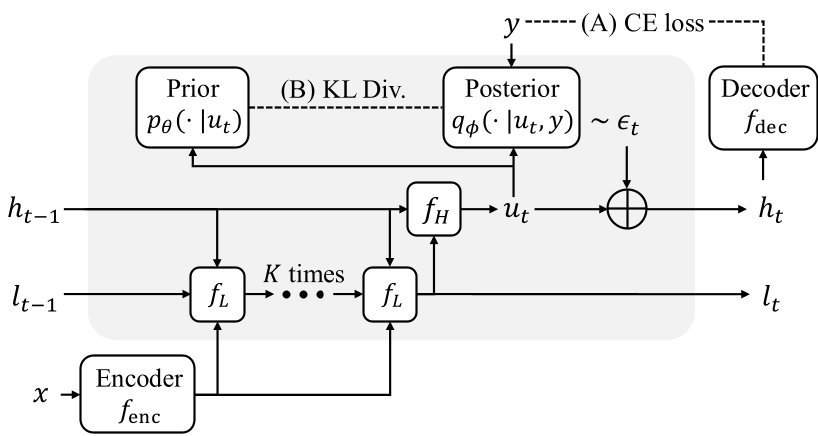 Figure 1: The GRAM architecture showing the interaction between low-level refinement and high-level stochastic updates.
Two Axes of Scaling: Depth and Width
A major contribution of this work is Width-based Inference-Time Scaling. Most models scale by thinking "deeper" (more iterations). GRAM can scale by thinking "wider" (sampling trajectories in parallel).
- Depth: More supervision steps to refine the solution.
- Width: Parallel sampling of paths, with a Latent Process Reward Model (LPRM) selecting the best candidate.
The results are striking: a GRAM model with 20 parallel samples and only 16 iterations beats a deterministic TRM model with 320 iterations.
Experimental Battlefront
1. Cracking Sudoku-Extreme and ARC-AGI
On Sudoku-Extreme, which requires deep constraint propagation, GRAM achieved 97.0% accuracy, far exceeding the 87.4% of the previous SOTA (TRM).
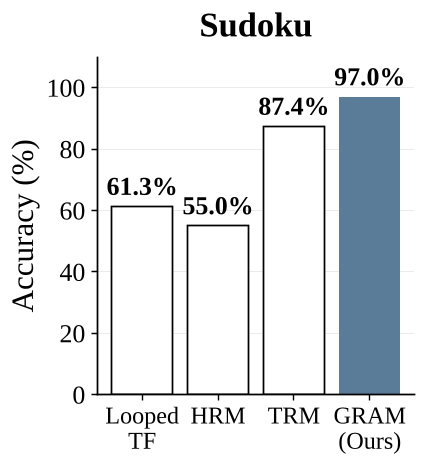 Figure 2: Performance on ARC-AGI and Sudoku. Notice how GRAM consistently sits above the deterministic recursive baselines.
2. Multi-Solution Coverage
In N-Queens and Graph Coloring, GRAM's ability to "see" multiple solutions is its superpower. While deterministic models collapse to ~36% coverage, GRAM achieves over 90% coverage, finding almost all valid ways to solve the problem.
3. Unconditional Generation: Reasoning as a byproduct
The researchers tested GRAM as a pure generator (starting from a blank board). It successfully generated valid Sudoku boards with 99.05% validity, proving that the model has internalized the "rules of the game" within its stochastic transitions.
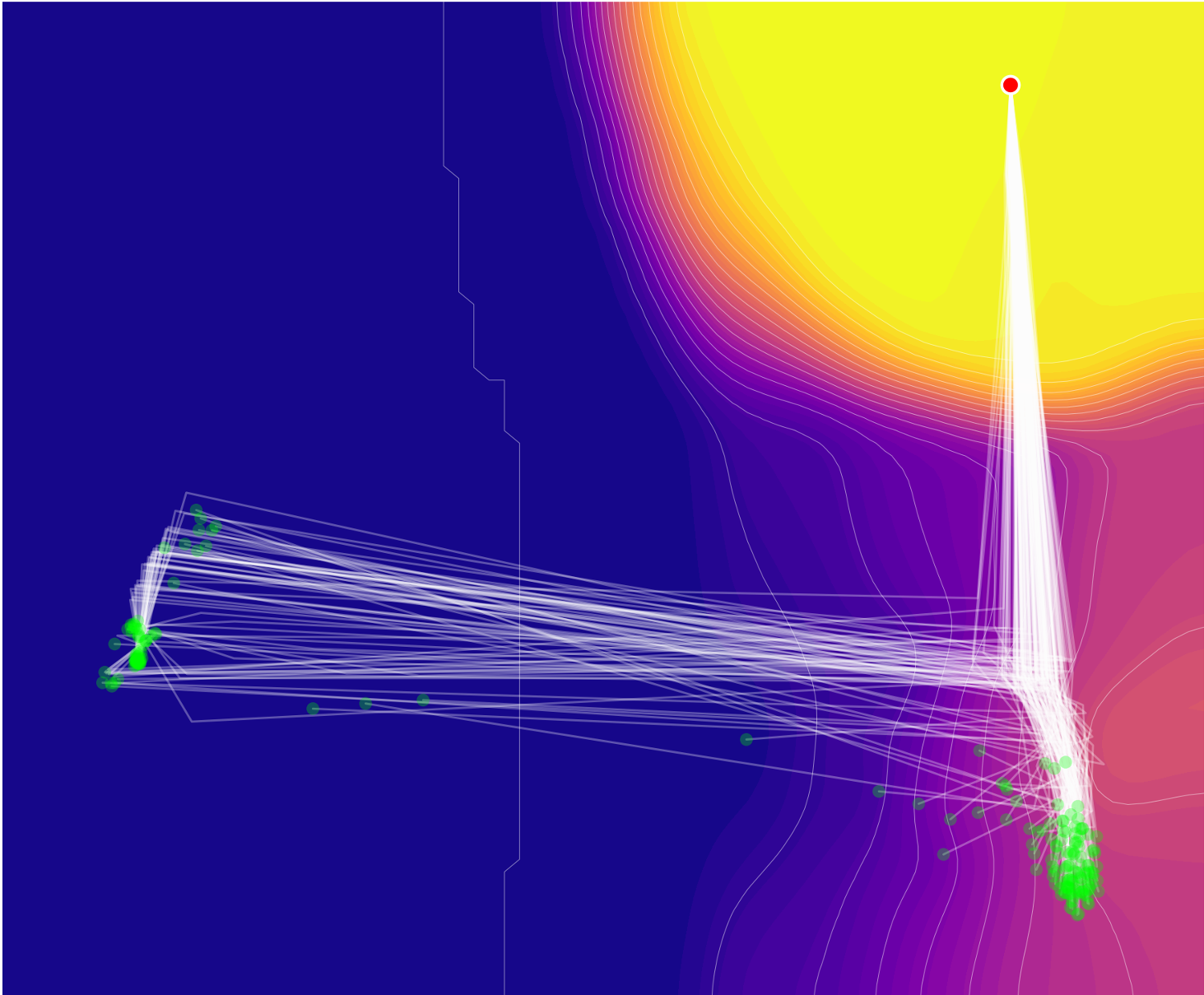 Figure 3: Visualization of 50 sampled trajectories. While some get stuck (yellow), the stochasticity allows many to find the global optimum (dark blue).
Conclusion & Insight
GRAM represents a shift from "Reasoning as a Sequence" to "Reasoning as a Distribution." By allowing neural networks to be uncertain and explore, we unlock a new scaling law at inference time that doesn't rely purely on sequential depth.
Limitations: The sequential nature of deep supervision remains a training bottleneck. However, the success of GRAM suggests that future foundation models might benefit from moving away from deterministic "chains of thought" toward probabilistic "fields of thought."
Key Takeaway: If you want a model to solve hard problems, give it the freedom to wander in its latent space. Stochasticity isn't just noise; in the context of recursion, it is the engine of exploration.