
Bridging the SNS Gap: A Generic API for Socially Aware Computing
A Generic API for Retrieving Human-Oriented Information from Social Network Services
This paper proposes a generic Application Programming Interface (API) designed to extract "human-oriented information" from Social Network Services (SNS). By utilizing the L2-Norm similarity measure, the system identifies relationships between user communities to facilitate "socially aware computing."
TL;DR
This research addresses the "information silo" problem of Social Network Services (SNS). The authors propose a generic API that extracts "human-oriented information"—the collective interests and perceptions of users—to enable "socially aware computing." By measuring community membership overlaps using the L2-Norm, the system can map complex social topographies and provide data for more intelligent search and suggestion engines.
Background: SNS as a Human Relationship Repository
Back in the mid-2000s, SNS platforms like Friendster, Orkut, and Mixi were burgeoning. While users were busy building relationships and joining "circles" (communities), this data remained locked within the services. The authors argue that these platforms are not just for recreation; they are digital goldmines of human behavior. The goal of Socially Aware Computing is to create software that understands human circumstances—favorites, interests, and concerns—to solve issues like SPAM and information overload.
The Methodology: Decoding Community Dynamics
The core challenge is quantifying how "similar" two communities are. If you belong to a Jazz community, what else are you likely to enjoy?
L2-Norm Similarity Measure
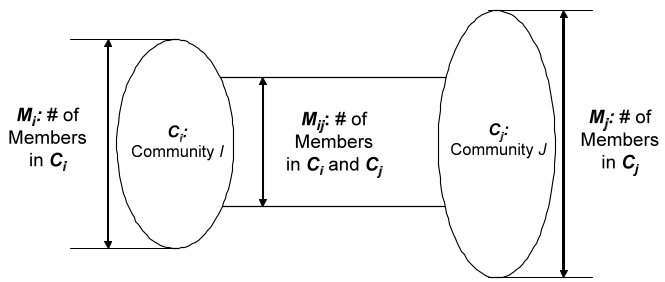
The authors utilize the L2-Norm to calculate the bidirectional correlation () between two communities. The logic is grounded in a bipartite graph structure: if a high ratio of users in Community A also belong to Community B, these communities share a "propensity."
The formula for the ratio from community to () is: where is the number of shared members. The final L2-Norm is the geometric mean of the two directed ratios.
The API Architecture
The proposed API consists of six core functions. While Login and Members are foundational, the intelligence lies in:
- CalcSimilarity: Calculates the L2-Norm between two nodes.
- CommunityNetwork: An iterative function that crawls the graph to build a cluster map of related interests.
Experimental Demonstration: The "Jazz" Case Study
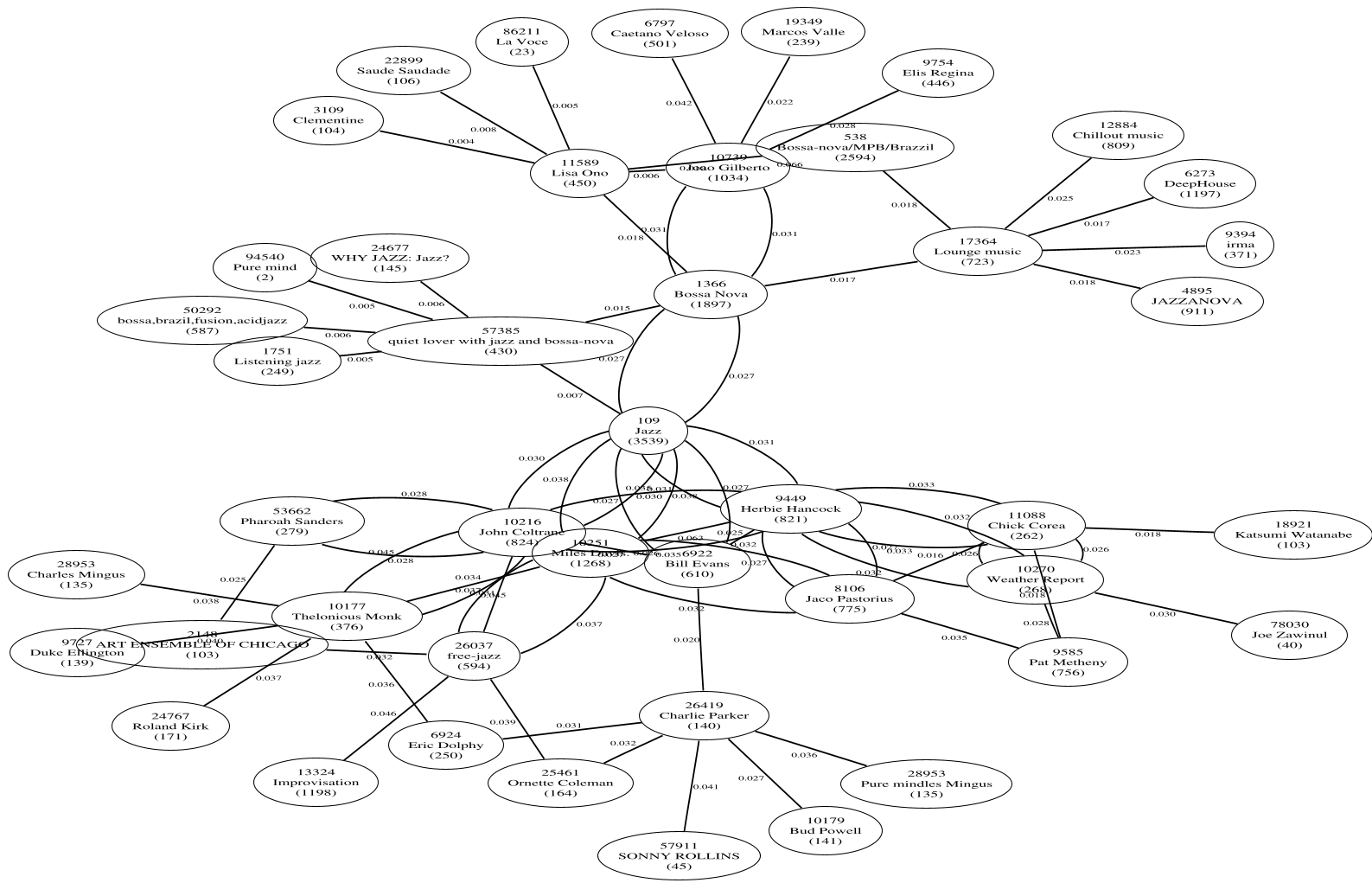
To prove the API's effectiveness, the researchers applied it to Mixi, a dominant Japanese SNS. Starting with the "Jazz" community, the API automatically identified its closest relatives.
Key Findings:
- Direct Influences: The top three related communities were legendary artists (Miles Davis, Herbie Hancock, John Coltrane).
- Cross-Genre Discovery: The system found a strong link to "Bossa Nova" (Brazilian music), revealing a latent preference pattern among jazz listeners without needing any musicological data.
- Emergent Clusters: Using the
CommunityNetworkfunction, they visualized three distinct branches, identifying a unique bridge community called "Quiet lovers with jazz and bossa nova."
Critical Insight & Future Outlook
The beauty of this work lies in its simplicity and portability. By treating SNS communities as sets in a bipartite graph, the authors created a mathematical lens to view human interest.
Takeaways for the Industry:
- Inductive Bias: The method assumes that "membership equals interest," which is a powerful proxy but misses the nuance of lurking versus active participation.
- Privacy Concerns: The authors candidly admit that extracting this data raises significant privacy flags. As we move toward more open social protocols (like Fediverse or Farcaster), the "generic API" concept becomes even more relevant.
In conclusion, this paper successfully demonstrates that with a standardized interface and basic set theory, we can turn a social playground into a structured knowledge base for the next generation of intelligent applications.