
GeoCrowd: Building the Future of Trustworthy Spatial Crowdsourcing
Towards a generic framework for trustworthy spatial crowdsourcing
This paper introduces GeoCrowd, a generic and multi-purpose framework for "Spatial Crowdsourcing" (SC). It shifts the paradigm from single-campaign participatory sensing to a scalable market-based system that matches location-dependent tasks with mobile workers while ensuring data reliability through a reputation-based trust mechanism.
TL;DR
As smartphones become ubiquitous sensors, Spatial Crowdsourcing (SC) has emerged as a transformative method for real-time data collection. This paper presents GeoCrowd, a generic framework designed to move beyond niche sensing projects into a scalable, multi-campaign market. By addressing the critical bottlenecks of Scale (real-time task assignment) and Trust (worker reliability), the work provides a blueprint for reliable, human-powered spatial data ecosystems.
Context: Beyond the PC-Bound Crowd
Traditional crowdsourcing platforms like Amazon Mechanical Turk treat the physical location of the worker as irrelevant. However, tasks like urban planning, disaster response, and journalism require a physical presence. Prior to this work, most "participatory sensing" projects (like UC Berkeley’s Mobile Millennium) were built for specific goals (e.g., traffic monitoring). The author argues that for SC to truly succeed, we need a generic framework—an "Amazon Mechanical Turk for the physical world."
The Core Challenge: Scale and Trust
The transition from single-purpose apps to a generic platform introduces two massive hurdles:
1. The Scaling Bottleneck
In SC, task assignment is not a one-time static match. It is a highly dynamic process:
- Worker Mobility: Workers are constantly moving, entering, and leaving the system.
- Spatiotemporal Constraints: Each task has a deadline and a specific coordinate, while each worker has a limited "reach" or itinerary.
- Computational Complexity: Matching thousands of tasks to thousands of moving workers in real-time is a significant algorithmic challenge.
2. The Illusion of Trust
If you ask a crowd of strangers to report a fire or a gas leak, how do you know they aren't lying or simply mistaken?
- Current Failure: Existing security methods focus on protecting data transmission (encryption/secure hardware), but they cannot stop a user from taking a photo of the wrong location.
- The Solution: GeoCrowd proposes a reputation-based system. Every task has a confidence level, and every worker has a reputation score. The system assigns a single task to multiple workers until their aggregate reputation meets the required confidence.
Methodology: The GeoCrowd Framework
The framework is split into a central web server and a mobile client. The server acts as the "brain," translating requester needs into spatial tasks and managing the assignment logic.
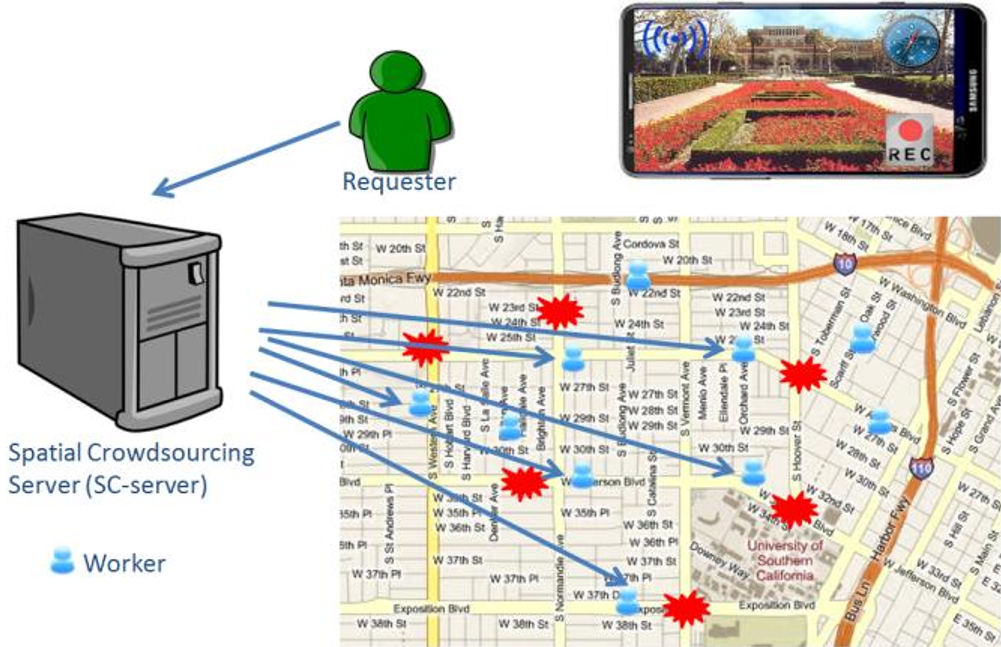
The core innovation lies in the Task Assignment Engine. Unlike standard resource allocation, SC must optimize for the Efficiency vs. Trustworthiness trade-off:
- Efficiency: Use the worker closest to the task to minimize travel time.
- Trustworthiness: Select workers with high reputation, even if they are further away.
Critical Insight: The NP-Hard Nature of SC
The paper posits that finding the optimal subset of workers for a task to satisfy a confidence level is likely NP-hard. Simple voting or decision fusion doesn't scale when the search space includes all possible subsets of workers. The author advocates for Heuristic Algorithms that exploit "spatial properties"—using geographic proximity to prune the search space and make real-time assignment feasible.
Conclusion and Future Outlook
Spatial Crowdsourcing is more than just "volunteered geographic information"; it is a market that turns every smartphone user into a potential high-fidelity sensor. While the GeoCrowd framework sets the stage, the future of the field rests on:
- Cloud-based Distributed Architectures: Essential for scaling to millions of users.
- Advanced Truth Discovery: Developing more sophisticated ways to aggregate conflicting data from different workers.
- Privacy: While not the main focus here, anonymizing worker locations remains a paramount concern for future deployments.
Ultimately, this work serves as an essential bridge between database management and mobile computing, providing the theoretical and structural foundation for any system that seeks to harness the "crowd" in physical space.