
Beyond Perfect Play: A Simpler Path to Emotional AI in Fighting Games
A Generic Model for Emotional AI in Real-Time Multiplayer Fighting Games
The paper introduces a simple generic model for Emotional AI tailored for real-time multiplayer fighting games. It defines an emotional component based on three interconnected factors—Personality, Memory, and Mood—to create AI agents that exhibit non-optimized, "human-like" behaviors.
TL;DR
In the quest for more engaging digital experiences, high-performance AI is no longer the final frontier—emotional resonance is. This paper presents a Generic Emotional AI Model that moves away from pure optimization. By integrating Personality, Memory, and Mood, the authors create agents that act "rationally based on emotion" rather than just winning, making them feel significantly more human to players.
Background: The Limits of Winning
While AI has defeated world champions in Chess and Go, "perfect" play is often predictable and sterile in an entertainment context. The authors argue that Entertainment AI should focus on the user's experience. The core challenge is that human emotion involves "irrational" actions—like seeking revenge even if it leads to a loss. To replicate this, we need a model that doesn't just calculate the best move, but asks how the agent feels about the player.
The "Triple-Threat" Emotional Component
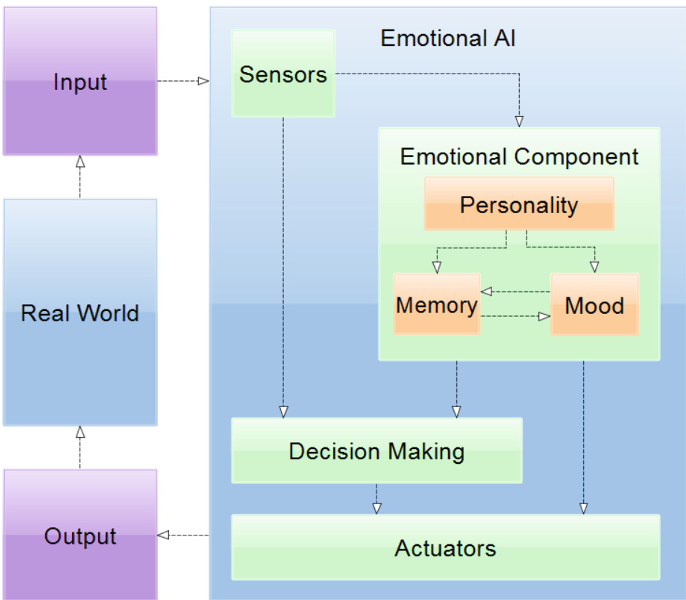
The paper's breakthrough is its radical simplicity. Instead of simulating complex neural pathways of feeling, it uses three interconnected modules:
- Personality (The Constant): Initialized values (e.g., Calm vs. Hasty, Timid vs. Brave) that define the agent's unique baseline.
- Memory (The History): A relational database of events (e.g., "Player B killed me"). Memory decay simulates forgetting over time.
- Mood (The Variable): Real-time feelings like Joy, Anger, Boredom, and Fear that fluctuate based on gameplay and personality.
Architecture of an Emotional Agent
The interaction between these components is what drives the decision-making process. Personality treats some moods as more likely—for example, a "Hasty" agent gets "Angry" faster.
Putting the Model to the Test
The researchers built a custom fighting game where players compete for points. Interestingly, the game doesn't require killing, yet emotional agents might choose to retaliate based on their internal state—a perfect litmus test for "emotion."
Key Experimental Findings:
- Identifiability: Human testers could identify the AI's personality axes (like Cruelty vs. Mildness) significantly better than a random guess.
- Visual Cues Matter: Personalities were much easier to recognize when the AI displayed emoticons or mood bars, suggesting that internal states need "output channels" to be effective.
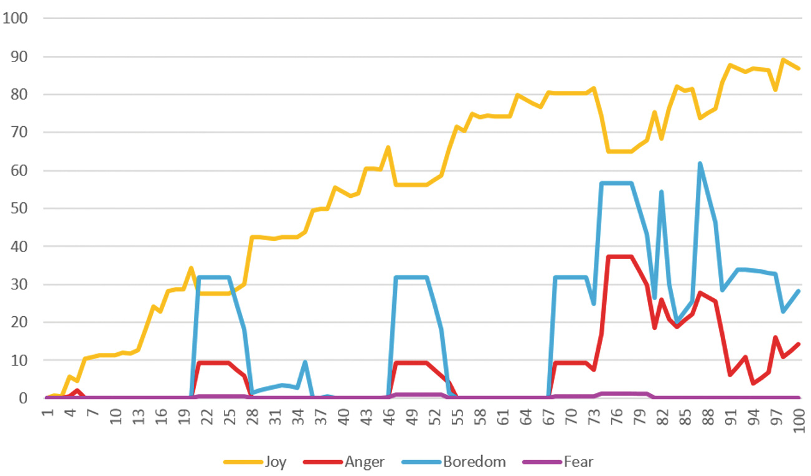
- The Dynamics of Feeling: As shown in the graph below, moods are inversely related; as Joy increases, Boredom and Anger naturally recede.
Critical Analysis & Professional Insights
The true value of this work lies in its scalability. By defining emotion as a mathematical function: it provides a "plug-and-play" framework for developers.
Limitations: The current model struggles with Scalability of Memory. In a game with 100 players, an agent would need 100 memory slots. The authors propose "group relationships" as a fix—hating a whole faction rather than individuals. Additionally, the line between "emotional play" and "strategic play" can still be blurry; did the AI kill me because it was angry, or because it was the most efficient way to stop me from scoring?
Conclusion
This paper serves as a vital reminder that in game design, simplicity is a feature, not a bug. By focusing on three basic factors, developers can create AI that feels alive, vengeful, or cowardly, providing a rich, unpredictable experience that keeps players coming back for more than just a challenge.