
Genetic Algorithm-Driven Patching: Outrunning Malware in Social Networks
Genetic algorithm based patching scheme for worm containment on social network
This paper introduces a Genetic Algorithm (GA) based patching scheme designed for worm containment in Online Social Networks (OSNs). By modeling the social network as a graph and utilizing GA operators (selection, crossover, and mutation), the method identifies "key nodes" that maximize patch propagation speed to neutralize malicious worms.
TL;DR
Social network worms spread at exponential speeds, often leaving security teams in a defensive "catch-up" mode. This paper proposes a Genetic Algorithm (GA) based patching scheme that identifies the most influential "key nodes" to initiate patch distribution, effectively using the network's own connectivity to propagate a "cure" faster than the virus.
Problem & Motivation: The Latency Gap
In the landscape of cyber security, the start of patch distribution is almost always later than the start of worm propagation. Social networks like Facebook or LinkedIn amplify this problem: a single malicious link can reach thousands of users in minutes.
Prior works, such as those by Xu et al., focused on detection using decoy accounts (honeypots). However, detection is only half the battle. Once a worm is found, how do you stop it? Traditional patching is often linear and slow, while worm expansion is geometric. The authors argue that we need a distribution strategy that is mathematically optimized to cover the entire social graph in the shortest time possible.
Methodology: The Genetic Advantage
The core innovation lies in treating the social network as a survival-of-the-fittest optimization problem.
1. Social Graph Construction
The system first builds a graph where:
- (Vertices): Represent individual user accounts.
- (Edges): Represent data exchanges or "friend" relationships. Unlike weighted graphs, this model focuses on the existence of a path to prioritize rapid reach.
2. The GA Optimization Loop
Instead of randomly picking users to receive a security update, the paper uses a Genetic Algorithm to find the "Key Nodes."
- Chromosome: A set of candidate nodes designated to receive the initial patch.
- Fitness Function: Calculated based on the distance (hops) required for a patch to reach the rest of the network. A "high quality" chromosome is one where the chosen nodes collectively minimize the distance to all other users.
- Evolution: Through Selection, Crossover, and Mutation, the algorithm evolves these sets until it finds a group of nodes that can maximize coverage speed.
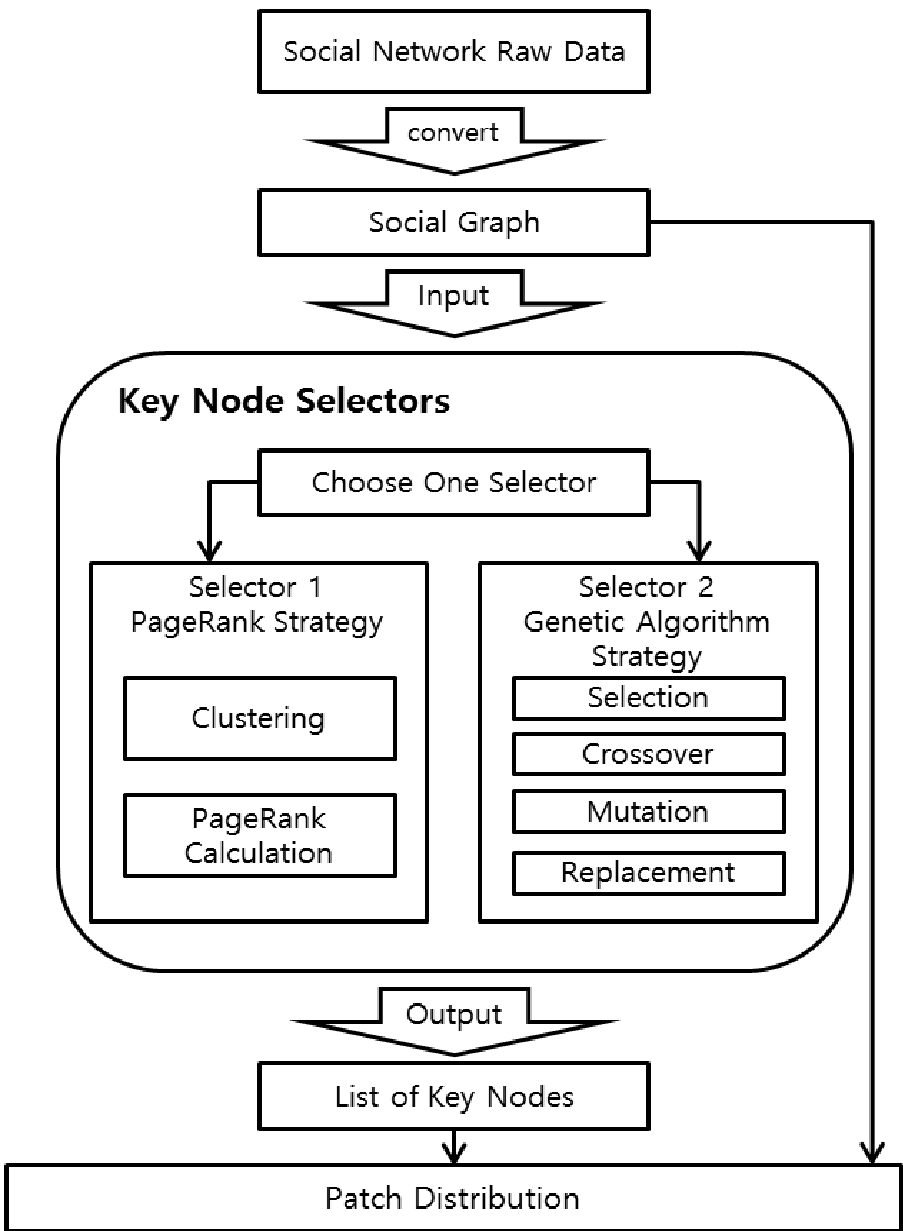 Figure 1: The proposed workflow from Social Graph generation to GA-based key node selection.
System Architecture of Detection vs. Containment
To understand where this fits, it is helpful to look at previous modular architectures like Xu's system (Figure 2), which focuses on "Evidence Collection" and "Worm Detection." The current paper extends this logic by providing the response mechanism that should trigger immediately after the "Communication" module reports an infection.
 Figure 2: A reference detection architecture that identifies the threat before the GA-patching scheme can be deployed.
Experiments & Results
By modeling relationships based on actual data exchanges (e.g., if User A and User B are "friends," a potential infection edge exists), the GA can identify "super-connectors."
The key insight from the results is that proactive distribution to high-centrality nodes (selected by GA) drastically reduces the "Total Infection Time" (TIT) compared to random or proximity-based patching. Even with a small number of initial key nodes, the patch "cascades" through the network, mirroring the worm's own propagation behavior to neutralize it.
Critical Analysis & Conclusion
Takeaway
The value of this work lies in its Inductive Bias: it assumes that the best way to fight a network-based threat is to adopt the network's own topology as the solution's distribution channel.
Limitations
- Dynamic Graphs: Social networks change every second. The paper assumes a static snapshot of a social graph, which might become stale.
- Computational Overhead: Running a GA on a graph with millions of nodes (like Facebook) is computationally expensive; future iterations might need to use Graph Neural Networks (GNNs) for faster inference.
Future Outlook
This approach paves the way for "Self-Healing Networks" where security patches are treated like "Digital Vaccines" distributed to the most socially active "immune cells" of the internet.