
Mining the Evolution: A Hybrid GA-Data Mining Meta-Heuristic for JSS
A genetic algorithm and data mining based meta-heuristic for job shop scheduling problem
This paper introduces a hybrid meta-heuristic for the Job Shop Scheduling (JSS) problem by integrating Genetic Algorithms (GA) with Data Mining techniques (See5/C4.5). The core methodology involves using GA to generate a population of high-quality schedules, which are subsequently mined to extract priority decision rules that form a new, efficient meta-heuristic for operation assignment.
TL;DR
Optimization of Job Shop Scheduling (JSS) is notoriously difficult due to its NP-hard nature. This paper proposes a clever "Distillation" strategy: use a Genetic Algorithm (GA) to find the "best" schedules, then use Data Mining (Decision Trees) to figure out the "secret sauce" behind those schedules. The result is a simple, 3-step meta-heuristic that performs remarkably well without the heavy computational cost of running a GA every time.
Problem & Motivation: Beyond Brute Force
Job Shop Scheduling involves assigning jobs across machines, each with specific sequences and processing times. Traditional solutions fall into two categories:
- Exact Methods (Branch & Bound): Guaranteed optimal but explode in time complexity as size increases.
- Dispatching Rules (SPT, FIFO): Fast but "dumb"—they only look at local information and often miss the global optimum.
The authors' insight was: If a GA can find a great schedule, can we learn the rules it followed? Instead of just using the GA result, they treat the GA as a "teacher" for a data mining model.
Methodology: The GA-to-Rule Pipeline
1. Generating the Knowledge Base (GA)
The authors utilized an operation-based representation where chromosomes are sequences of job indices. This ensures all generated offspring are feasible.
- Crossover: Used LOX (Low Order Crossover), which preserves the relative order of operations—a critical factor in scheduling.
- Selection: A mix of Roulette Wheel and Elitism to maintain population diversity while converging on high-fitness (low Makespan) individuals.
2. Extracting the "Brain" (Data Mining)
Once the GA produced 22 unique near-optimal schedules, the authors extracted features for every operation, such as:
- POJ: Position of the operation in its job.
- TLJ: Total length of the job.
- RPT: Remaining process time.
To handle continuous data, they applied the ChiMerge algorithm to discretize these values into categories like "Short," "Mean," and "Long."
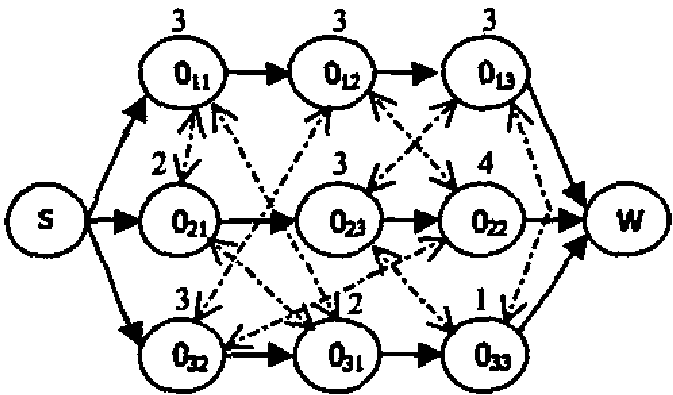 Figure 1: The Disjunctive Graph representation used to model the JSS constraints.
The Resulting Meta-Heuristic
Through the See5/C4.5 classifier, the authors condensed the GA's "wisdom" into a three-step priority sort:
- Primary Sort: Ascending order of POJ (Get early-job operations started).
- Secondary Sort: Descending order of TLJ (Prioritize operations from the longest total jobs).
- Tertiary Sort: Descending order of RPT (Tie-break using remaining work).
Experiments & Results
The "learned" meta-heuristic was tested against standard benchmarks:
- 6x6 Muth & Thompson: Reached the optimal Makespan.
- Law 16 (10x10): Achieved a result within 10% of the optimum.
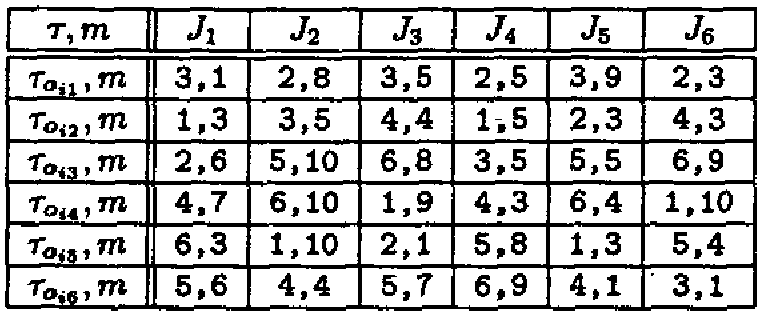 Table 1: The 6x6 benchmark data used to train the Data Mining model.
Critical Analysis & Conclusion
This paper is a classic example of Heuristic Distillation. Instead of relying on a "black box" GA that must be re-run for every new problem instance, the authors extracted an interpretable set of rules.
Limitations: The meta-heuristic was trained on a specific 6x6 instance. While it generalized well to the 10x10 Lawrence problem, the rules might require "re-training" or a larger initial training set (diverse problem sizes) to be truly robust across all industrial scenarios.
Future Outlook: The logical next step is integrating Reliability Indicators (like MTBF). In a real factory, machines break. Combining maintenance scheduling with production scheduling using this GA-Mining framework could yield highly resilient industrial systems.