
Beyond Randomness: Boosting Genetic Algorithms with Random Forest Seeding
Seeding Initial Population, in Genetic Algorithm for Features Selection
This paper introduces two novel seeding methods, Standard Seeding (SSM) and Elitism Seeding (ESM), to initialize Genetic Algorithms (GA) for feature selection. By leveraging Random Forest feature importance to guide the initial population, the approach significantly improves convergence and accuracy across both Eclectic GA (EGA) and Genetic Algorithm with Aggressive Mutation (GAAM).
TL;DR
Genetic Algorithms (GAs) are powerful for feature selection but are often hamstrung by their random beginnings. This paper proposes a "Seeding" strategy—using Random Forest importance to hand-pick the initial population. This simple yet effective heuristic significantly accelerates convergence and helps GAs outperform heavyweights like PCA and Auto-encoders in high-dimensional feature selection tasks.
The "Cold Start" Problem in Genetic Algorithms
In the realm of feature selection, Genetic Algorithms operate through the biological metaphors of crossover and mutation. However, a major bottleneck is the Initial Population. When we start with a purely random set of features, the algorithm spends many generations wandering through "noisy" or irrelevant search spaces.
The authors argue that we shouldn't start blind. Instead, we can use a "Filter" method (Random Forest importance) to transform the initial search from a blind guess into an informed strategy.
Methodology: SSM and ESM
The core innovation lies in two seeding techniques that translate Random Forest Gini importance into GA chromosomes:
- Standard Seeding Method (SSM): Features are selected for the starting population based on their importance scores from a pre-trained Random Forest. High-importance features have a higher probability of being included in the initial "genes."
- Elitism Seeding Method (ESM): A "survival of the fittest" approach even before the GA starts. The algorithm generates a large pool of SSM individuals, evaluates them using a fast classifier (Gaussian Naive Bayes), and seeds the GA with only the top-performing subset.
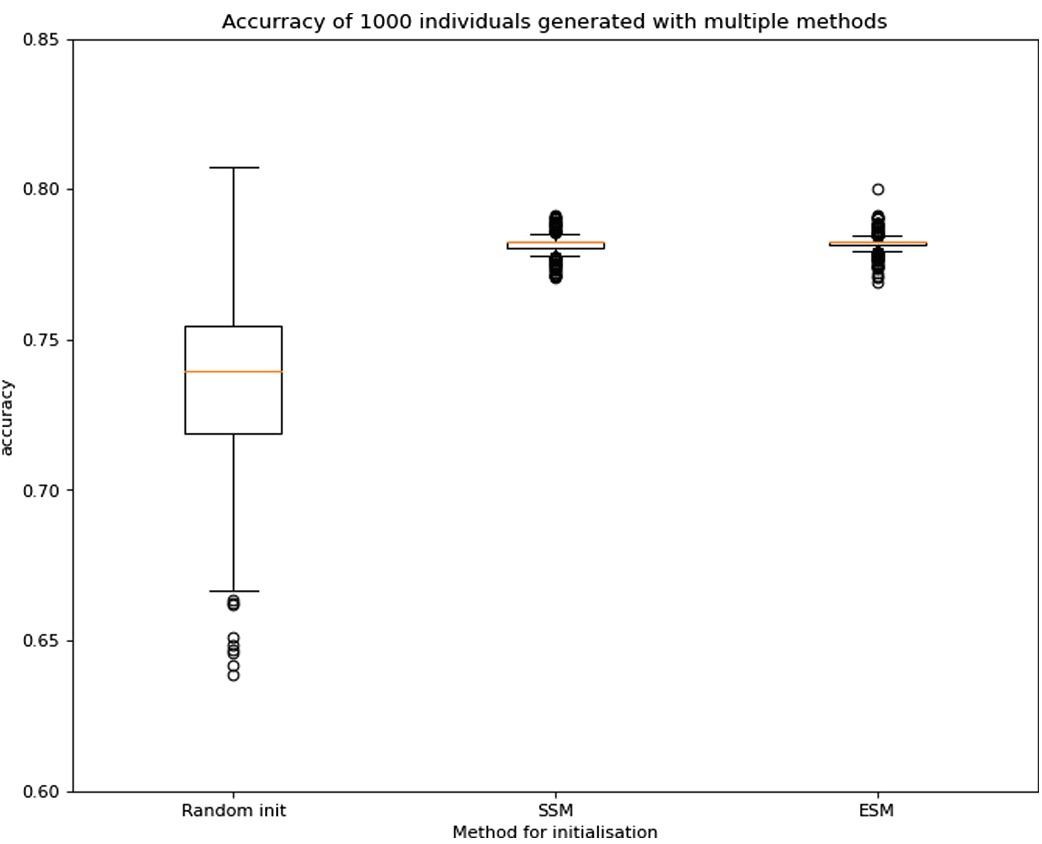 Figure 1: Comparison showing that SSM and ESM produce individuals with significantly higher median accuracy than random generation before the GA even begins.
Architecture of the Experiments
The study evaluated these seeding methods across two distinct GA architectures:
- Eclectic GA (EGA): Featuring annular crossover and dynamic mutation rates.
- GAAM (GA with Aggressive Mutation): Designed to prevent premature convergence by aggressively mutating genes to maintain diversity.
Performance vs. Classical Methods
The authors didn't just test against random GAs; they benchmarked against PCA (Principal Component Analysis) and Auto-encoders.
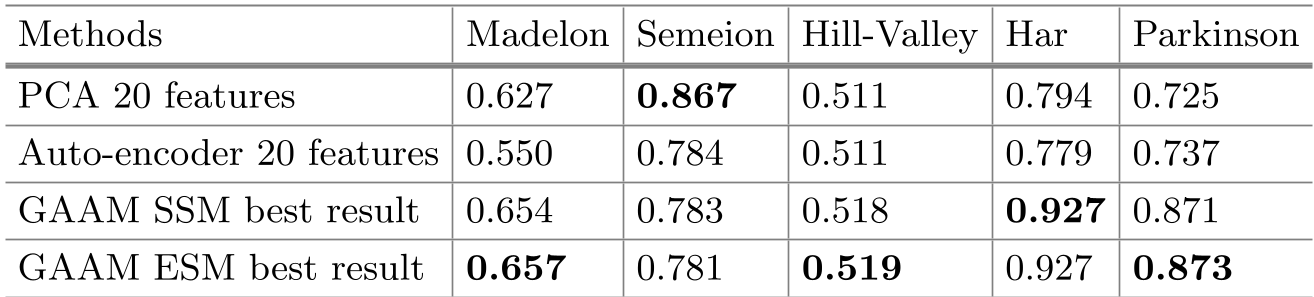 Table: GAAM with seeding outperforms PCA and Auto-encoders across most high-dimensional datasets like HAR and Parkinson.
Deep Insights & Results
- Convergence Speed: The seeded populations (especially with 100% seeding) reached higher accuracy plateaus much faster than their random counterparts.
- Stability: Seeding reduced the standard deviation of results. In stochastic algorithms like GA, this consistency is vital for production environments.
- The 10% Sweet Spot: In the GAAM architecture, seeding only 10% of the population often yielded the best results. The authors attribute this to the need for a balance—seeding provides "good genes," while the 90% random population provides the "diversity" needed for the aggressive mutation to explore effectively.
Critical Analysis & Conclusion
This paper demonstrates that initialization matters. By replacing randomness with a probabilistic importance-based heuristic, GAs become not just "explainable" meta-heuristics, but high-performance feature selectors that can outmatch neural-network-based reduction techniques (Auto-encoders).
Limitations: The primary challenge remains determining the optimal "seeding ratio." As seen in the GAAM experiments, 100% seeding can sometimes lead to reduced exploration due to population homogeneity.
Future Work: Integrating these seeding techniques into multi-objective GAs (balancing accuracy vs. the number of features) could further refine the utility of this approach for real-world "Big Data" cleaning and processing tasks.