
AGMOD-GA: Bridging the Regional Gap in Agricultural AI via Genetic Algorithms
Genetic Algorithms (GAs) in the Role of Intelligent Regional Adaptation Agents for Agricultural Decision Support Systems
This paper introduces the AGMOD-GA methodology, which leverages Genetic Algorithms (GAs) as intelligent adaptation agents to localize agricultural models across different geographic regions. By optimizing model parameters (thresholds, coefficients) against historical outcome data, the framework achieves high-fidelity technology transfer for Decision Support Systems (DSS) such as the P.R.O. model for fungus prediction.
TL;DR
Transferring agricultural models between different geographic regions is notoriously difficult due to environmental variability. This paper introduces the AGMOD-GA framework, which couples Genetic Algorithms (GAs) with existing biological models. By treating the GA as an "intelligent adaptation agent," the system automatically tunes internal model parameters to match the historical data of a new region, ensuring that high-accuracy Decision Support Systems (DSS) can be scaled globally without manual expert recalibration.
The Localization Trap: Why Agricultural Models Fail Abroad
In the world of agricultural technology, a model that accurately predicts fungus outbreaks in Germany might be completely unreliable in Italy or Spain. This isn't necessarily because the underlying biology is different, but because the model parameters—the specific thresholds for temperature, humidity, and time—are finely tuned to the climate of its origin.
The authors identify two types of non-transportable models:
- Case 1: Models that are inherently too location-specific (inflexible architecture).
- Case 2: Models that are scientifically sound but require different parameter settings to function in a new environment.
The AGMOD-GA methodology targets Case 2, addressing the "black magic" of manual parameter tuning with an automated, intelligent search process.
Methodology: The GA as a Localization Engine
The core innovation lies in using the GA not to create a new model, but to wrap an existing one. This preserves the "biologically significant" structure of the simulation while allowing the "numerical knobs" to be adjusted.
The AGMOD-GA Architecture
To localize a model, the system requires four elements:
- Historical Situation Data: Input variables like meteorological data.
- Historical Outcome Data: Real-world "ground truth" (e.g., dates when fungus actually appeared).
- The Model: The simulation engine (e.g., the P.R.O. model).
- The GA: The search mechanism.
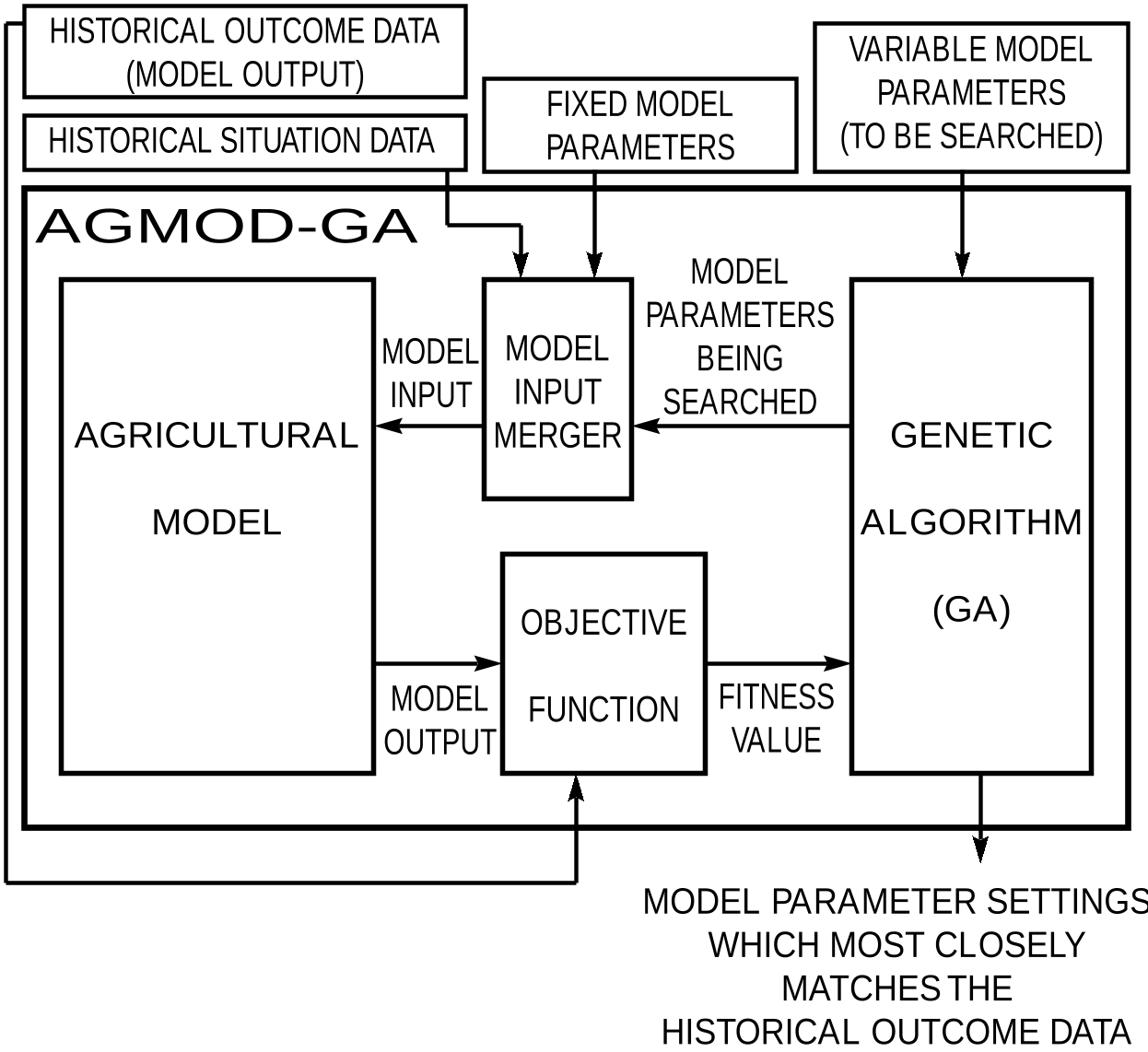
The GA generates a population of parameter sets (chromosomes). Each set is fed into the agricultural model, and the model's output is compared against historical outcomes. The closer the match, the higher the fitness of that parameter set. Through reproduction, crossover, and mutation, the GA evolves a set of parameters optimized for the new region.
Experimental Proof: The PRO-GA Component
The methodology was tested within the SYBIL project, specifically on the P.R.O. model (designed to predict Plasmopara viticola, or downy mildew, on grape vines).
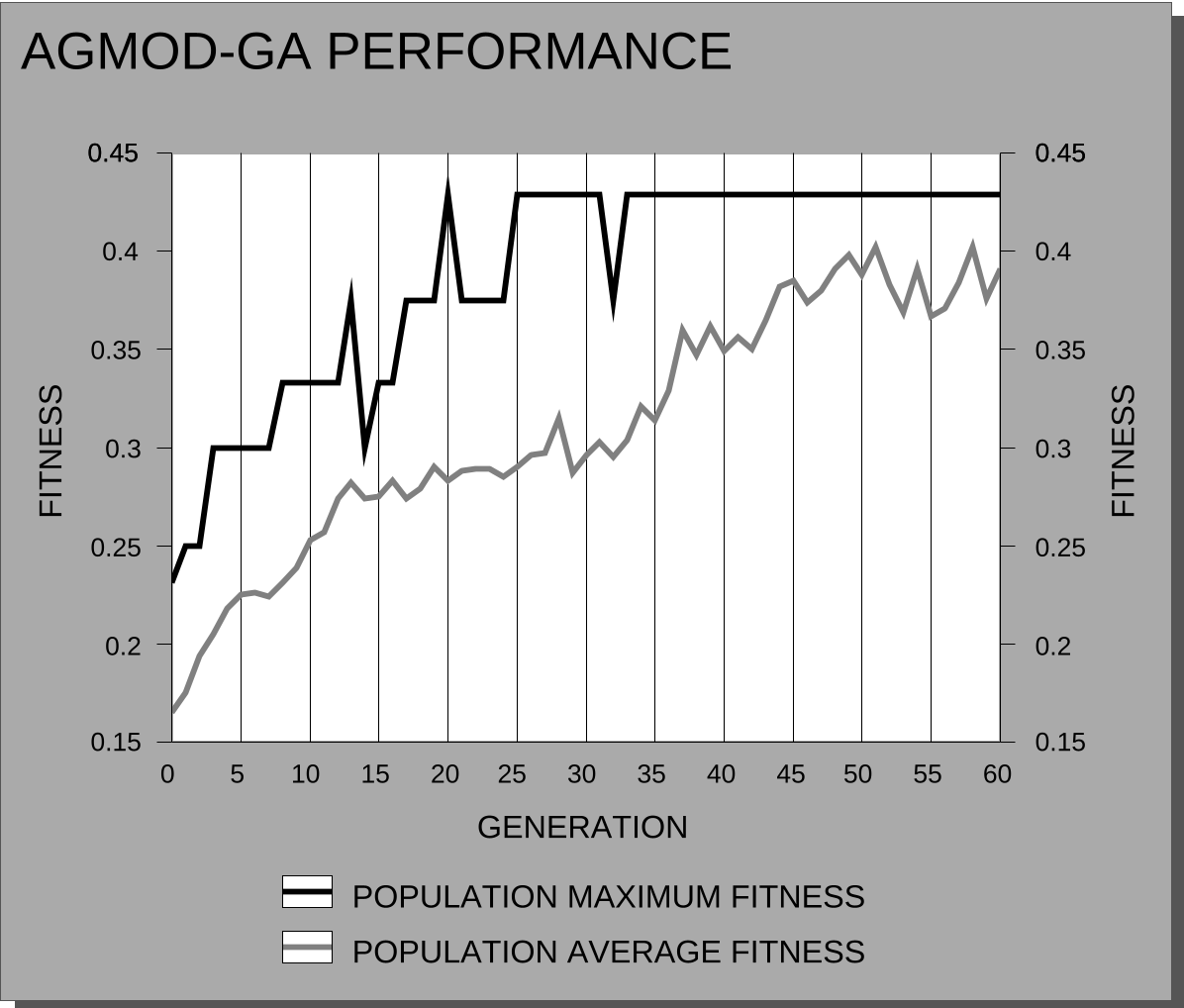
The results confirmed the classic GA convergence pattern: over successive generations, both the maximal and average fitness of the parameter sets increased significantly. This indicates that the GA successfully "learned" the environmental coefficients necessary to make the German-developed model accurate in its new Italian context.
Critical Insights & Conclusion
Why it Works
Unlike purely empirical (data-driven) models that might find correlations without causation, AGMOD-GA keeps the biological logic intact. It uses the GA to find the optimal "operating point" for that logic in a new environment. This hybrid approach ensures the model remains explainable to farmers and agronomists while benefiting from AI optimization.
Limitations and Future Outlook
While GAs are robust, they require high-quality historical "outcome" data, which may not always be available in developing regions. Furthermore, as we move into an era of climate change, these "intelligent agents" may need to operate continuously, adapting to shifting patterns in real-time rather than just performing a one-time localization.
Final Takeaway: AGMOD-GA represents a significant step in AI for Climate and Agriculture, proving that we can scale scientific knowledge globally by using evolutionary search to handle the "noise" of regional variability.