
GRDM: Mirroring Rumor Propagation through the Lens of Genetic Evolution
A new genetic-based rumor diffusion model for social networks
The paper introduces the Genetics-based Rumor Diffusion Model (GRDM), a novel framework that simulates rumor propagation in social networks using Genetic Algorithms. By treating individuals as "chromosomes" and information as "genes," it achieves SOTA-level realism in modeling multi-factor interactions on dynamic Sina-Weibo datasets.
TL;DR
The Genetics-based Rumor Diffusion Model (GRDM) transforms our understanding of "fake news" by treating rumors as genes competing for survival in a social ecosystem. By moving beyond simple epidemic models, GRDM incorporates individual rationality and media refutation, providing a far more accurate simulation of how misinformation scales on platforms like Sina-Weibo.
Motivation: Why Epidemic Models Fall Short
Classical models like SIR (Susceptible-Infected-Recovered) treat rumors like biological viruses. However, humans are not passive hosts. We evaluate information based on its utility and truthfulness. Prior work largely ignored the "cognitive resistance" of users (individual reason) and the active "immune response" of the network (mainstream media refutation). GRDM was designed to close this gap by creating an intuitive, multi-factor framework.
Methodology: The Genetic Architecture of Social Media
The genius of GRDM lies in its mapping of Genetic Algorithm (GA) components to social behaviors:
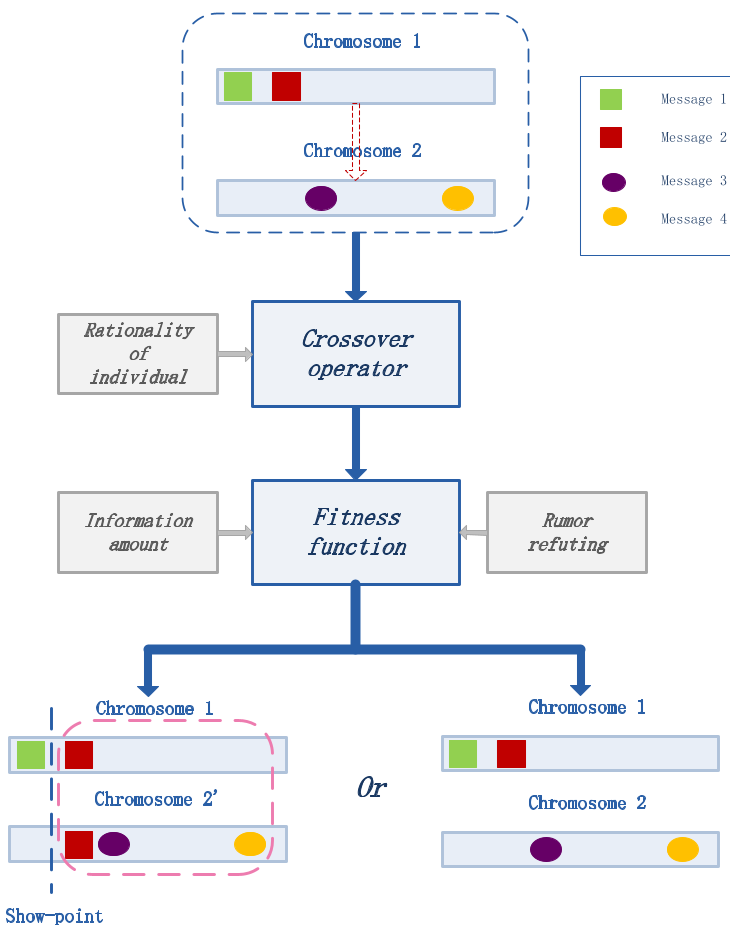
- Chromosome & Gene: Each user is a chromosome. A "gene" is a specific piece of information coded with a starting point, information score (), length (), and a trueness flag ().
- Directional Crossover: Unlike standard GA, social interaction is directional (follower-following). The probability of a "crossover" (a retweet) is defined by the formula: This elegantly captures the intuition that rational individuals are less likely to forward unverified content.
- The Survival of the Fittest: Users update their "knowledge" (chromosome state) only if the incoming information increases their total fitness, defined as a balance between information volume and the intensity of rumor refutation.
Experimental Insights: What Drives the Spread?
The authors tested GRDM on a massive Sina-Weibo dataset. The findings validate several social intuitions:
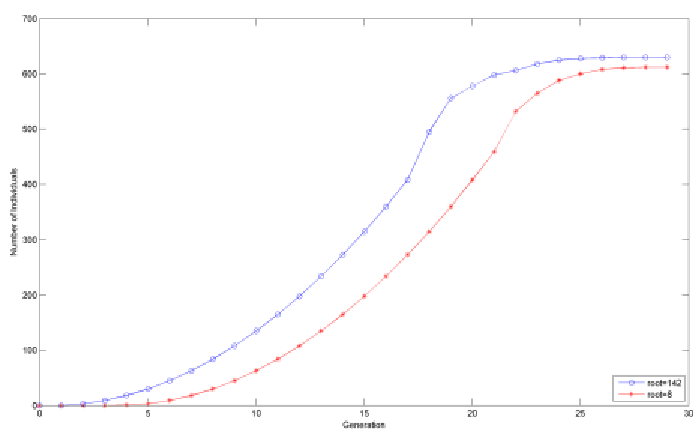
- The Power of the Root Node: Nodes with higher "out-degree" (more followers) don't just reach more people; they reach them faster and the diffusion stabilizes more quickly.
- The "Reason" Threshold: In segments of the population where "reason" was low (irrational behavior), the rumor spread followed an exponential growth curve, whereas rational populations effectively "quarantined" the rumor through lack of forwarding.
- The Impact of Refutation: The study quantitatively showed that when mainstream media (e.g., sina.com.cn) refutes a rumor, the "fitness" of that rumor gene drops, causing a sharp decline in infection rates.
Deep Insight & Conclusion
GRDM succeeds because it acknowledges that rumors are not just transmitted—they are selected. The use of a fitness function suggests that the battle against misinformation isn't just about deleting posts; it’s about increasing the "cost" of possessing false information by lowering its social fitness.
Limitations: While powerful, the current model uses binary strings for genes, which simplifies the nuanced semantic nature of text. Future iterations could integrate LLM-based embeddings to better represent the complexity of human language in the "gene" encoding.