
Evolutionary Graph Logic: Why Random Walks Outperform Geometry in Social Networks
Genetic clustering of social networks using random walks
The paper introduces a graph clustering framework that combines Genetic Algorithms (GAs) with an Average Commute Time (ACT) distance measure derived from random walks. It achieves significantly higher accuracy in identifying subgroups within social networks compared to traditional Euclidean distance-based clustering methods.
TL;DR
In the study "Genetic clustering of social networks using random walks," researchers demonstrate that the secret to understanding social subgroups lies not in "how far" nodes are, but in "how many ways" they can reach each other. By combining Genetic Algorithms (GAs) with a Random-Walk-based distance (Average Commute Time), the authors created a clustering method that achieves near-perfect accuracy, leaving traditional Euclidean and hierarchical methods in the dust.
The "Shortest Path" Fallacy
In traditional spatial data, the distance between two points is a straight line. But social networks aren't geometric; they are topological. Previous methods often relied on Euclidean distances or simple shortest paths.
The Problem: Shortest paths are fragile. In a social context, two people might be "one step" away via a coincidental acquaintance, but that doesn't mean they belong to the same community. Conversely, two people in the same tight-knit group might be connected by dozens of slightly longer paths. Traditional distance measures ignore this "density of connection," leading to poor clustering performance.
Methodology: The Stochastic Intuition
The authors propose that a random walk is the ultimate "stress test" for a cluster. If a walker starts in a dense community, they are likely to bounce around inside that community many times before "escaping" through a thin bridging edge to another group.
1. The Metric: Average Commute Time (ACT)
Instead of measuring the crow-flies distance, the authors use the Average Commute Time (ACT).
- Logic: The more paths that exist between node A and node B, the shorter the "commute time" for a random walker.
- Math: It is computed using the Moore-Penrose pseudo-inverse of the Laplacian Matrix ().

2. The Optimizer: Genetic Algorithms with Medoids
To solve the NP-hard clustering optimization, the authors use GAs. Rather than a messy bit-string, they use a k-medoid representation:
- Each chromosome represents nodes chosen as "anchors" (medoids).
- Exception Bins: In an advanced version, they added "exception bins" allowing certain nodes to defy their closest medoid, adding a layer of flexibility for complex overlaps.
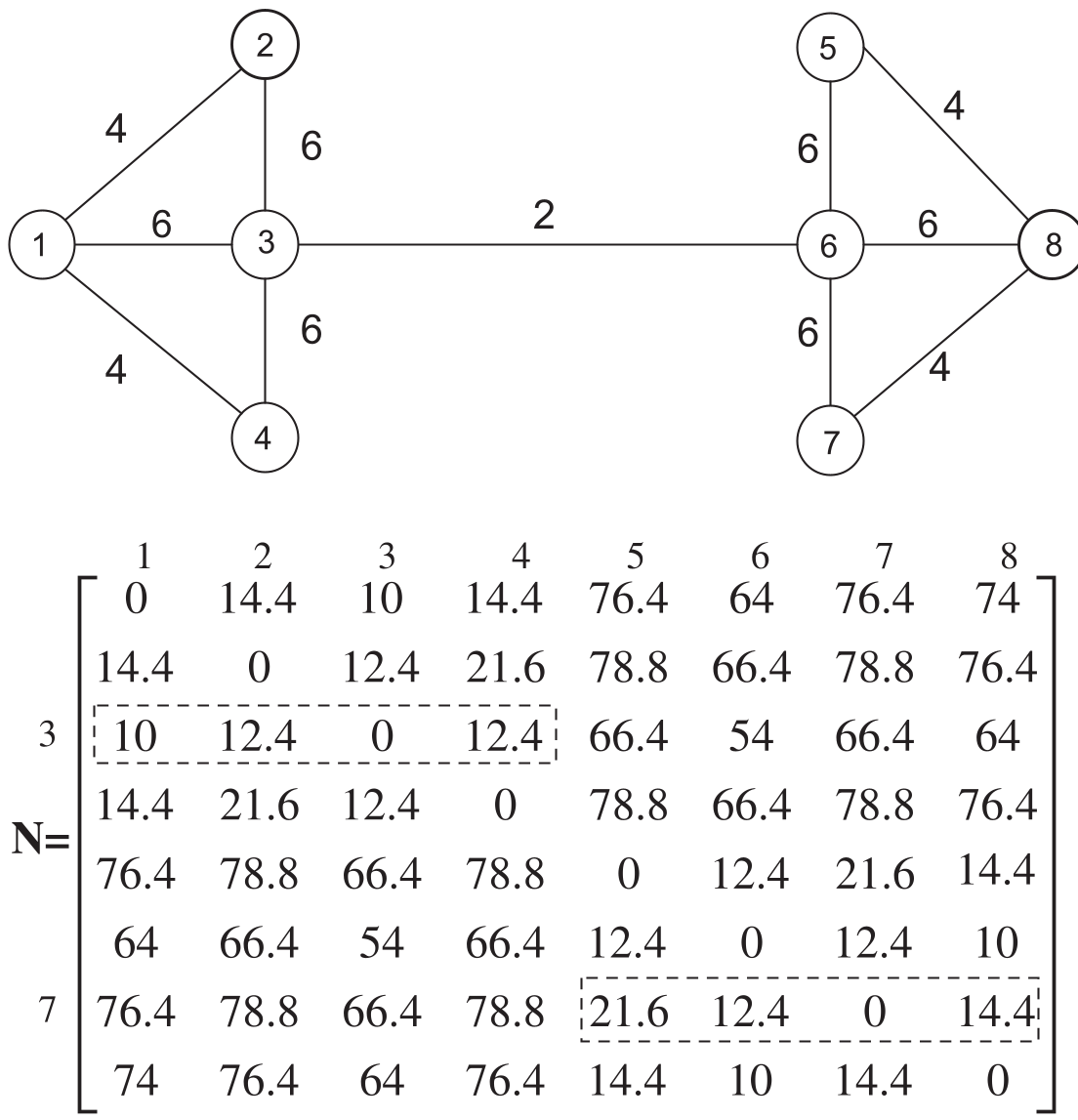 Figure: The evolution of clusters through medoid-based genetic representation.
Experimental Showdown
The authors compared their GA + Random Walk approach against hierarchical clustering and Euclidean metrics across five settings of increasing complexity.
Key Findings:
- The Random Walk Advantage: Across all tests (Setting 1 to 5), using ACT distance instead of Euclidean distance roughly doubled the accuracy of the clusters.
- GA Superiority: The Genetic Algorithm (k-medoids) consistently outperformed Hierarchical Ward and Single-Linkage methods. In a network of 250 nodes, the GA + ACT found nearly all correct assignments, while Single-Linkage failed catastrophically due to the "chaining effect."
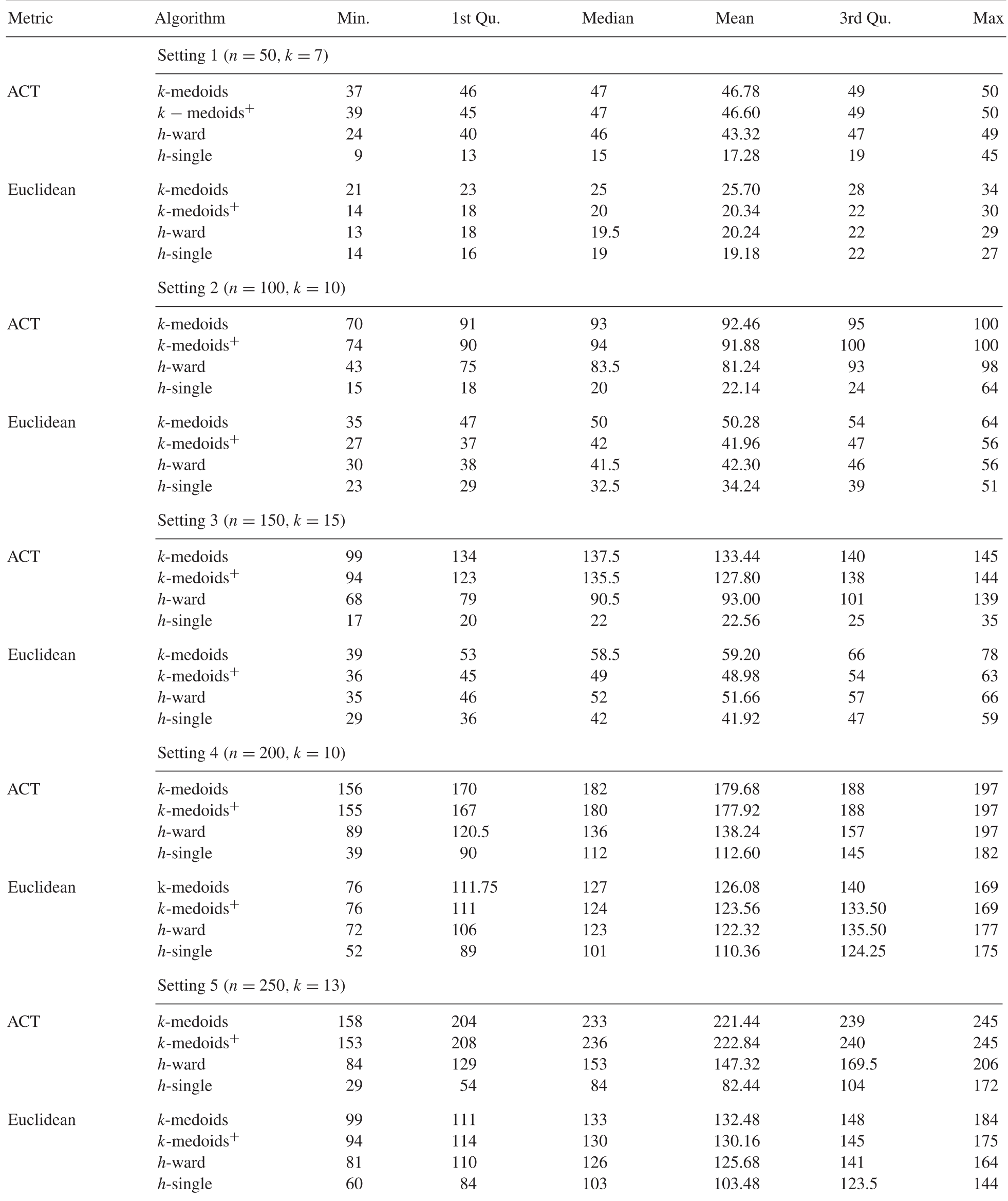 Table: Accuracy results showing ACT (Random Walk) consistently beating Euclidean measures.
Critical Insight & Future Outlook
The beauty of this work is its Inductive Bias. By choosing random walks, the authors encoded the physical reality of social dynamics into a mathematical distance.
The Catch: The calculation of (the pseudo-inverse) has a complexity of . In 2007, this limited the method to networks of a few thousand nodes. In today's era of billion-node social graphs, we would need to replace the exact matrix inversion with sparse approximations or iterative solvers.
Conclusion: This paper serves as a foundational reminder that in network science, topology is destiny. If you want to find a community, follow the walker, not the ruler.