
G-LBSN: Re-engineering Social Networks into Evolving Problem-Solving Engines
Genetic Location-Based Social Networks (G-LBSN)
This paper introduces Genetic Location-Based Social Networks (G-LBSN), an innovative framework for forming temporary, goal-oriented social networks. It leverages real-time location data and member expertise to solve specific problems, evolving its strategies over time through a "genetic" archival process.
TL;DR
Most social networks are built to last forever but accomplish very little in the way of structured work. Genetic Location-Based Social Networks (G-LBSN) flips this script. It proposes the creation of temporary, "genetic" networks that form instantly to solve a specific problem—like a localized emergency or a coordinated task—and then disband, leaving behind an intellectual "memory" that helps the system handle the next crisis even better.
Background Positioning
Published at the intersection of Geoinformatics and Social Computing, this work moves beyond the "check-in" culture of early LBSNs (like Foursquare). It positions social networks not just as communication layers, but as distributed operating systems for real-world collaborative problem solving.
Problem & Motivation: The Void of Purpose
Prior to this research, LBSNs were primarily characterized by:
- Permanence: You are always "in" the network, leading to information fatigue.
- Passive Sharing: The focus was on what you are doing and where, but rarely on why it matters to the community.
The author argues that there is a critical void: the inability to form temporary social networks that address specific issues using intelligent member classification. The motivation is the belief that expertise and location, when combined with a sense of urgency, can solve problems that static organizations cannot.
Methodology: The "Genetic" Blueprint
The "Genetic" aspect of G-LBSN refers to a process of evolution. Every time a problem is identified and solved, the experience is archived. This allows the system to "evolve" its response strategies.
The System Architecture
The framework consists of several specialized components working in the background:
- The Daemon: A background process monitoring existing SNS and sensor arrays.
- Problem Identifier & Optimizer: Analyzing the scale of the issue and formulating a solution path.
- Task Planner & Member Selector: Matching the right people (experts vs. non-experts) based on their current GPS coordinates and professional profiles.
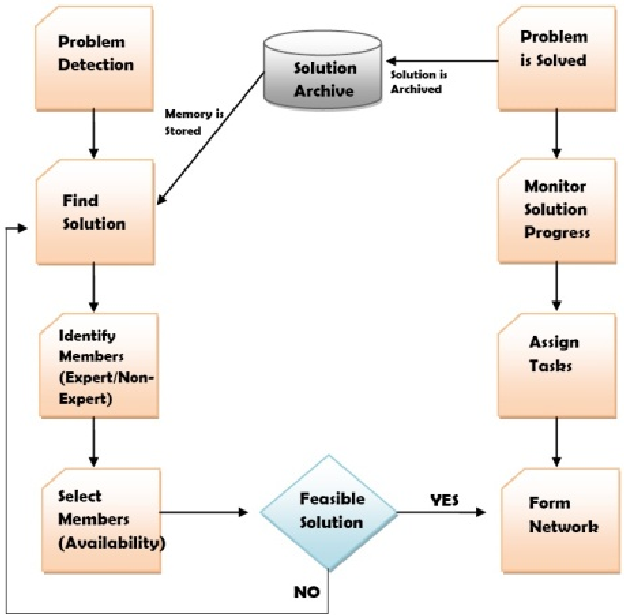 Figure 1: The modular structure of G-LBSN, illustrating the flow from problem detection to archived memory.
The Mechanics of Selection
The paper emphasizes Match-making Algorithms. Unlike simple proximity alerts, G-LBSN seeks both "Local" and "Global" solutions:
- Local: Can this specific person contribute to a sub-task right now?
- Global: Does the aggregate of all selected members have the necessary expertise to solve the entire problem?
Critical Analysis & Conclusion
Takeaway
The true value of G-LBSN lies in its Inductive Bias toward utility. By treating a social network as a temporary, evolving entity, it minimizes the privacy risks of long-term tracking while maximizing the localized impact of crowdsourced intelligence.
Limitations
As a position paper, the primary challenge remains the Incentive Model. While the author suggests people are naturally motivated to help, the technical overhead of maintaining a "ready-to-act" status might lead to significant user churn. Additionally, the privacy implications of a "Daemon" scanning multiple SNS profiles for expertise are substantial.
Future Outlook
G-LBSN pre-dates the modern "Gig Economy" and "Edge Computing" booms, yet it perfectly describes the logic behind them. We can see its DNA in modern emergency alert systems and decentralized task platforms. The next logical step for this research is the integration of Autonomous Agents that can participate in these temporary networks alongside humans.
References
- Karimi, H. A. (2010). Genetic Location-Based Social Networks (G-LBSN). LOCWEB '10.