
GP for Ecology: Balancing Predictive Power and Interpretability in Mosquito Dynamics
Towards the use of genetic programming in the ecological modelling of mosquito population dynamics
The paper explores the application of Genetic Programming (GP) to predict mosquito abundance (Culex pipiens) for West Nile Virus surveillance. By benchmarking against SOTA methods like XGBoost, Random Forest (RF), and GLMM, GP achieved superior generalization and model interpretability, essential for ecological decision-making.
TL;DR
Predicting mosquito populations is vital for controlling diseases like West Nile Virus. This study demonstrates that Genetic Programming (GP) outperforms modern heavyweights like XGBoost and Random Forest not by sheer accuracy, but by its remarkable generalization ability and interpretability. Unlike black-box models, GP provides a clear mathematical formula that ecologists can actually read and validate against biological knowledge.
The "Black Box" vs. "Fixed Structure" Dilemma
In ecological modeling, researchers usually face a trade-off:
- Classic Statistics (GLMM): Easy to understand, but too rigid. It assumes relationships are linear, which rarely holds true in complex ecosystems.
- Modern ML (XGBoost/RF): Highly flexible but prone to overfitting. As shown in this study, these models often "memorize" the training years (2002-2005) so well that they fail miserably when predicting a future year (2006).
The authors argue that GP offers a "third way": an evolutionary search for the best-fitting mathematical expression that doesn't sacrifice transparency for power.
Methodology: Evolving the Best Solution
The researchers used a tree-based GP to evolve functions. The "building blocks" (terminals) included temperature, rainfall, vegetation indices (NDVI), and geographic distances (to rice fields, woods, etc.).
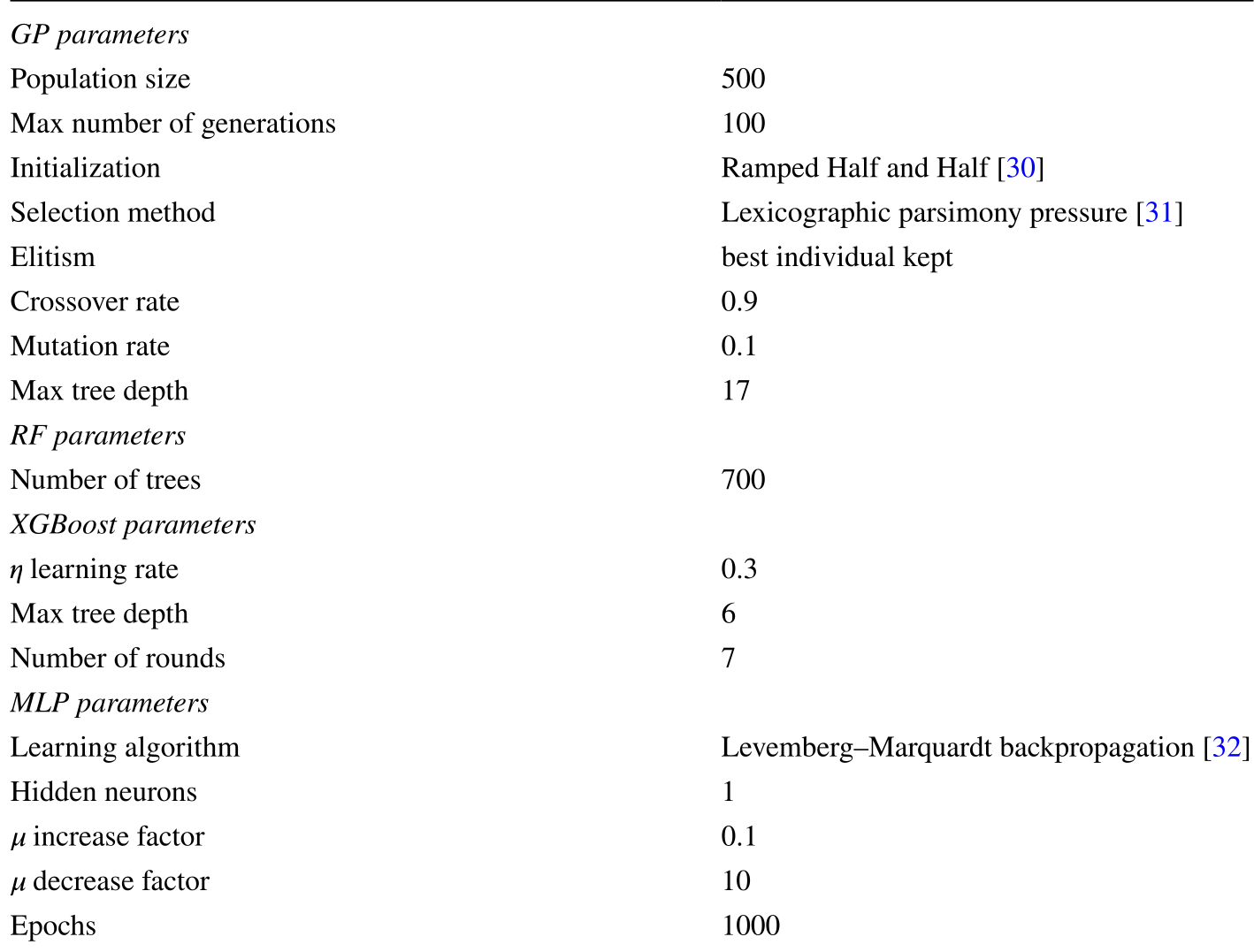
Model Architecture and Parameters
The GP process involves a population of 500 individuals evolving over 100 generations using operations like crossover and mutation.
The fitness was measured by RMSE (Root Mean Squared Error). To ensure the model wasn't just "lucky," the team ran 60 independent GP trials and validated models on a subset of data they hadn't seen during training.
Results: Why GP Wins the Long Game
When looking at the 2006 test data, Random Forest (RF) technically had a slightly lower median RMSE than GP (83.0 vs 83.8). However, the Overfitting Profile tells a different story.
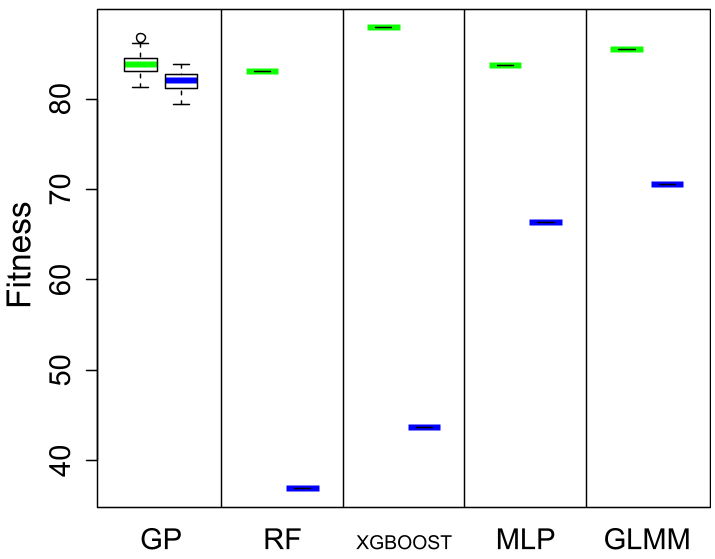
- Random Forest & XGBoost: Showed a massive gap between training and testing performance. They captured "noise" rather than the underlying biological signal.
- GP: Exhibited an almost negligible gap (1.8 RMSE difference). This suggests that the symbolic expressions found by GP represent a more fundamental, generalizable truth about mosquito dynamics.
Deep Insight: Reading the Model's Mind
One of the most striking results is the resulting equation produced by GP:
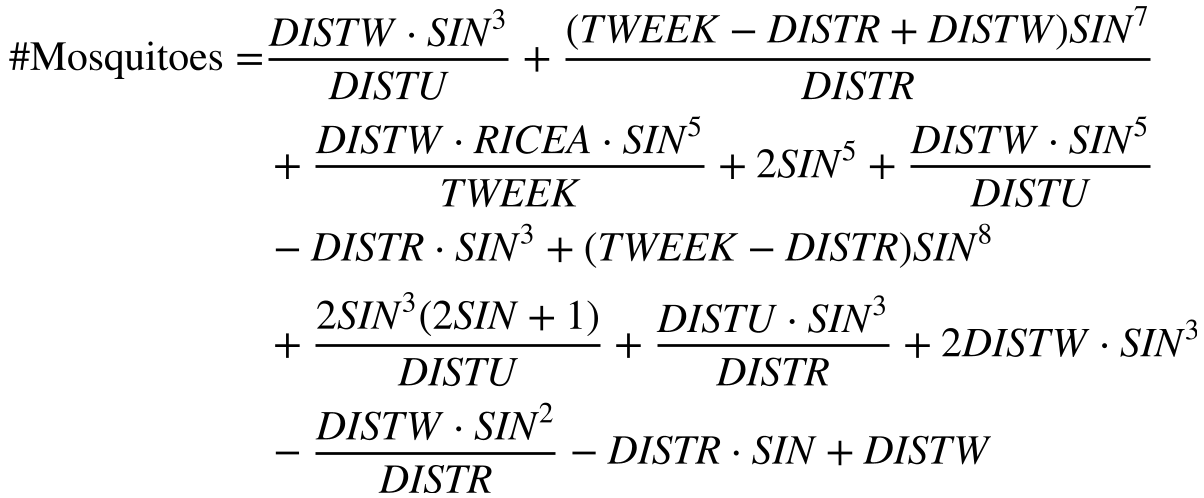
By analyzing this formula, the authors gained several biological insights:
- Urban Proximity: The "distance to urban center" (DISTU) appeared in denominators, confirming that mosquitoes are more abundant closer to human settlements (due to artificial breeding sites).
- Rice Fields: The model correctly identified rice fields as primary breeding grounds.
- Woodland Buffer: Interestingly, distance to woodland (DISTW) had a positive effect, suggesting that forests (likely due to bird predators) are less hospitable for mosquitoes than urban/agricultural areas.
Conclusion and Future Outlook
The study proves that in fields like ecology, Interpretability is a Feature, not a Bug. GP's ability to discard irrelevant data (like rainfall and elevation in this specific dataset) while providing a transparent formula makes it superior for real-world surveillance.
However, the authors noted a limitation: the reliance on an artificial "SIN" variable to represent seasonality. They suggest that Vectorial GP (VE-GP)—which treats environmental data as true time-series rather than independent points—is the next frontier for autonomous ecological discovery.