
GPPIDMM: Enhancing Urban Environmental Assessment through Genetic Projection Pursuit
Genetic Projection Pursuit Interpolation Data Mining Model for Urban Environmental Quality Assessment
This paper introduces the Genetic Projection Pursuit Interpolation Data Mining Model (GPPIDMM) for evaluating urban environmental quality. By integrating projection pursuit with a gray-encoded hybrid accelerating genetic algorithm and interpolation curves, the model reduces high-dimensional environmental indices into a single-dimension projection value (z*) to achieve high-precision, objective classification.
TL;DR
The assessment of urban environmental quality is often plagued by subjective weight assignments and low-dimensional constraints. The Genetic Projection Pursuit Interpolation Data Mining Model (GPPIDMM) addresses these issues by projecting high-dimensional environmental data into a one-dimensional space, optimized via Genetic Algorithms. Tested against Chinese national standards, it delivers a continuous, high-precision assessment that effectively removes the "black box" nature of traditional weight determination.
Problem & Motivation: Beyond Subjectivity
Urban environments are complex systems influenced by water, air, and noise factors. Historically, researchers relied on:
- Analytic Hierarchy Process (AHP): Highly subjective; weights depend on expert opinion.
- Fuzzy Comprehensive Assessment: Struggles with "incompatible" data indices where different units of measurement conflict.
- Artificial Neural Networks (ANN): High precision but requires massive data and lacks interpretability in "weight" logic.
The authors recognized a fundamental need for a model that analyzes weights objectively (letting the data speak for itself) and handles limited real-world monitoring data by using standard-based synthetic data generation.
Methodology: The Core Mechanism
The GPPIDMM operates through five rigorous steps, centering on the "Projection Pursuit" (PP) logic.
1. High-Dimensional Projection
The core idea is to find an optimal projection vector that collapses multi-dimensional indices (COD, DO, Noise, etc.) into a single eigenvalue . The challenge is finding the direction that reveals the "most interesting" structure of the data.
2. Genetic Algorithm Optimization
The model defines an objective function that balances two factors:
- (Standard Deviation): Ensuring the projection values are spread out enough to distinguish between grades.
- (Correlation Coefficient): Ensuring the projection values align strictly with known environmental grades (I-V).
Because this is a non-linear optimization problem, the authors use a Gray-encoded Hybrid Accelerating Genetic Algorithm to find the global optimum for the weight vector .
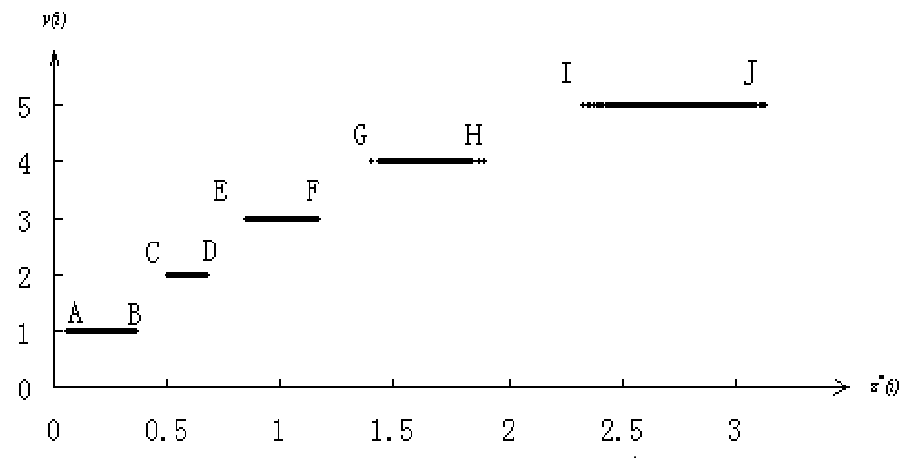 Figure 1: Scatter plot of projection values z(i) vs sample grades y(i), showing the characteristic ladder-shape curve used for interpolation.*
3. Interpolation for Continuity
Unlike traditional methods that categorize a city simply as "Grade II," GPPIDMM uses a linear interpolation formula (Formula 6 in the paper). This allows for continuous values (e.g., 2.015), indicating exactly where the environment sits within a specific grade spectrum.
Experiments & Results: The Xuanzhou Case Study
The model was applied to Xuanzhou city using 13 parameters, including Water (DO, COD, BOD5, etc.), Air (TSP, SO2, NOX), and Noise.
SOTA Comparison
The researchers compared GPPIDMM against the Fuzzy Synthesis and Matter Element methods:
| Method | Result Appraised | Nature of Result |
|---|---|---|
| GPPIDMM | Still Clean (2.015) | Continuous & Objective |
| Fuzzy Synthesis | Still Clean (2) | Discrete & Subjective |
| Matter Element | Still Clean (2) | Discrete |
Key Findings
- Precision: The error between the predicted grade and the actual sample grade was reduced to 0.0 within the training set.
- Stability: Testing with 50 to 5000 samples proved that the projection parameters remain steady once the sample size exceeds a certain threshold, ensuring the model isn't swayed by minor data fluctuations.
Critical Analysis & Conclusion
The Takeaway
GPPIDMM represents a significant step forward in making environmental data mining more scientific. By automating the weight determination process through GA-optimized projection, it eliminates the "human factor" that often skews environmental policy decisions.
Limitations & Future Work
While highly accurate, the model's reliance on synthetic data based on national standards assumes that the standards themselves are perfectly linear in their impact—an assumption that might not hold true for synergistic pollutants. Future research could explore Non-linear Projection Pursuit or integrating Kernel Methods to better capture the complex, non-linear interactions between different types of urban pollutants.
Editor's Note: This work highlights the transition from "Expert-driven" to "Data-driven" environmental science, providing a robust mathematical tool for urban planners worldwide.