
Beyond Topic: Decoding Genre in Chinese Finance Text with Likelihood Ratios
Genre identification of Chinese finance text using machine learning method
2008-10-01
Summary
Problem
Method
Results
Takeaways
Abstract
This paper investigates genre identification within Chinese finance texts (Announcements, News, and Reviews) using machine learning. It introduces a novel feature selection method based on the Likelihood Ratio Test (LRT) combined with SVM classifiers to distinguish style from topic.
## TL;DR
In the world of finance, *what* a document is about is often less important than *how* it is written. An official board announcement carries different weight than a blogger's opinion, even if both discuss the same stock. This paper tackles the challenge of **Genre Identification**, proposing a novel feature selection method based on the **Likelihood Ratio Test (LRT)** that maintains high accuracy while stripping away 80% of redundant, topic-heavy vocabulary.
## The Motivation: Why Topic is Not Enough
Most search engines and classifiers are "topic-centric." If you search for "Tencent," you get a mix of news, rumors, and official filings. For a financial analyst, this creates noise. The pain point is that current systems often ignore the **Genre Facets**—subjectivity, authority, and functional traits.
The authors argue that within a single domain (Finance), the vocabulary is so homogeneous that standard feature selection methods (like CHI) fail to ignore dominant "topic terms" (e.g., "stock," "dividend") which don't help in distinguishing an **Announcement** from an **Opinion**.
## Methodology: The Surprising Power of Likelihood Ratios
The core innovation is the application of the **Likelihood Ratio Test (LRT)** for vocabulary reduction.
### How it works:
Instead of just counting frequencies, LRT evaluates two hypotheses for every term:
1. **Hypothesis 1**: The term occurs independently of the genre.
2. **Hypothesis 2**: The occurrence of the term is highly dependent on the genre.
By calculating the log-likelihood ratio ($\lambda$), the system identifies "surprising" words that appear significantly more (or less) in specific genres.
### Architecture & Implementation:
The authors define three distinct categories:
- **Announcement**: Objective, authoritative, published by companies.
- **News Report**: Factual, low subjectivity, published by reporters.
- **Review & Opinion**: Subjective, informal, written by analysts or bloggers.
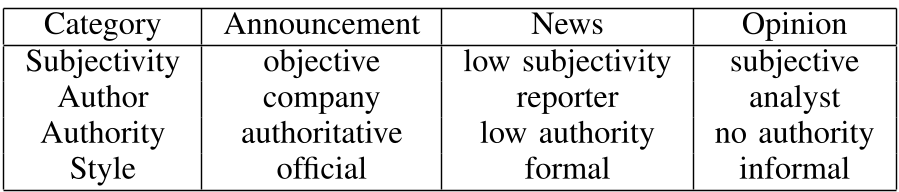
The algorithm uses **ELUS** for Chinese segmentation and **libSVM** (with an RBF kernel) for the heavy lifting of classification.
## Experiments: Less is More
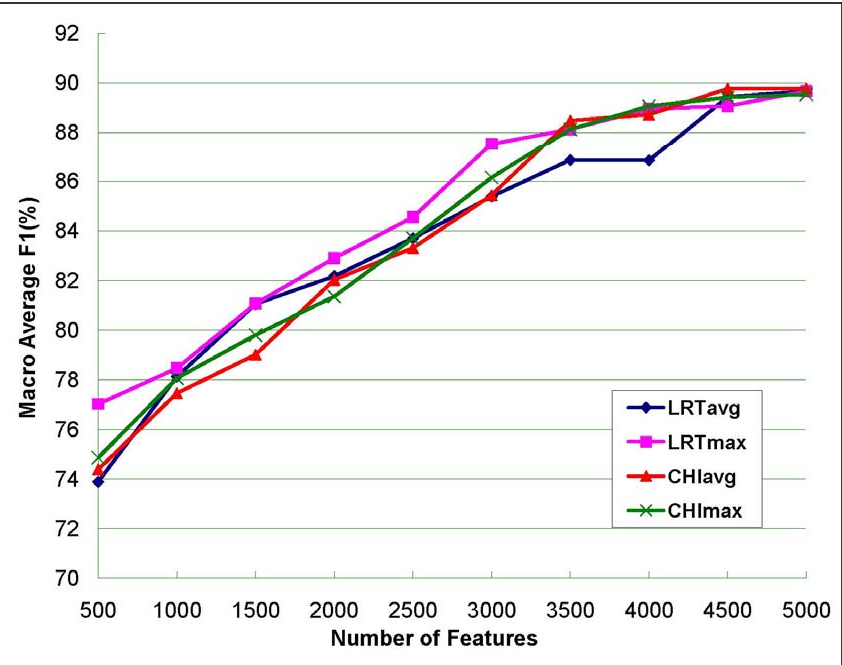
The researchers tested their method against the standard $\chi^2$ (CHI) statistic. The results were revealing:
1. **Aggressive Pruning**: The LRT-max method showed superior resilience. While performance usually drops as features are removed, LRT maintained high Macro-F1 scores even after removing 80% of the unique terms.
2. **Optimal Point**: They found that ~3,000 features strike the perfect balance between inference efficiency and classification accuracy.
## Critical Insights & Conclusion
The study proves that **LRT-max** is particularly effective because it prioritizes terms with high discrimination power for at least one specific category, whereas **LRT-avg** can get diluted by terms that are mediocre across all categories.
**Limitations**: The paper relies on a Bag-of-Words (BOW) approach. While effective for structural genre detection in 2026-era benchmarks, it may miss nuanced semantic cues that modern Transformers (like BERT or RoBERTa) could capture. However, for large-scale search engine indexing, the efficiency of SVM + LRT remains highly competitive.
**Future Work**: The authors aim to integrate structural features like POS tags, sentence type statistics, and named entities to further refine the "stylistic fingerprint" of financial genres.