
genSpace: Turning Scientific Workflows into Social Knowledge Networks
genSpace: Exploring social networking metaphors for knowledge sharing and scientific collaborative work
The paper introduces genSpace, a collaborative platform that implements social networking metaphors into scientific research environments to facilitate knowledge sharing. Unlike traditional data or tool-sharing systems, genSpace automatically captures user activity to build organizational memory, providing features like expert finding and automated workflow suggestions for computational biologists.
TL;DR
genSpace is an innovative collaborative framework that brings "Facebook-style" social dynamics to the world of heavy-duty scientific analysis. By observing how biologists use tools in real-time, it builds a collective memory that suggests the best workflows, identifies experts, and connects peers—effectively turning standalone software into a living community of practice.
The Motivation: Beyond Data and Tool Sharing
In scientific research, collaboration is often reduced to "sharing files" or "sharing access to a tool." However, the missing link is Knowledge Sharing. Knowing that a tool exists is easy; knowing how to sequence five different tools to analyze a specific genomic dataset is the real "black magic" of research.
The authors identified that static documentation (wikis) fails because it is high-maintenance and lacks trust. Instead, they propose that the usage history of specialists contains all the implicit knowledge needed. If we can mine the patterns of experts, we can guide novices automatically.
Methodology: Socializing the Workbench
The genSpace system operates on a three-tier architecture:
- The Client (Instrumentation): Built as a plugin for geWorkbench, it monitors user activity (tool choice, dataset name, timestamps) and sends XML logs to a server.
- The Server (Mining): Aggregates logs and applies data mining. It uses an exponential time-decay function to ensure that recent, modern workflows are weighted more heavily than obsolete methods.
- The Interface (Interaction): Users interact with this data via social network visualizations (HyperGraph) or a "chatbot" (IM Server Bot), keeping the interaction lightweight and social.
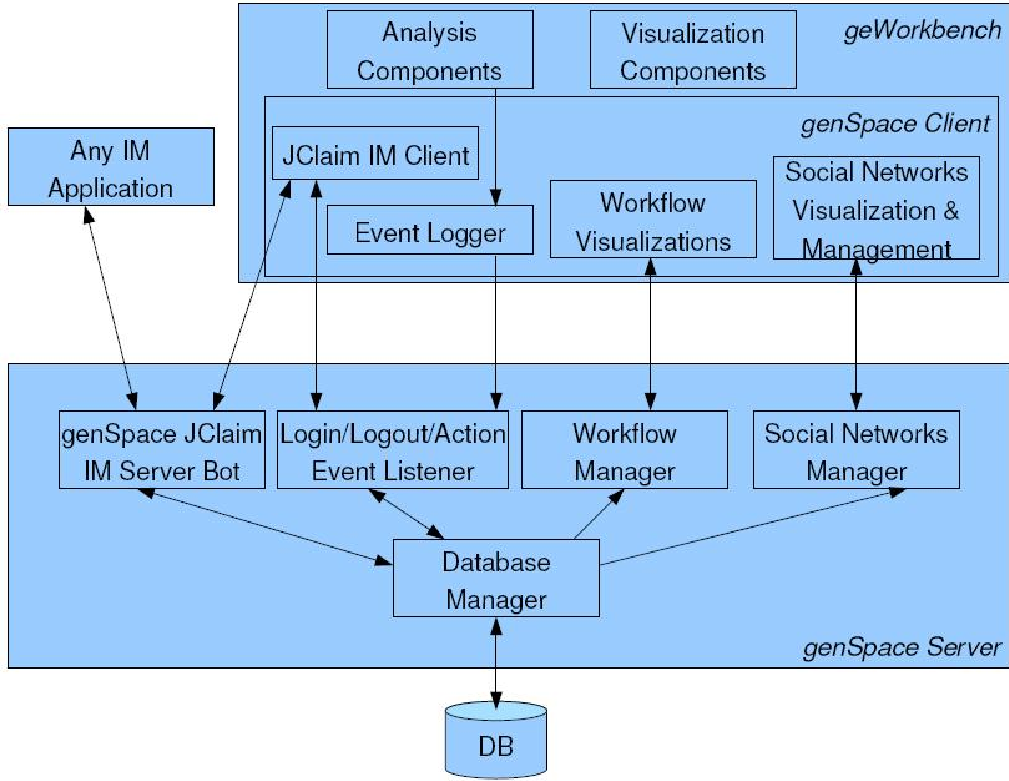
Key Social Metaphors Applied:
- Expert Finder: Instead of guessing who knows a tool, the system identifies the "Power User" based on actual frequency of use.
- Collaborative Workflow Composition: It suggests typical sequences. If you start with Tool A, the system shows a directed graph of the most common "next steps" taken by the community.
- Peer Suggestions: A "Friend Finder" based on operational profiles—linking researchers who use similar specialized toolsets.
Experiments and Results
The authors proved the feasibility of this approach by integrating it into the geWorkbench open-source platform. The technical beauty lies in the low-friction integration: because of the host application’s publish/subscribe model, they enabled tracking with just 145 lines of code.
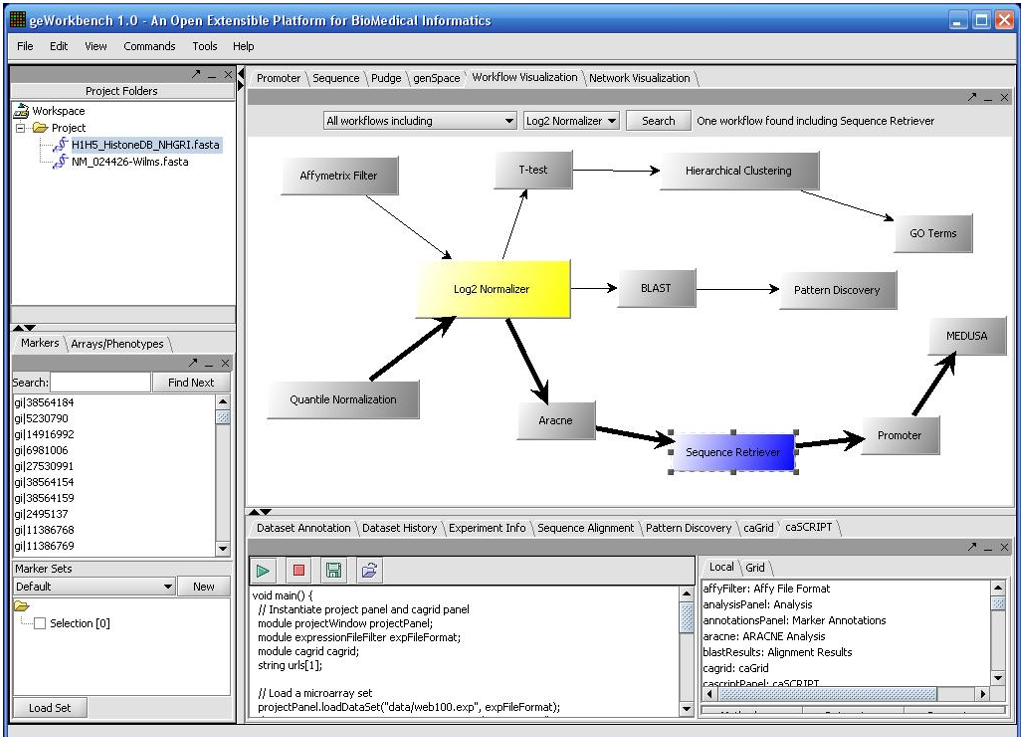 Figure: The Workflow Relationship graph allows users to visualize sequences from left to right, identifying standard operating procedures within their network.
The results show a robust system capable of:
- Visualizing social networks via hyperbolic graphs.
- Ranking tool popularity within specific sub-groups.
- Providing real-time help via IM bots (JClaim API) regardless of which chat client (Google Talk, etc.) the scientist uses.
Critical Analysis & Conclusion
The "Clippy Effect" and Privacy
The authors wisely acknowledge the "Clippy Effect"—the risk that automated suggestions become intrusive. They also address the significant privacy hurdles in science: researchers may not want their "secret sauce" workflows public before publication. Their solution includes opt-out features and anonymous logging, though more robust encrypted data-mining remains a future goal.
Takeaway
genSpace represent a shift from active contribution (where users must spend time writing wikis) to passive capture (where the system learns while the user works). As scientific tools become more complex, this "social software engineering" approach will be vital in preventing researchers from getting lost in the "tool-rich, knowledge-poor" gap.
Future Outlook: The next step for this field is addressing Concept Drift—ensuring the system doesn't suggest outdated workflows just because they were popular a year ago—and expanding into multi-modal data sharing.