
Precise Geo-location: Decoding the Social Map of Facebook Pages
Geo-Location Identification of Facebook Pages
This paper introduces an advanced Breadth-First Search (BFS) based machine learning framework for identifying the state-level geographic location of Facebook public pages. By leveraging a massive dataset of 15 million pages and the structural connectivity of the page-like graph, the method achieves a high classification accuracy of 89% for U.S. states.
TL;DR
Researchers from UC Davis have developed a high-precision framework to identify the U.S. state location of Facebook public pages with 89% accuracy. By moving beyond simple neighbor voting and using an advanced BFS-based Machine Learning approach that considers both structural distance (SDV) and neighborhood context (SNP), they've solved the "fine-grained location problem" that previously baffled standard social graph algorithms.
The "Boundary" Problem in Social Graphs
While predicting which country a Facebook page belongs to is relatively easy (thanks to language barriers and national firewalls), predicting the state is a nightmare. Within the U.S., social connections are high-entropy: a page in Nevada might frequently "like" pages in California or New York due to cultural or economic ties.
Traditional Majority Vote algorithms, which guess a location based on what most of a page's neighbors are doing, collapse in this domestic environment, yielding a measly 59.4% accuracy. The authors identified that we need more than just "neighbors"; we need structural anchors.
Methodology: From Hop Distances to Contextual Probability
The authors' "Advanced BFS" algorithm relies on two sophisticated feature sets extracted from the Facebook Page-Like Graph (where pages are nodes and "Likes" are directed edges):
- State Distance Vector (SDV): This measures the "hop distance" via Breadth-First Search from a target page to Anchored Pages (seeds known for absolute local focus, like "Only In Alabama").
- State Neighborhood Probability (SNP): This adds a layer of robustness by looking at the probability distribution of the locations of adjacent pages, effectively filtering out "noise" from global entities (like NBA or celebrity pages) that connect to everyone regardless of location.
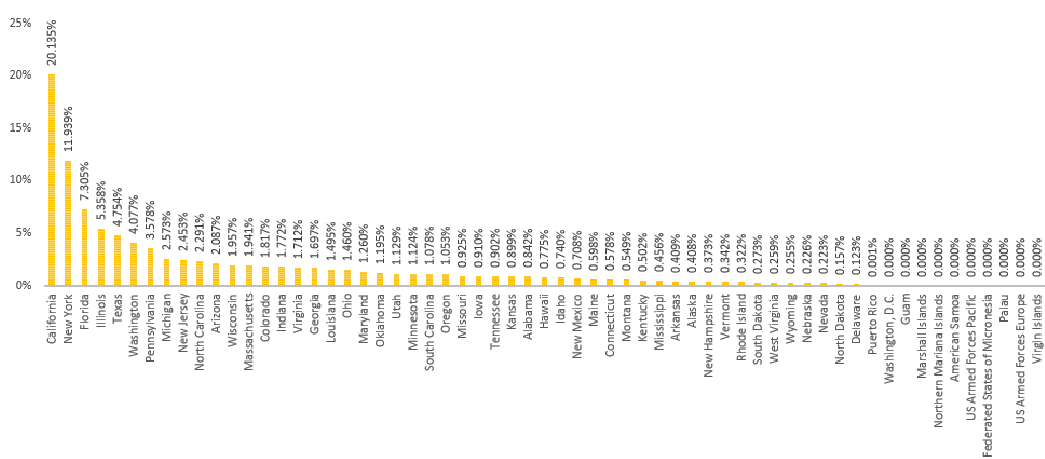 Fig 1: The long-tail distribution of Facebook pages across U.S. states, showing a heavy concentration in CA, NY, and FL.
Experimental Results: A 30% Leap in Accuracy
The researchers tested their method against a massive ground-truth dataset of 15 million pages. Using a Random Forest classifier, the results were definitive:
- Majority Vote: 59.4%
- Baseline BFS (SDV only): 69%
- Advanced BFS (SDV + SNP): 89%
The "Power State" Challenge
Analysis of the Confusion Matrix revealed that the most frequent errors occurred with "populous" states like New York and California. Because these states have a massive digital footprint, they act as "social gravity wells," attracting connections from all over the country and occasionally confusing the baseline models. However, the Advanced SNP module successfully mitigated this by prioritizing local neighborhood context over sheer edge count.
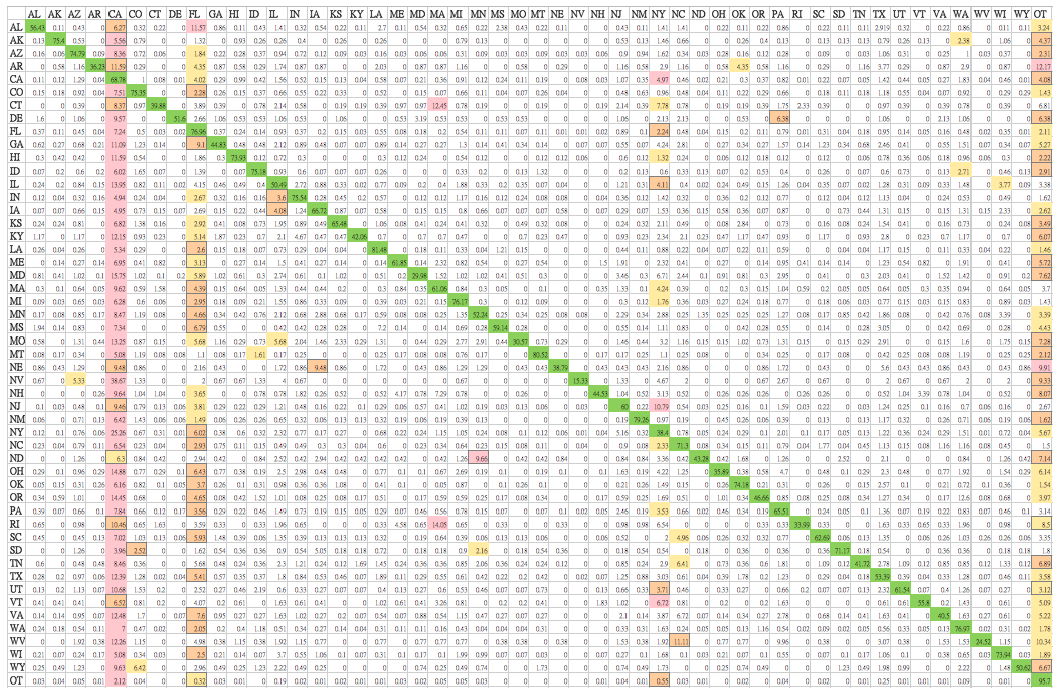 Table 1: The Random Forest classifier significantly outperforms Naive Bayes and Adaboost in structural prediction tasks.
Critical Insight & Future Outlook
The brilliance of this work lies in the Anchored Page Selection. By choosing highly localized community pages (like "OnlyInYourState" affiliates) as BFS seeds, the authors created a "coordinate system" for the social graph.
Takeaway: As privacy concerns make user-level data harder to access, page-level structural analysis offers a powerful alternative for social scientists to study regional economic trends, happiness indices, and even detect political campaign interference at a local level.
Limitations: The model still struggles with "transient" locations like Nevada (Las Vegas) and Maryland (DC-metro), where cultural and social ties are inherently multi-state. Future work using Graph Neural Networks (GNNs) might further refine these "fuzzy" boundaries.