
Geo-Social Co-location Mining: Finding Meaning in Uncertain Locations
Geo-Social Co-location Mining
The paper introduces "Geo-Social Co-location Mining," a framework to identify social groups frequently appearing at the same geographic locations using uncertain spatio-temporal data. By modeling user locations probabilistically and mapping the task to Probabilistic Frequent Itemset Mining (PFIM), the authors achieve robust pattern discovery in sparse datasets like geo-tagged tweets.
TL;DR
In the era of Big Data, we voluntarily share our lives via geo-tagged posts, yet this data is often "noisy" and "sparse." This paper presents an academic framework for Geo-Social Co-location Mining, which identifies groups of people who hang out at the same places by treating location uncertainty as a first-class citizen. By converting trajectories into probabilistic transactions, the authors can reliably predict social links even when GPS data is fuzzy.
Background: Beyond Simple "Check-ins"
Traditional spatial mining is like looking at a fixed map; it asks, "Which businesses are usually near each other?" But humans move. Geo-social mining asks, "Which types of people move together?"
The challenge? Uncertainty. If User A tweets near a bar at 10:00 PM and User B tweets near the same bar at 10:05 PM, were they actually there together? Existing "expected support" methods would treat this as a simple average, but that ignores the probability distribution. This paper argues we need to know the confidence that they were co-located.
The Core Insight: Uncertainty as a Probability Density
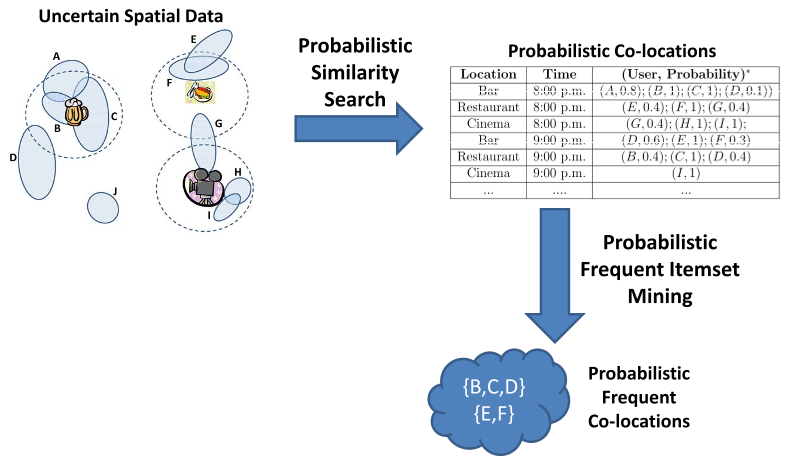
The authors suggest that a user's location isn't a point, but a probability. They use a normal distribution centered at the recorded GPS coordinate to estimate the likelihood of a person being at a Point of Interest (PoI).
Methodology Step 1: Probability Estimation
Using a grid-based spatial index to keep computation efficient, the system calculates the probability of user being at location .
Methodology Step 2: From Space to Transactions
This is the mathematical "magic" of the paper. They transform the problem into Probabilistic Frequent Itemset Mining (PFIM).
- A Spatial Feature (like "Affiliation: HKU") becomes an Item.
- A Co-location Instance (a specific time and place) becomes a Transaction.
Instead of asking "Is this group frequent?", they ask "What is the probability that this group appears at least minSup times?"
Breaking the Computational Ceiling
The "Naive" way to solve this is to look at every "Possible World" (every combination of where people might have been). However, with millions of tweets, the combinations are astronomical.
The authors leverage a Poisson Distribution approximation. If the dataset is large enough, the support distribution of a group follows a Poisson curve. This allows the system to compute results in milliseconds rather than hours.
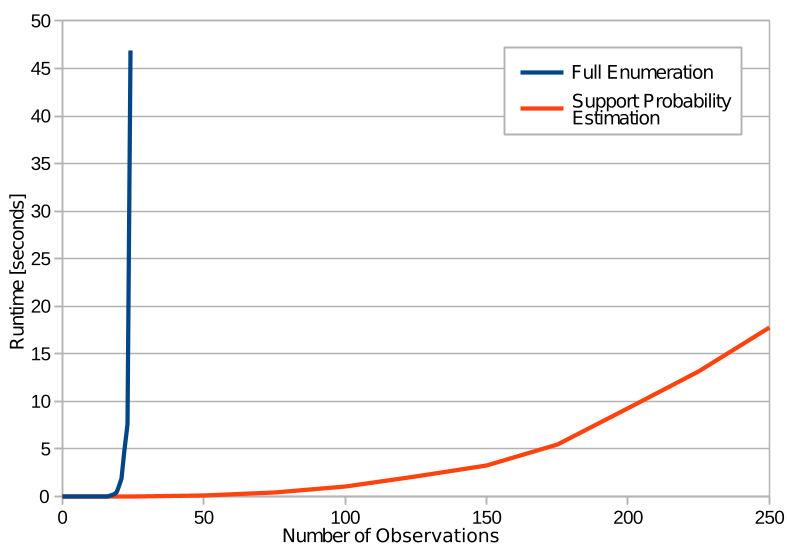 As shown in Figure 5, the estimation approach (blue) remains flat and efficient, while the naive enumeration (red) explodes exponentially.
Real-World Impact: The Los Angeles Twitter Study
Testing the theory on 8 million tweets from LA, the authors proved they could find social interactions that simpler models missed.
- Social Link Prediction: If two people who aren't friends "co-locate" with high probabilistic frequency, there is a hidden social link.
- Marketing: Identifying groups that visit Italian restaurants together, even if they don't check in at the exact same second.
Critical Analysis & Future Outlook
While the paper provides a robust mathematical foundation for uncertainty, its current implementation relies on a normal distribution for location, which might not account for physical obstacles (like walls or rivers).
The Takeaway: As privacy concerns lead to more "obfuscated" or "blurred" data, the ability to mine patterns from uncertain datasets will become the standard for social science and urban planning. This work effectively bridges the gap between raw, messy social media data and actionable social insights.