
Beyond the Numbers: Maximizing Geographical "Span" in Social Influence
Geo-Social Influence Spanning Maximization
The paper introduces the "Geo-social Influence Spanning Maximization" (MGSR) problem, which aims to identify seed nodes that maximize geographical coverage in a target region while ensuring a minimum influence threshold () in each sub-region. It proposes a novel OIR*-Tree index-based solution to solve this NP-hard problem efficiently across large-scale datasets like Gowalla and Twitter.
TL;DR
This paper addresses a critical gap in social media marketing: reaching broad geographical areas rather than just high volumes of people. By introducing the Maximum Geographic Spanning Region (MGSR) query, the authors provide a mathematical framework and an efficient indexing solution (OIR*-Tree) to find seed nodes that cover the most ground while maintaining a quality threshold of influence in every sub-region.
Background & Positioning
In the world of Influence Maximization (IM), the standard goal is simple: pick people to start a "viral" chain that reaches the maximum number of users. However, in the real world—think political elections or opening a new franchise—reaching 1,000 people in one city block is often less valuable than reaching 100 people in each of 10 different neighborhoods. This paper moves IM from a quantity-centric metric to a spatial-spanning metric.
The Problem: The "Density Trap"
Current methods ignore where users actually are. If you target a city based purely on "total activations," an algorithm will likely pick seeds that influence a dense city center, completely ignoring the suburbs.
The authors identify two main challenges:
- NP-Hardness: Calculating the optimal set of seeds that satisfies spatial constraints is computationally prohibitive.
- The Constraint: Just touching a region isn't enough; for a region to count as "covered," a minimum percentage () of its residents must be influenced.
Methodology: Spanning with Submodularity
The authors propose a objective function that balances two factors: the ratio of covered grids to total grids, and the total number of influenced users.
The Formal Objective
The MGSR query finds a set to maximize:
 Subject to the condition that each grid meets the activation threshold .
The OIR*-Tree Index
To make this practical, the authors didn't just rely on a Greedy algorithm. They developed the OIR Index, which combines:
- Ordered Influential Node Lists: Pre-computed lists of how much influence nodes have.
- R-Tree*: A spatial data structure used to quickly find which users fall into which geographical "buckets."
By combining these, the algorithm can "prune" (ignore) nodes that couldn't possibly contribute to the geographical span, drastically speeding up the query.
Experiments & Results
The researchers tested their methods on three major datasets: Gowalla, Twitter, and Foursquare.
Efficiency Benchmark
The proposed OIR*-Tree index-based solution proved to be the fastest across the board, maintaining high efficiency even as (the number of seeds) increased.
Spanning Effectiveness
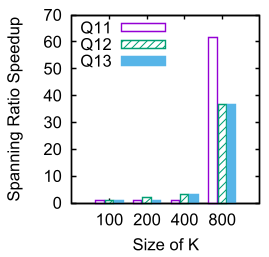
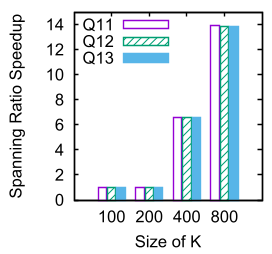
The study found that while increases the spanning ratio, the returns eventually diminish, which is a classic characteristic of submodular functions. Crucially, the model successfully adjusted to different types of user distributions (sparse vs. dense).
Critical Insight & Future Work
The "magic" of this paper lies in the parameter . It allows marketers to tune their strategy: set high to prioritize geographic "land-grabs," or set it lower to balance area with total "raw" influence counts.
Limitations: The current model assumes static locations (user home bases). In our mobile-first world, users move throughout the day. A future iteration incorporating spatio-temporal mobility would be the next logical leap for this research.
Conclusion: This work provides the mathematical foundation for "Geographic Influence," ensuring that social media campaigns don't just create echoes in dense rooms, but reach every corner of the intended map.