
GSKCG: Optimizing Socially-Cohesive Teams for Regional Spatial Coverage
5792_Geo-Social K-Cover Group queries for collaborative spatial computing.
The paper introduces the Geo-Social K-Cover Group (GSKCG) query, a novel spatial computing task that seeks the minimum user group satisfying both spatial coverage (covering all query points) and social cohesion (forming a k-core). To solve this NP-hard problem, the authors propose SaRBasedKCGFinder, an efficient algorithm utilizing a custom "Enhanced SaR-tree" index.
TL;DR
Finding the smallest group of people who are both "well-connected" and whose "regions of expertise" cover every required location is a major challenge in collaborative spatial computing. This paper introduces the Geo-Social K-Cover Group (GSKCG) query and solves it using a specialized index called the Enhanced SaR-tree, turning an NP-hard problem into a performant solution for real-world social networks.
Problem: The Hardship of Spatial-Social Hybridization
Most location-based services either find people near a point or find groups with tight social links. However, real-world "Coverage" is often about regions (e.g., a rescue worker's service area or a travel guide's familiar zone).
The GSKCG query asks: “Who is the smallest group where everyone has at least k friends in the group (k-core), and together they cover all target locations p?” This creates a combinatorial explosion. You can't just pick the "best" person spatially if they have no social ties, and you can't just pick a "clique" if they are all in the same corner of the map.
Methodology: The SaR-tree (Social-aware R-tree)
The core innovation is the Enhanced SaR-tree. While a standard R-tree uses Minimum Bounding Rectangles (MBR) to prune spatial searches, it is "blind" to social structures.
The authors propose adding Core Bounding Rectangles (CBRs). Each node in the tree doesn't just know where its children are located; it knows the "social potential" (k-core relevance) of those children. This allows the algorithm to prune an entire branch of the search tree if the users in that branch cannot possibly satisfy the social acquaintance constraint, even if they are spatially ideal.
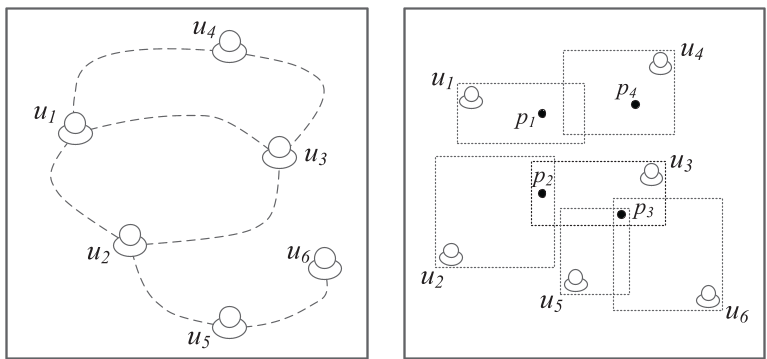 Figure 1: Conceptual visualization of social networks (a) and regional coverage (b) for a GSKCG query.
Experiments: Order of Magnitude Gains
The researchers compared three versions:
- Baseline (KCGFinder): Basic group enumeration.
- Advanced: Adding pruning strategies (diameter, coverage, k-core).
- SaRBased: The full implementation with the Enhanced SaR-tree.
The results were Stark. As shown in the log-scale plots, the SaRBased approach remains efficient as task complexity grows, while the baseline quickly becomes unusable.
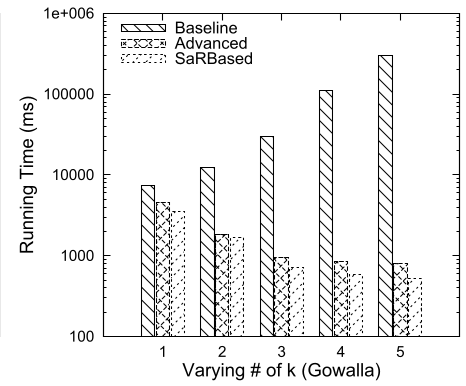 Figure 2: Running time vs. k-value (social constraint). SaRBased exhibits better scalability in log-scale.
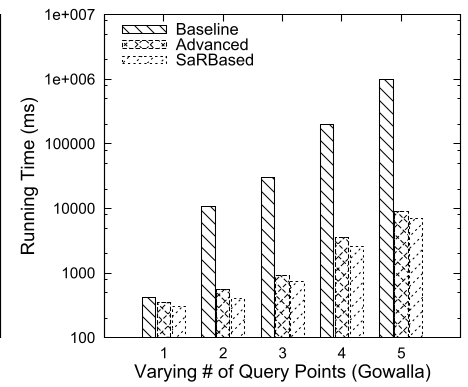 Figure 3: Running time vs. number of query points. SaRBased shows less sensitivity to spatial complexity.
Deep Insights & Takeaways
The brilliance of this work lies in the dual-pruning capability. By embedding graph theory (k-core) properties into a spatial data structure (R-tree), the authors bridge the gap between two traditionally separate fields of database optimization.
Critical Perspective:
- Strengths: Solves a very practical problem (minimum group size) which is highly relevant for cost-saving in crowdsourcing.
- Limitations: The "minimum group" requirement is strict. In highly dynamic scenarios, a "near-minimum" group that is much faster to compute might be more desirable.
- Future Direction: Applying this to "Moving Objects" (Real-time collaborative tracking) or multi-modal regions (e.g., users with different transit capabilities) would be a logical next step.
In conclusion, GSKCG represents a significant step forward in making collaborative team organization both socially viable and spatially efficient.