
Geo-Social Top-k Monitoring: Bridging the Gap Between Location, Content, and Social Circles
Geo-Social Keyword Top-k Data Monitoring over Sliding Window
The paper introduces a novel framework for Geo-Social Keyword Top-k Data Monitoring over a sliding window, a task that integrates spatial proximity, keyword relevance, and social relationships. It proposes a Quad-tree-based indexing method combined with a k-skyband technique to achieve real-time result updates in high-concurrency Publish/Subscribe (Pub/Sub) systems.
TL;DR
In the modern Pub/Sub era, being "relevant" isn't just about where you are or what you say—it's about who you know. This paper presents a high-performance system for monitoring the top-k most relevant points of interest (PoIs) by merging geographic distance, keyword similarity, and social network proximity. By leveraging a Linear Quad-tree and k-skyband logic, the authors achieve a 400% speedup over traditional monitoring baselines.
Background: Why Social Context Matters
Existing systems like Foursquare or Yelp often recommend data based on proximity or keyword matches. However, if your friend "likes" a specific café, you are likely interested in it too, even if you haven't visited yet. This paper formalizes this "Social Score" and integrates it into a continuous monitoring task over a sliding window, ensuring users only see fresh, socially-validated data.
The Dual Challenge: Massive Scale and Expiration
Monitoring top-k queries in a streaming environment is difficult for two reasons:
- The Update Storm: Every time a new PoI generates a data object, the system must check if it enters the top-k set for millions of registered queries.
- The Expiration Void: When the "newest" object becomes "old" and slides out of the window, the system must find a replacement. Standard systems would re-scan the entire window, which is computationally suicidal at scale.
Methodology: Pruning and Skybands
The authors solve these via two core technical pillars:
1. Quad-tree Pruning (The "Why Bother?" Filter)
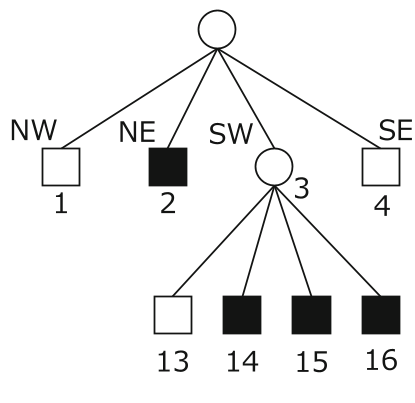
Queries are indexed in a Quad-tree. When a new data object arrives, the system calculates an Upper Bound Score for entire nodes (groups of queries). If the best possible score a data object could get in a node is lower than the worst top-k score within that node, the entire branch is pruned.
2. k-Skyband (The "Backup" Strategy)
Instead of just keeping the Top-k objects, the system maintains a k-skyband. These are objects not yet in the Top-k but are "not dominated" by more than other objects. When a Top-1 object expires, a member of the k-skyband immediately steps up to take its place, eliminating the need for a full window rescan.
Performance: Efficiency That Scales
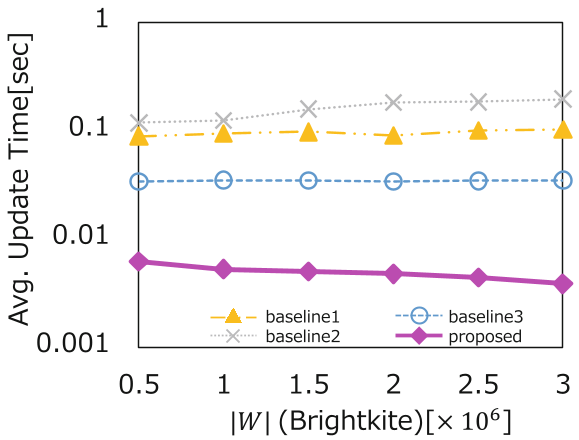
The most impressive finding is the system's behavior regarding window size. In traditional systems, a larger window means more data to process, leading to slower performance. Here, a larger window actually improves efficiency. Why? Because a larger window increases the "quality" (score) of the current Top-k, making it harder for new, mediocre objects to pass the pruning threshold.
Deep Insights & Summary
This work excels in its Inductive Bias: it assumes that space and social circles provide a natural hierarchy that can be exploited for computational gain.
Key Takeaways:
- Pruning is King: By calculating a global social score upper bound per Quad-tree node, the system avoids millions of redundant calculations.
- Memory-Speed Tradeoff: Maintaining a k-skyband requires more memory than a simple top-k list, but the payoff in sub-millisecond expiration handling is worth the cost for real-time apps.
- Limitations: The current model treats social relationships as static. In the future, incorporating real-time "follows" or "unfollows" into the scoring index will be the next frontier.
For developers building the next generation of real-time proximity alerts or social discovery apps, the marriage of Quad-trees and Skybands presented here offers a robust blueprint for performance.