
Geo-Social Ranking: Bridging the Gap Between Where You Are and Who You Know
Geo-Social Ranking: functions and query processing
The paper introduces Geo-Social Ranking (GSR), a novel framework for ranking users in Geo-Social Networks (GeoSNs) based on spatial proximity to a query point and social connectivity. It proposes four distinct ranking functions—LC, RC, HGS, and GST—and develops specialized top-k query processing algorithms that achieve State-of-the-Art efficiency in both sparse and dense user environments.
TL;DR
This research pioneers the Geo-Social Ranking (GSR) problem, moving beyond simple "find nearby friends" queries to complex influence-based ranking. By introducing four distinct mathematical functions (LC, RC, HGS, GST), the authors allow systems to identify "power users" who are not just close to a location, but are social hubs within that specific vicinity.
Background & Positioning
In the era of Foursquare, Facebook, and Twitter, location data is abundant. However, most existing algorithms either treat spatial distance and social networks separately or only look for specific group structures (like cliques). This paper sits at the intersection of Spatial Databases and Social Network Analysis, providing the first comprehensive framework for ranking individuals based on their "localized social capital."
The Core Problem: Why Distance is Not Enough
A standard k-Nearest Neighbor (k-NN) search tells you who is closest to a shop. But for a marketer, the person 500 meters away with 20 friends nearby is a much better target for an ad than the person 100 meters away with zero local connections. The challenge is:
- Complexity: Social and spatial data are fundamentally different (graph vs. coordinate space).
- Diversity: A "good" rank depends on the goal—is it pure proximity or social influence?
- Efficiency: Intersecting trillion-edge social graphs with millions of GPS points in real-time is computationally expensive.
Methodology: Four Ways to Rank
The authors suggest that no single formula fits all needs. They propose a toolkit of functions:
1. Linear Combination (LC) & Ratio Combination (RC)
These are the "workhorses." LC uses a weighted sum of distance and friend counts, perfect for range-limited ads. RC, conversely, promotes users whose friends significantly lower the "average distance" to the query point, prioritizing extreme locality.
2. h-Geo-Social (HGS) - The Academic Intuition
Inspired by the h-index used for researchers, a user’s HGS score is the largest integer h such that they have h friends within specific concentric circles. This creates a "progressive" influence measure that favors people with dense local clusters.
3. Geo-Social Triangles (GST) - The Connectivity Expert
GST doesn't just count friends; it counts triangles—friendships between the friends themselves. This identifies users in tightly-knit communities, ideal for promoting social events where groups are likely to attend together.
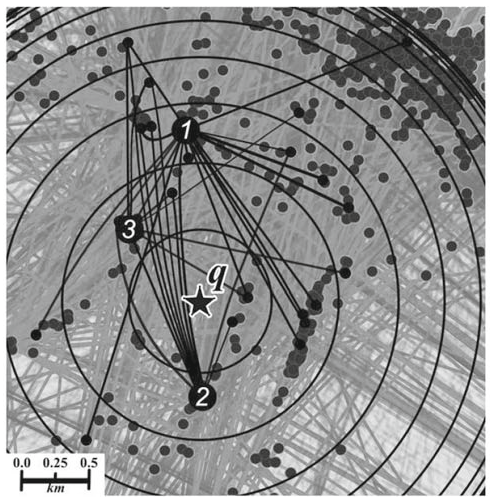 Figure: Visualization of top-k results in sparse areas, demonstrating how different functions prioritize different local hubs.
Specialized Query Processing
To make these functions fast, the authors developed algorithms that avoid checking every user:
- Range Pruning: Filtering users based on a "relevant range" derived from the formula's weights.
- Branch-and-Bound (BnB): For functions like RC and GST, the system calculates an upper bound on the possible score of unseen users. If the current top-k scores are better than the bound, the search stops immediately.
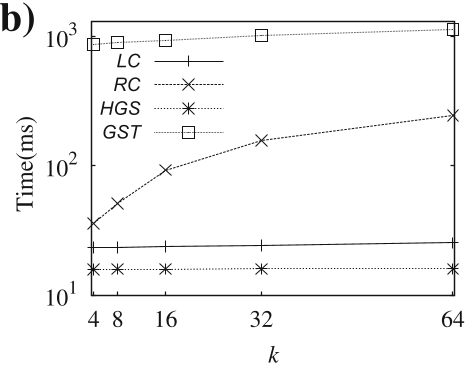 Figure: Execution time vs. k. HGS and LC show near-constant time performance, while GST's complexity grows with social density.
Experiments & Deep Insights
Using Gowalla check-in data from Austin, Texas, the study reveals:
- Density Matters: In dense urban areas (downtown), social connections are often more "diluted," causing functions to diverge significantly in their rankings.
- The Cost of Connectivity: GST is the most expensive to compute (checking friend-of-friend connections) but provides a qualitatively different "tightness" in its results.
- Scalability: The HGS algorithm can handle networks of 6 million users in under 100 milliseconds, making it viable for production-scale recommendation engines.
Critical Analysis & Conclusion
Takeaway
The genius of this work is the adaptation of the h-index to spatial data (HGS). It captures the intuitive notion of "influence" without requiring the heavy computation of triangle counting or eigenvector centrality.
Limitations
The model assumes static "last check-in" locations. In a real-world scenario, users are moving. Future GSR models would need to account for spatio-temporal trajectories (where a user will be), rather than just where they are now.
Future Outlook
As we move toward "Hyper-local" marketing and decentralized social apps, the ability to rank users based on their immediate physical and social context will be the backbone of personalized LBS (Location Based Services).