
Geo-Social-RBAC: Redefining Security through Location and Social Intelligence
Geo-Social-RBAC: A Location-Based Socially Aware Access Control Framework
The paper introduces Geo-Social-RBAC, a comprehensive access control framework that integrates geographic location, social relationships, and historical movement traces. It extends the traditional Role-Based Access Control (RBAC) model to handle complex security scenarios where access depends on both "where you are" and "who you are with."
TL;DR
In an era where GPS-enabled devices and social networks are ubiquitous, the Geo-Social-RBAC framework emerges as a vital evolution of Role-Based Access Control. It moves beyond simple "User-Role" mapping by incorporating where a user is, who is nearby, and where they have been previously. This creates a multi-layered security net capable of handling complex scenarios like hospital privacy and high-security industrial floors.
Contextual Positioning
While traditional RBAC organizes permissions by roles, and Geo-RBAC adds a spatial layer, Geo-Social-RBAC is a major architectural extension. It acts as a bridge between spatial-awareness and social-graph theory, filling a critical gap in existing literature that treated these two dimensions as mutually exclusive.
The Problem: The "Silo" Trap of Context-Awareness
Most current access control systems suffer from a lack of multi-dimensional context. For example:
- Geo-RBAC knows you are in the Operating Room, but doesn't care if you are alone or with a suspicious stranger.
- Prox-RBAC knows someone is near you, but can't distinguish if that person is your supervisor, a colleague, or a visitor based on a social hierarchy.
- Trace Ignorance: Almost no current systems account for "where you just came from"—a critical factor in infection control or industrial physical security.
Methodology: The Geo-Social Engine
The core of the paper lies in how it formalizes the relationship between location and social ties through three main components:
1. Tagged Social Graphs & Hierarchies
The model uses an asymmetric directed graph . Unlike simple friendship links, these edges are annotated with Tags (e.g., Nanny, Patient, Supervisor). These tags are organized in a Lattice, allowing the system to understand that a "Primary Physician" is a superior relation to a "Medical Resident" when evaluating access.
2. Geo-Social Cardinality
This mechanism dictates the "social density" required for access. Example logic: "To open this safe, the user must be in the Vault Room (Location) in the presence of at least 2 people (Cardinality) who hold the tag 'Security Officer' (Social Relation)."
3. Trace-Based Logic
The framework introduces (Geo-social traces). It records the historical sequence of locations and co-located users.
 Table 1: Comparing Geo-Social-RBAC against prior Location/Proximity-based RBAC extensions.
Architecture and Activation
A Role () is only "Enabled" if three conditions are met simultaneously:
- Spatial Scope ( prereq): The user is in the correct zone.
- Cardinality ( prereq): The social environment meets the requirements.
- Trace ( prereq): The user’s history (e.g., "visited sanitizing station") is valid.
Experimental Insights: Expressiveness in Action
The authors validate the model using several high-utility scenarios. The "For Your Eyes Only" policy demonstrates the power of negative cardinality: restricting access if anybody else is in the room.
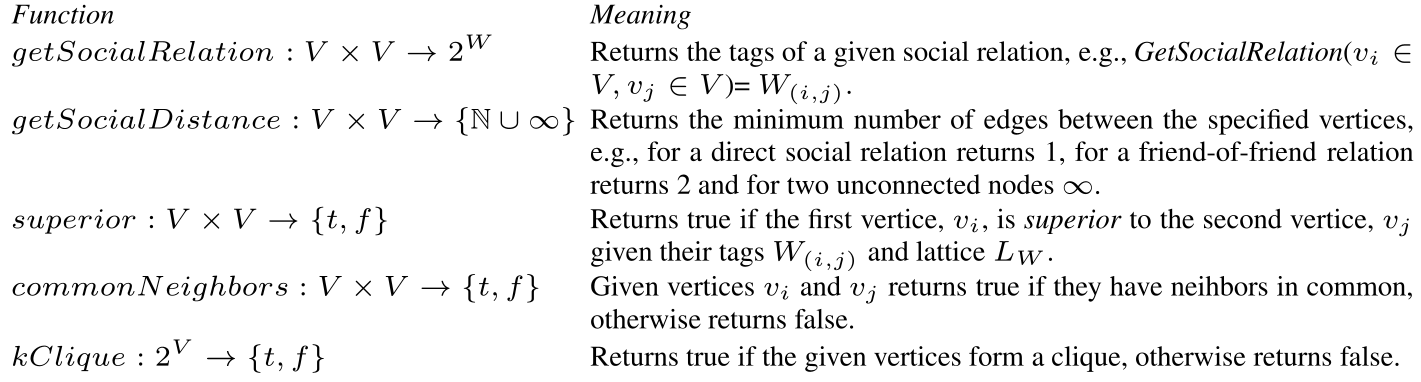 Table 2: Key functions used to extract depth from the social graph, enabling superior/subordinate logic.
Critical Analysis & Future Outlook
Strengths
- Hierarchy Handling: Unlike standard inheritance, Geo-Social-RBAC requires junior roles to be explicitly activated and verified, upholding the Principle of Least Privilege.
- Hybrid Constraints: It is the first to allow "Hybrid Realm" policies (Location + Social + Trace).
Limitations & Future Work
The primary challenge for this model is Privacy vs. Utility. Collecting constant location and social traces of employees raises significant surveillance concerns. The authors acknowledge that future work must focus on efficient enforcement techniques and likely, privacy-preserving ways to verify these geo-social constraints without exposing raw user data.
Conclusion
Geo-Social-RBAC provides a robust, formal mathematical foundation for the next generation of physical and digital security. By treating "context" as a combination of geography and social fabric, it offers a pragmatic solution for organizations that operate in highly dynamic and sensitive environments.