
Geo-Social Skyline: Balancing Physical Distance and Social Trust
Geo-Social Skyline Queries
The paper introduces Geo-Social Skyline Queries (GSSQ), a novel query type that retrieves a Pareto-optimal set of individuals based on both spatial proximity to a target location and social closeness to a query user. It utilizes the Random Walk with Restart (RWR) metric for social distance and proposes an efficient pruning-based algorithm using social distance bounds to avoid expensive exact computations.
Executive Summary
In an increasingly connected world, our decisions are rarely based on a single factor. Whether you are looking for a place to stay while traveling (Couchsurfing) or seeking a local expert to help with a broken-down car, you are constantly trading off spatial proximity (is this person nearby?) against social trust (how well do I know/trust this person?).
This paper introduces the Geo-Social Skyline Query (GSSQ). Unlike traditional searches that return a single "best" result based on a weighted formula, the GSSQ provides a Pareto-optimal set—a list of candidates where no candidate is "strictly better" than another in both social and spatial dimensions. It is a vital milestone in geo-social networking research, moving from simple "direct friend" searches to complex, transitive social relationship analysis.
The Core Challenge: The Complexity of Social Distance
Why isn't this problem trivial? The answer lies in the definition of "social distance."
- Beyond Binary Friendships: Real trust isn't just "Friend" or "Not Friend." It flows through the network.
- The RWR Bottleneck: The authors use Random Walk with Restart (RWR) to measure social closeness. RWR considers all possible paths between two people, but computing it exactly for every user in a network of millions is computationally exhausting ().
- The Trade-off: As you travel further from home, your "strong" social ties become scarce. You must decide if you'd rather travel 50 miles to a close friend or 2 miles to a friend-of-a-friend.
Methodology: Pruning the Search Space
The technical brilliance of this paper lies in avoiding the computation of exact social distances. The authors introduce a "Filter-and-Refine" strategy powered by two types of bounds:
1. Network Distance Bounds
Using Graph Embedding, the system precomputes distances to reference nodes () to estimate the social distance. If a user is 10 "hops" away in the social graph, there is a physical limit to how much "social influence" can reach them.
2. BCA-Driven Dynamic Bounds
The Bookmark Coloring Algorithm (BCA) is used to refine these bounds incrementally.
- Lower Bound: The amount of "color" (social trust) a node has already received.
- Upper Bound: The current color plus all remaining "unassigned" color in the system.
The Improved Algorithm
The algorithm processes users in order of their spatial distance (using an R-Tree). By comparing the Spatial Distance against the Social Bounds, the algorithm can "prune" (discard) users who are guaranteed to be worse than existing results, often stopping long before examining the entire database.
 Informally, a user is in the skyline if no other user is both closer to the destination AND more socially connected to the searcher.
Experiments & Real-World Insights
The authors tested their approach on Gowalla data. Key takeaways include:
- Efficiency: As the personalization factor () increases, the query becomes faster because the "social color" concentrates more quickly, tightening the bounds sooner.
- Sparsity Matters: If you search in a "socially sparse" area (like the middle of the Indian Ocean when your friends are in LA), the skyline set grows larger because the trade-offs are less obvious.
- Utility: Even in a network of 200,000 people, the skyline usually contains fewer than 30 people, providing a highly relevant "shortlist" for the user.
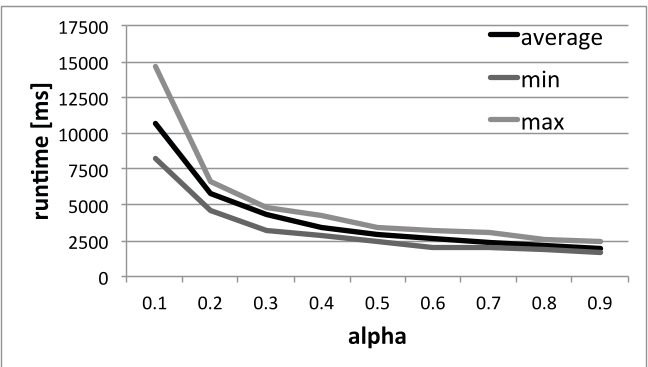 Figure 2: Runtime improves drastically with pruning compared to naive approaches.
Critical Perspective & Future Work
The GSSQ is a powerful tool for recommendation engines. However, its current limitation is the reliance on a static "check-in" location. The authors' future vision involves using historical check-in patterns—for instance, finding a friend-of-a-friend who visited Bali recently to give you travel tips, rather than just someone currently residing there.
In conclusion, this research provides a scalable solution to a deeply human problem: finding the right person, at the right place, through the right connection.