
Geocommunity-Based Broadcasting: Leveraging Social Geography for Active Data Dissemination
Geocommunity-Based Broadcasting for Data Dissemination in Mobile Social Networks
This paper introduces a geocommunity-based broadcasting framework for Mobile Social Networks (MSNets), utilizing a "superuser" to actively disseminate data. By integrating geographic and social regularities, the authors propose a semi-Markov mobility model and geocentrality metric to optimize superuser routes, achieving superior dissemination ratios compared to traditional message-ferrying approaches.
TL;DR
This research shifts the paradigm of data dissemination in Mobile Social Networks (MSNets) from passive waiting to active broadcasting. By defining geocommunities—geographic areas where social interactions are concentrated—and modeling user transitions via a semi-Markov process, the authors design a superuser (mobile broadcaster) route that maximizes reach while minimizing travel overhead.
Problem & Motivation: The Flaw in Randomness
Most literature in Delay Tolerant Networks (DTNs) treats mobility as either entirely random or strictly fixed (like a bus route). However, human behavior is neither. We are "creatures of habit" who frequent specific geolocations—offices, cafeterias, gyms—forming what the authors call Geocommunities.
The technical challenge lies in two areas:
- Characterization: Real-world data shows that user "staying time" (sojourn time) follows a power-law distribution, not the memoryless exponential distribution used in simple Markov chains.
- Optimization: If a salesman (superuser) wants to broadcast an ad to a campus, where should they stand, and for how long, to hit 90% of the population within 2 hours?
Methodology: Geocommunities and Geocentrality
The authors define Geocentrality as a metric for "dynamic user density." Unlike static centrality, geocentrality measures the probability that a superuser staying at location for time will encounter a unique user.
The Semi-Markov Mobility Model
Because sojourn times are power-law distributed, the authors employ a semi-Markov model. This allows the probability of "moving to the next location" to depend on "how long the user has already been there."
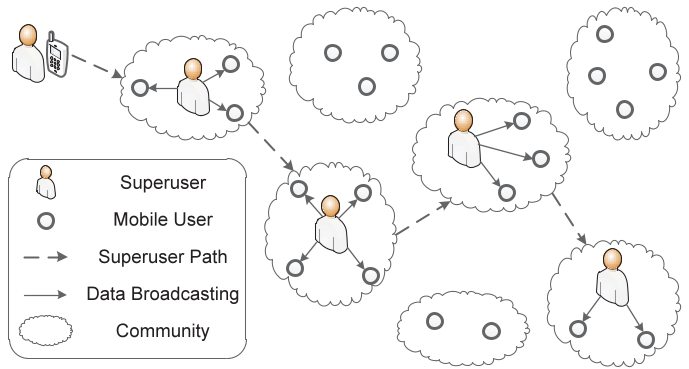 Figure 1: Illustration of the geocommunity-based data broadcast scheme.
The Greedy Adaptive Route Algorithm (GARA)
The paper moves beyond static planning with GARA. Instead of just visiting popular spots, GARA calculates the marginal utility of non-contacted users. If the "gain gradient" at the current location drops below the potential gain of moving (accounting for travel time), the superuser migrates.
Experiments & Results
Using the Infocom '06 and MIT Reality traces, the authors compared their approach against standard Message Ferry (MF) models.
- Efficiency: In time-sensitive scenarios, GARA achieved the target dissemination ratio with drastically lower travel costs.
- The "Stay vs. Go" Tradeoff: The results highlight that traditional "shortest tour" (TSP) solvers fail because they focus on covering distance, whereas GARA focuses on covering people.
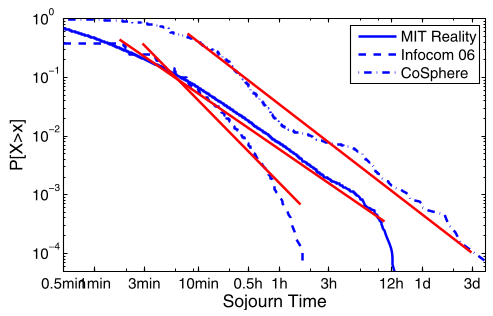 Figure 2: Empirical evidence of power-law sojourn times across MIT, Infocom, and CoSphere traces.
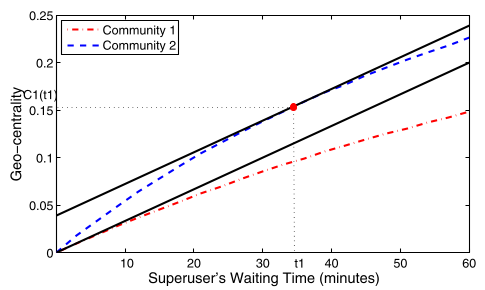 Figure 3: Dissemination ratio vs. superuser speed, showing the clear advantage of GARA and SRA over random-waypoint models.
Critical Analysis & Conclusion
Takeaway
The paper effectively proves that spatial regularity is a powerful predictor in MSNets. By treating locations as "social hubs" (geocommunities), we can optimize broadcasting much more effectively than by treating users as independent moving particles.
Limitations
- Incentive Mechanisms: The paper assumes "regular users" are willing to receive data once encountered. In reality, privacy concerns or battery saving might cause users to opt-out.
- One-hop Focus: The study focuses on direct broadcasting from the superuser. Future work could integrate multi-hop "epidemic" spreading between regular users once the superuser has seeded the data.
Future Prospect
This framework is highly relevant for 5G/6G edge offloading and UAV-assisted communication. In a world where mobile data traffic is exploding, using a "mobile edge" (like a bus or a drone) to broadcast popular content based on geocommunity density could save massive backbone bandwidth.