
Geocommunity-Based Broadcasting: Optimizing Data Dissemination via Social-Geographic Insights
Geocommunity-Based Broadcasting for Data Dissemination in Mobile Social Networks
The paper proposes a geocommunity-based broadcasting framework for data dissemination in Mobile Social Networks (MSNets). It introduces the concepts of "geocommunity" and "geocentrality" to model human mobility using a semi-Markov process, and develops Static (SRA) and Greedy Adaptive (GARA) route algorithms to optimize the superuser's trajectory for maximum dissemination ratio and minimum duration.
TL;DR
This research tackles the challenge of active data broadcasting in Mobile Social Networks (MSNets). By identifying that human mobility is not random but revolves around "geocommunities," the authors introduce geocentrality—a metric for dynamic user density. They provide a semi-Markov framework to model user stays and propose trajectory optimization algorithms (SRA and GARA) that allow a "superuser" to disseminate data with 3x the energy efficiency of traditional ferry-based methods.
Background: Beyond Random Waypoints
In the world of Delay-Tolerant Networks (DTNs), we often rely on "chance encounters" to move data. However, in a Mobile Social Network, mobility is driven by social intent. People don't wander aimlessly; they move between offices, cafeterias, and gyms. The authors argue that existing models like the "Message Ferry" are too rigid or ignore these social-geographic patterns, leading to wasted time in "empty" zones.
The Core Insight: Geocommunity and Geocentrality
The paper makes a compelling case for two new primitives:
- Geocommunity: A physical location (like an office) where a stable group of socially linked users (a community) regularly interacts.
- Geocentrality: Unlike standard "Betweenness" centrality which looks at graph paths, Geocentrality measures the probability of a geocommunity contacting a randomly chosen user over time. It effectively converts spatial-temporal density into a utility function.
The authors discovered through trace analysis (MIT Reality, Infocom '06) that sojourn times—the duration a user stays in a geocommunity—follow a power-law distribution rather than an exponential one. This necessitates a semi-Markov model to accurately predict where users will be.
Methodology: Designing the Route
The broadcasting problem is transformed into a trajectory optimization task: Which geocommunities should the superuser visit, and how long should they wait at each?
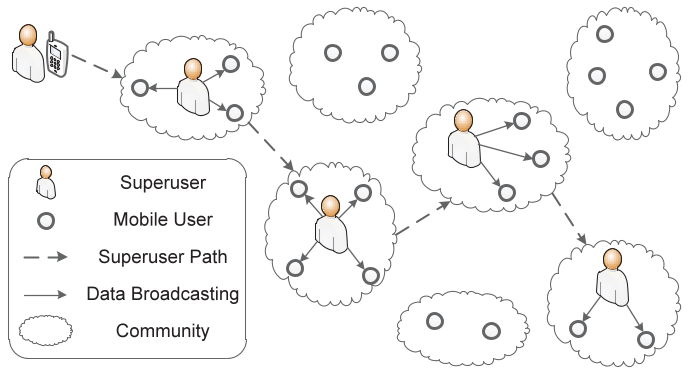
The authors proposed two main algorithmic tracks:
- Static Route Algorithm (SRA): Solves a convex optimization problem to minimize time for a target dissemination ratio, then uses a TSP solver to link the chosen communities.
- Greedy Adaptive Route Algorithm (GARA): A real-time approach that updates the utility of each community by only considering "non-contacted" users, preventing the superuser from wasting time in areas where everyone has already received the data.
Experiments and Results
Using the Infocom '06 dataset, the team compared their algorithms against standard Message Ferry (MF) models.
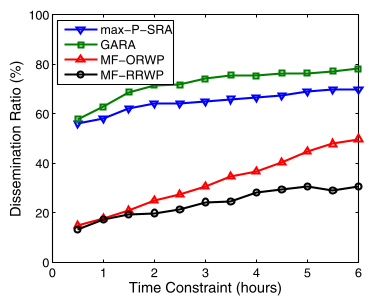
Key Findings:
- Energy Efficiency: GARA recorded a total route length of 40 km compared to 150 km for MF-ORWP under the same constraints—a massive saving in "superuser overhead."
- Efficiency: SRA and GARA achieve higher dissemination ratios because they prioritize "high-gradient" geocommunities. As seen in the results, traditional ferry models (MF-RRWP) often visit "dead zones," leading to poor performance.
Critical Analysis & Takeaways
The brilliance of this work lies in its transition from abstract networking to geography-aware social modeling. By recognizing the heterogeneity of spatial user distributions, the authors move away from "blind" broadcasting toward "informed" dissemination.
Limitations: The model assumes the superuser has near-perfect knowledge of the regular users' mobility patterns (derived from history). In highly volatile environments where social patterns shift rapidly, the accuracy of the semi-Markov steady-state might degrade.
Future Outlook: This framework is a precursor to modern "Smart City" logic. One can imagine these algorithms being applied to autonomous delivery drones or mobile base stations (UAVs) that hover over "geocommunities" during peak social hours to offload cellular traffic or provide localized services.