
GeoDCF: Harmonizing Contextual Multi-Views with Deep Pairwise Ranking for POI Recommendation
GeoDCF: Deep Collaborative Filtering with Multifaceted Contextual Information in Location-Based Social Networks
GeoDCF is a deep collaborative filtering framework designed for Point-of-Interest (POI) recommendation in Location-Based Social Networks (LBSNs). It integrates multifaceted contextual information—social, geographical, and sequential—using multi-view learning and a deep pairwise ranking architecture, achieving SOTA performance on Gowalla and Foursquare datasets.
Executive Summary
TL;DR: GeoDCF (Geographical Deep Collaborative Filtering) is a robust framework that tackles the "data scarcity" problem in location recommendations. By fusing social, geographical, and sequential data through a multi-view embedding layer and a deep neural ranking architecture, it significantly boosts the accuracy of Top-K recommendations.
Positioning: This work bridges the gap between traditional Matrix Factorization and modern Deep Learning. It moves the field from "Predicting if a user will check-in" (pointwise) to "Ranking which POI a user prefers more" (pairwise), while utilizing a rich variety of side-information.
The Problem & Motivation
Point-of-Interest (POI) recommendation is notoriously difficult because the user-item matrix is extremely sparse. Most users check in at only a dozen places out of tens of thousands.
The Limitations of Prior Work:
- Pointwise Loss Bias: Many models (like PACE) treat check-ins as isolated events, ignoring the relative preference of one venue over another.
- Linear Constraints: Standard Matrix Factorization cannot capture the complex, non-linear ways social influence or geographical proximity affect behavior.
- Disconnected Context: Contextual factors (whom you follow, how far you travel, and where you went last) are often treated as independent variables rather than a cohesive "multi-view" of the user's intent.
Methodology: The GeoDCF Architecture
The GeoDCF model operates through a sophisticated pipeline that first aligns data and then learns deep representations.
1. Multi-View Embedding Layer
The authors use MV-NMF (Multi-View Non-negative Matrix Factorization) as a cornerstone. They don't just factorize the check-in matrix; they co-factorize:
- Social Link Matrix (A)
- Geographical Similarity Matrix (G)
- Sequential Transition Matrix (T)
The goal is to find consensus latent vectors and that satisfy all views simultaneously.
2. Deep Pairwise Ranking (BPR Learning)
Once latent vectors are computed, they are fed into three parallel neural networks (one for user , observed POI , and unobserved POI ).
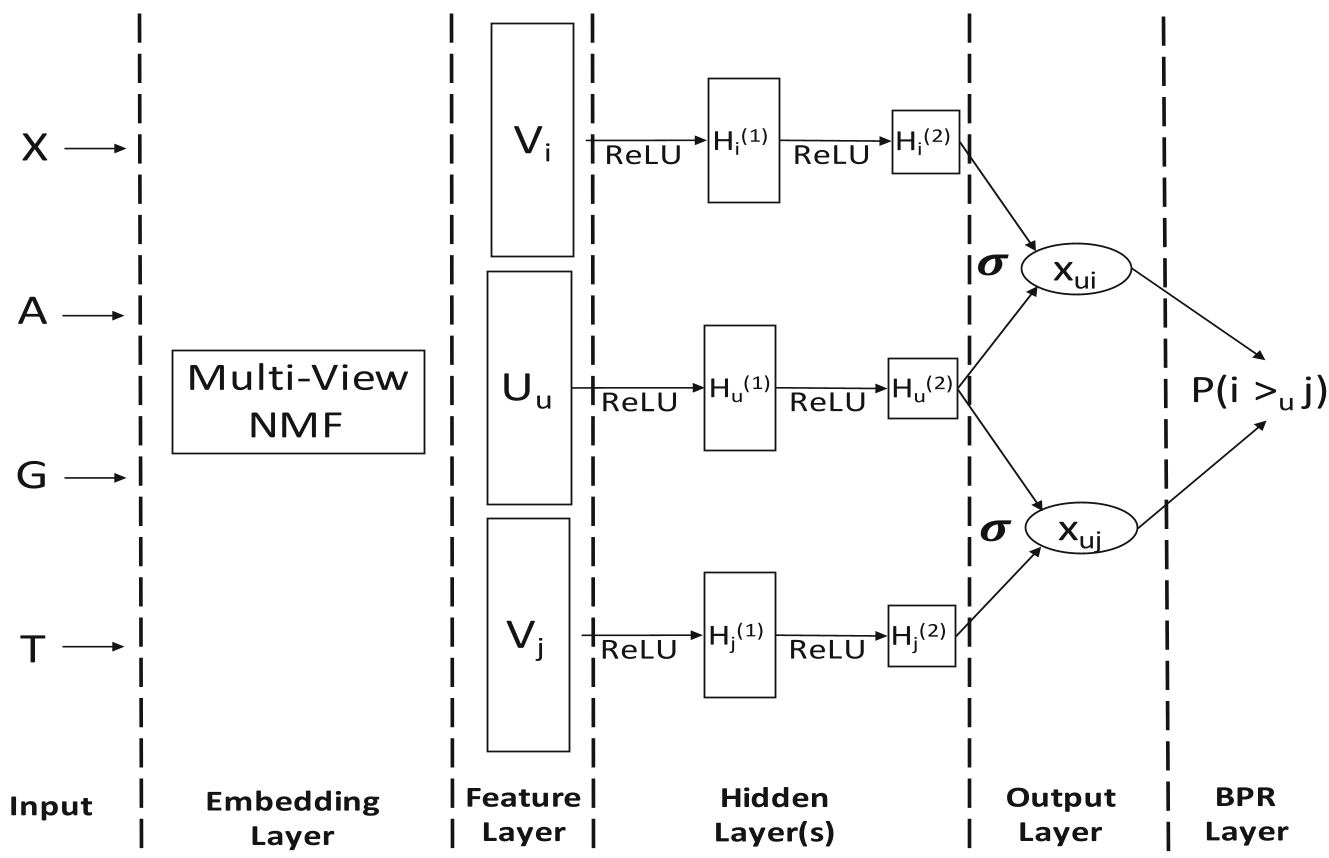
The Tower Structure is key: the layers gradually narrow (e.g., ), forcing the model to learn abstract, high-level features. The final layer uses a sigmoid function to output check-in probabilities, which are then used in a BPR Layer to maximize the probability that .
Experiments & Results
The model was validated on the Gowalla and Foursquare benchmarks.
Performance Comparison:
- Against Pointwise Models: GeoDCF significantly outperformed PACE (a deep pointwise model), proving that the pairwise ranking objective is superior for top-k tasks.
- Quantitative Gain: The model achieved nearly a 19% improvement in Recall over the strongest baselines.
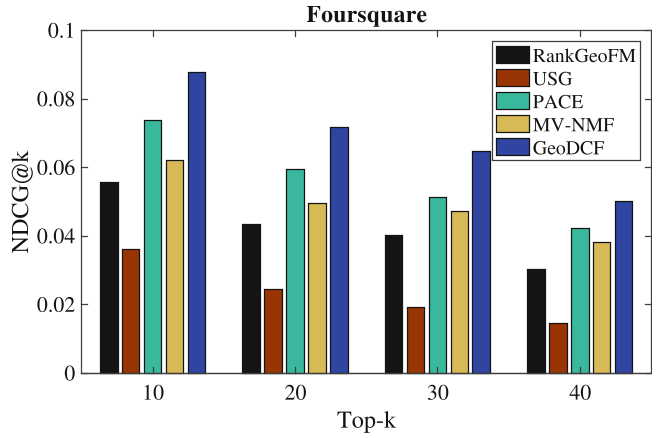
Ablation Study Insights: Interestingly, "POI Context" (Geographical + Sequential) proved to be a stronger predictor of user behavior than "Social Context." This suggests that physical constraints and habits are more influential in movement than friend circles in LBSNs.
Critical Analysis & Conclusion
Takeaway
GeoDCF proves that Context is King, but only if you have the right architecture to process it. By combining multi-view alignment with deep ranking, it overcomes the sparsity that traditional Collaborative Filtering cannot handle.
Limitations
- Scalability: The multi-view factorization step requires computing large similarity and transition matrices (), which can be memory-intensive for millions of POIs.
- Dynamic Nature: The model currently assumes a static snapshot of data. It does not account for real-time temporal changes (e.g., how preferences change on weekends vs. weekdays).
Future Outlook
The authors suggest a move toward Cross-Domain Recommendations, such as leveraging Instagram or Twitter data to improve Foursquare recommendations. This highlights a trend toward "Ubiquitous User Modeling" where a user's digital footprint across different ecosystems is unified.