
GeoCNTN: Bridging Global and Local Contexts for Superior LBSN Embeddings
Geographical Feature Extraction for Entities in Location-based Social Networks
The paper introduces GeoCNTN (Geographical Convolutional Neural Tensor Network), a deep learning embedding framework for Location-based Social Networks (LBSN). It uniquely combines global positioning with local visiting patterns to create unified entity embeddings, achieving SOTA results in link prediction and entity classification.
TL;DR
Researchers from Fudan University and EPFL have developed GeoCNTN, a neural architecture that solves the problem of geographical feature extraction in Location-based Social Networks (LBSN). By combining a novel curvature-sensitive clustering algorithm with CNNs and Neural Tensor Networks, they’ve managed to turn sparse longitude-latitude data into powerful embeddings, boosting link prediction performance by 9%.
Background: Beyond Tobler's First Law
Tobler’s First Law of Geography states that "near things are more related than distant things." In LBSNs like Yelp or Meetup, this has traditionally meant calculating distances or finding common grid IDs. However, this "Global Factor" ignores the "Local Factor"—the specific geometry of how a user moves within a city. Is their activity concentrated around a single home-office axis, or scattered across diverse leisure spots? GeoCNTN is the first model to explicitly architect for both.
The Methodology: From Raw Coordinates to Tensor Fusion
The challenge with geographical data is sparsity. If you simply grid the world, a user's 10 check-ins disappear into a sea of empty cells. GeoCNTN solves this through a sophisticated pipeline:
1. Geo-CMeans & Local Zooming
The authors developed Geo-CMeans, a fuzzy clustering algorithm that accounts for the Earth's curvature. Instead of hard boundaries, it identifies "Areas" (truncated clusters). By "zooming in" on these areas, they transform sparse global coordinates into 2D matrices that are dense enough for a CNN to process.
2. The GeoCNTN Architecture
The model employs a dual-stream approach:
- Global Stream: Maps cluster centers to global grid IDs and learns a distributed embedding via a lookup table.
- Local Stream: Processes the "zoomed" density matrices through a 3-layer CNN to extract structural patterns of movement.
- Neural Tensor Network (NTN): Rather than just concatenating the two vectors (which often fails to capture interactions), the NTN uses a tensor layer to model high-order correlations between where a user is (Global) and how they behave (Local).
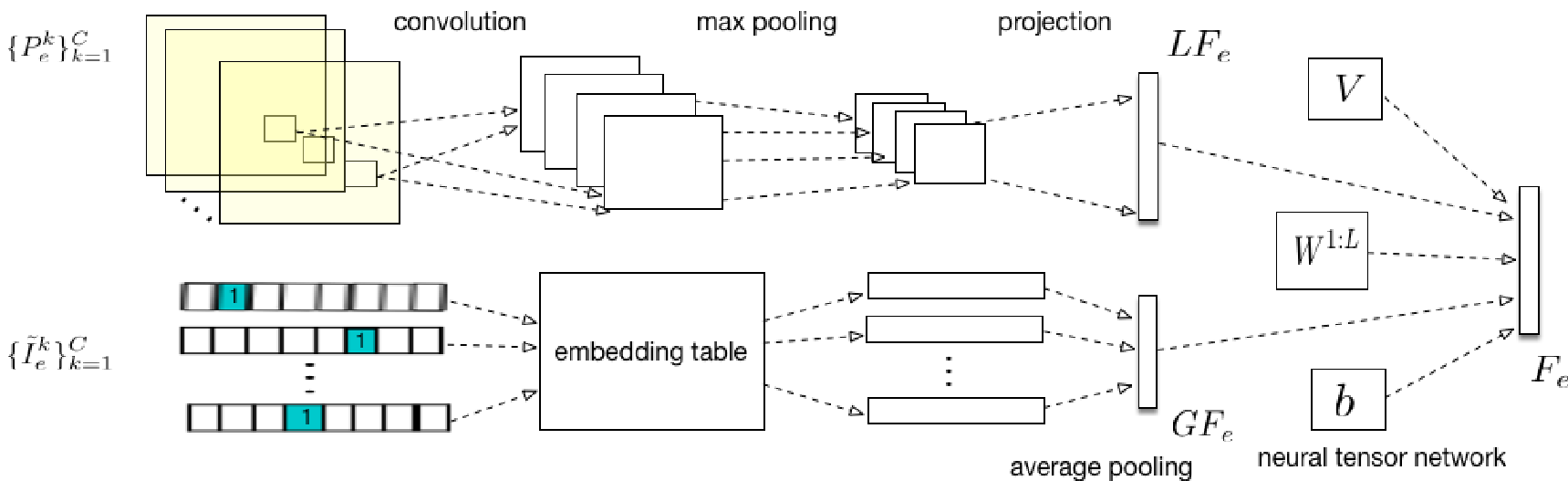 Figure: The GeoCNTN architecture showing the dual-path extraction and NTN fusion.
Experimental Results & Insights
The model was tested on Meetup datasets from the USA and Europe.
- Link Prediction: GeoCNTN achieved an NDCG@10 of 0.718, significantly higher than GeoMF (0.625).
- Ablation Study: The authors proved that removing the NTN and using simple concatenation (GeoCNTN-no-tensor) dropped performance by ~5%, justifying the need for complex interaction modeling.
- Interpretability: Using t-SNE visualizations, the authors showed that the model doesn't just cluster people by location; it adjusts distances based on social ties. Two people living in the same neighborhood but moving in different "patterns" (concentrated vs. scattered) are pushed apart in the embedding space.
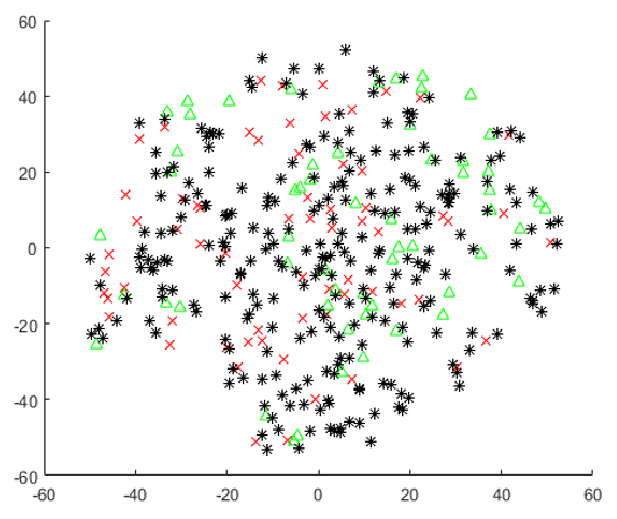 Figure: ROC curves showing GeoCNTN (top line) outperforming all traditional and recent baselines.
Critical Analysis & Conclusion
GeoCNTN identifies a major blind spot in spatial data science: the neglect of local "texture" in movement patterns. Its success lies in the Data Representation phase—making raw data "CNN-friendly."
Limitations: The current model relies on a fixed number of clusters () and grid sizes (). In highly dynamic or hyper-local scenarios, these hyperparameters might require automated tuning (e.g., via Dirichlet Processes).
Future Outlook: The logical next step is integrating temporal dynamics. Knowing where someone is is powerful; knowing the sequence (trajectory) of where they go next could lead to even more potent embeddings for real-time recommendation.