
Simplicial Analysis: Beyond Pairwise Ties in Geolocalized Social Networks
Analysis of geolocalized social networks based on simplicial complexes
The paper introduces a topological framework for analyzing geolocalized social networks by modeling them as simplicial complexes (specifically flag complexes). It utilizes a "Stellar tree" data structure and a "missing-based" algorithm to perform homology-preserving simplification and efficient detection of "blockers" (missing community ties).
TL;DR
Social networks are more than just lines between dots. This paper moves beyond traditional Graph Theory to Simplicial Complexes, offering a way to represent multi-user "cliques" as solid geometric shapes. By using a specialized Stellar tree data structure and homology-preserving simplification, the authors can shrink massive datasets by 90% without losing the "holes" (missing connections) that represent potential friendship opportunities.
Background: Why Graphs Aren't Enough
For decades, we’ve modeled social networks as graphs . While elegant, graphs have a fatal flaw: they only describe pairwise relationships. If Alice, Bob, and Charlie are all friends, a graph treats this as three separate edges. It doesn't inherently distinguish between three people who happen to know each other and a cohesive "triadic" community.
The authors argue for Simplicial Complexes. In this model:
- 2 users = a 1-simplex (Edge)
- 3 mutually connected users = a 2-simplex (Triangle)
- mutually connected users = a -simplex.
This change in perspective allows researchers to find Blockers—minimal non-faces that represent missing links in an almost-complete community.
Methodology: The Stellar Tree and Topology Preservation
To handle the scale of geolocalized data (like the Brightkite dataset), the authors use the Stellar Tree. Unlike global data structures that choke on high-dimensional simplices, the Stellar Tree uses a quadtree-based spatial decomposition to process the network locally.
1. Homology-Preserving Simplification
Scaling down a network usually involves removing edges, which can change the network's fundamental "shape." The authors use Edge Contraction guided by the Link Condition. This ensures that if a "hole" (a tunnel or void in the social fabric) exists, it is preserved during simplification.
- Weights: Simplification is driven by either spatial distance (GPS) or check-in similarity.
2. The Blocker Extraction Breakthrough
Finding "blockers" is traditionally a nightmare because it involves searching through all possible subsets of a clique—a process that grows exponentially. The authors introduce a missing-based strategy. By looking at the "Star" of an edge (the simplices connected to it), they identify missing simplices much faster.
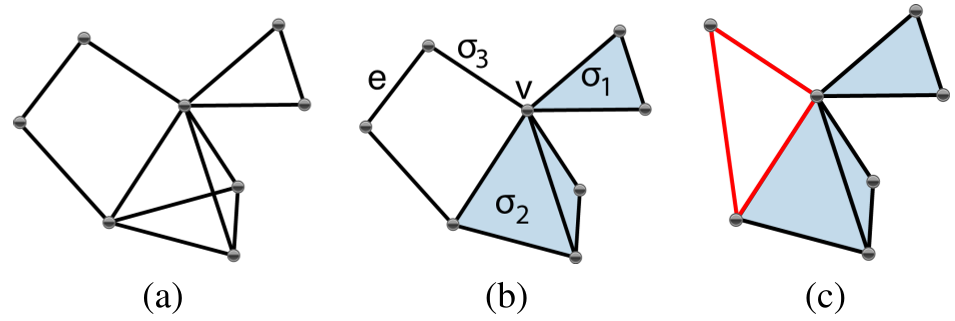 Figure 1: Transition from a simple graph (a) to a flag complex (b) and identifying a blocker (c).
Experimental Results
The results highlight a massive leap in efficiency:
- Scalability: On the North America dataset (~31k vertices), the Stellar tree maintained a memory peak of only 56-60MB compared to ~100MB for standard structures.
- Speed: For blocker computation, the traditional clique-based method failed to finish within 12 hours on larger sets. The proposed missing-based method finished in as little as 13.8 seconds.
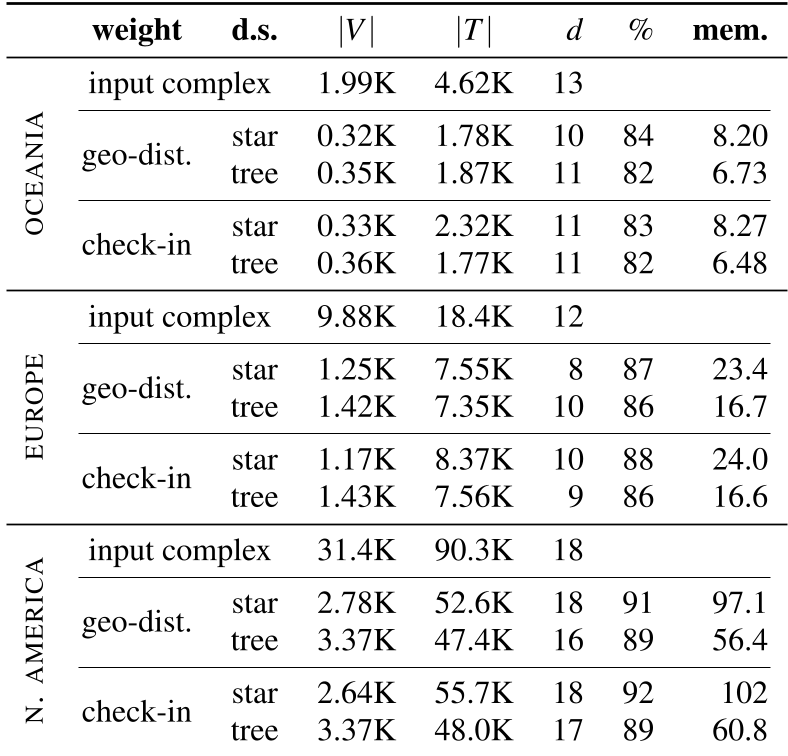 Table 1: Note the high simplification ratios (%) while maintaining the complex dimension .
Visualizing the Social Fabric
The paper concludes with a visualization of the Australian sub-network. By mapping the Top Degree (how many communities a user belongs to) and Upper Degree (how many friends a user has), they can distinguish between "social butterflies" in Melbourne versus more isolated clusters in Perth.
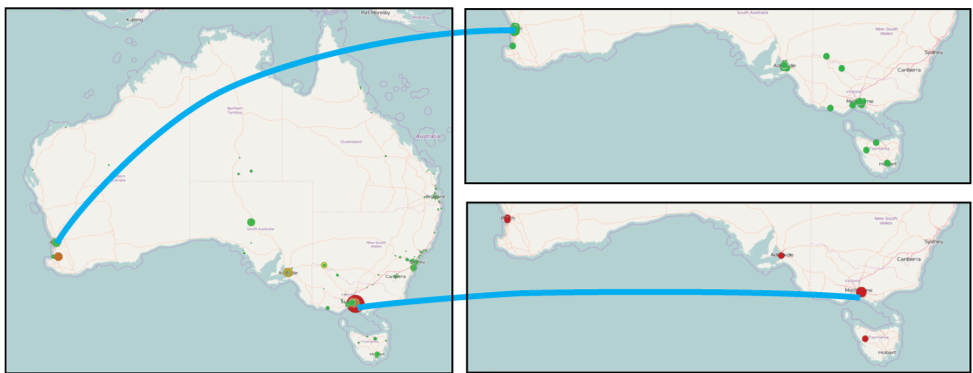 Figure 2: Heatmap of connectivity in Australia; dot size represents community participation.
Critical Insights & Future Work
The real value of this research lies in its Inductive Bias: it assumes that the "holes" in a social network are as important as the connections. These holes are the birthplaces of future communities.
Limitations: While powerful, the current model is static. Social networks evolve every second. The authors suggest that Persistent Homology—measuring how topological features persist across different thresholds—is the next logical step to capture the temporal "heartbeat" of social data.
Takeaway: By treating social data as a geometric shape rather than a flat graph, we can simplify big data without losing the structural nuances that define human interaction.