
Geolocation Hazards: The Hidden Surveillance of Geosocial Networks
Geolocation Hazards in Geosocial Networks
This paper investigates "Geolocation Hazards in Geosocial Networks" (GSNs), analyzing how modern mobile applications like Highlight and WhosHere expose users to privacy risks. The study utilizes empirical discovery tests to demonstrate that current location-protection techniques fail to prevent precise user tracking and identity reconstruction.
TL;DR
Geosocial Networks (GSNs) have transformed from simple "check-in" tools into massive data aggregators that link our physical movements to our digital identities. This paper exposes how easy it is for strangers to find your home, work, and social circle using apps like Highlight and WhosHere, even when those apps claim to protect your privacy through "relative location" settings.
Background Positioning: This work serves as a critical security audit and impact assessment, highlighting the widening gap between mobile technology capabilities and existing privacy legislation.
The Core Friction: Utility vs. Anonymity
The fundamental motivation of the authors is the irony of the "Global Village." As we become more interconnected through geography, our "Point of Interest" (POI) data—where we sleep, work, and socialise—becomes a goldmine for malicious actors. The paper highlights a chilling statistic: only four spatiotemporal coordinates are sufficient to uniquely identify 95% of individuals.
Prior work often focused on theoretical privacy, but this paper brings it into the real world, looking at how "social discovery" features (finding people nearby) turn every user into a potential target for "Please Rob Me" style attacks.
Methodology: Testing the "Accuracy" Trap
The authors categorize GSNs into two buckets:
- Precise Coordinate GSNs: (e.g., Foursquare, Highlight) These share exact GPS data.
- Relative Location GSNs: (e.g., WhosHere, Tinder) These share distance (e.g., "2 miles away") rather than coordinates.
Architecture of a Leak
The authors point out that mobile OS APIs (Android/iOS) make it trivial for developers to access fine-grained location. The "leak" happens not just through the GPS itself, but through the cross-platform aggregation of data.
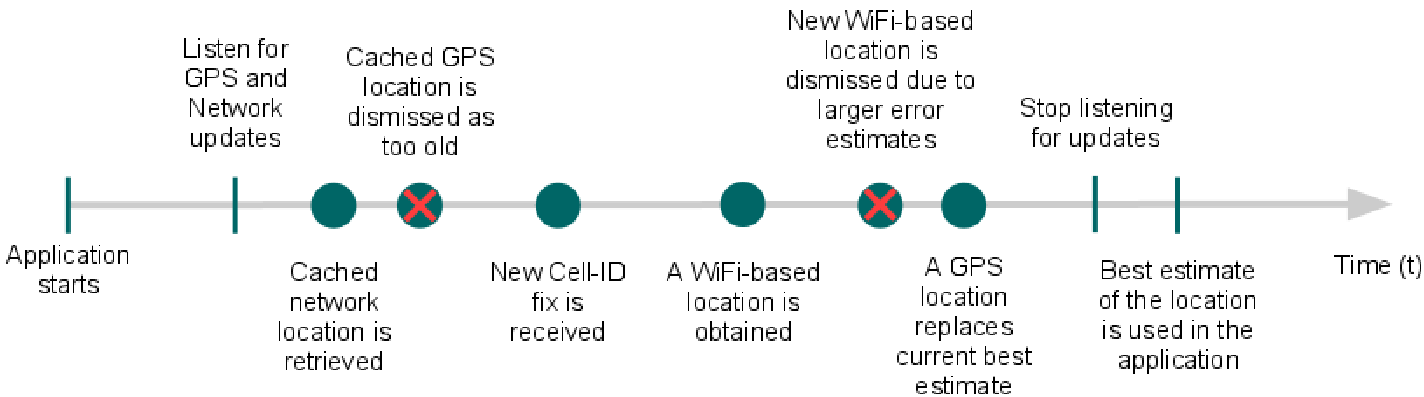 Figure 1: How mobile applications exploit GPS, Wi-Fi, and Cell-ID to build a persistent tracking history.
Experimental Results: A 100% Success Rate in Identity Theft
The researchers conducted "Social Discovery" on 60 random profiles. The results were devastating for the "privacy" claims of these apps:
- Highlight: By linking Facebook and LinkedIn, researchers found the Full Name, Photos, and Exact Location of 100% of targets.
- WhosHere: Even though it used "relative location," attackers could use "Space Partition Attacks" (changing their own location to triangulate the target) to find exact positions.
| Information Found | Highlight (out of 30) | WhosHere (out of 30) |
|---|---|---|
| Full Name | 30 | 30 |
| Home/Work Address | 28 | 0 |
| Precise Location | 30 | 26 |
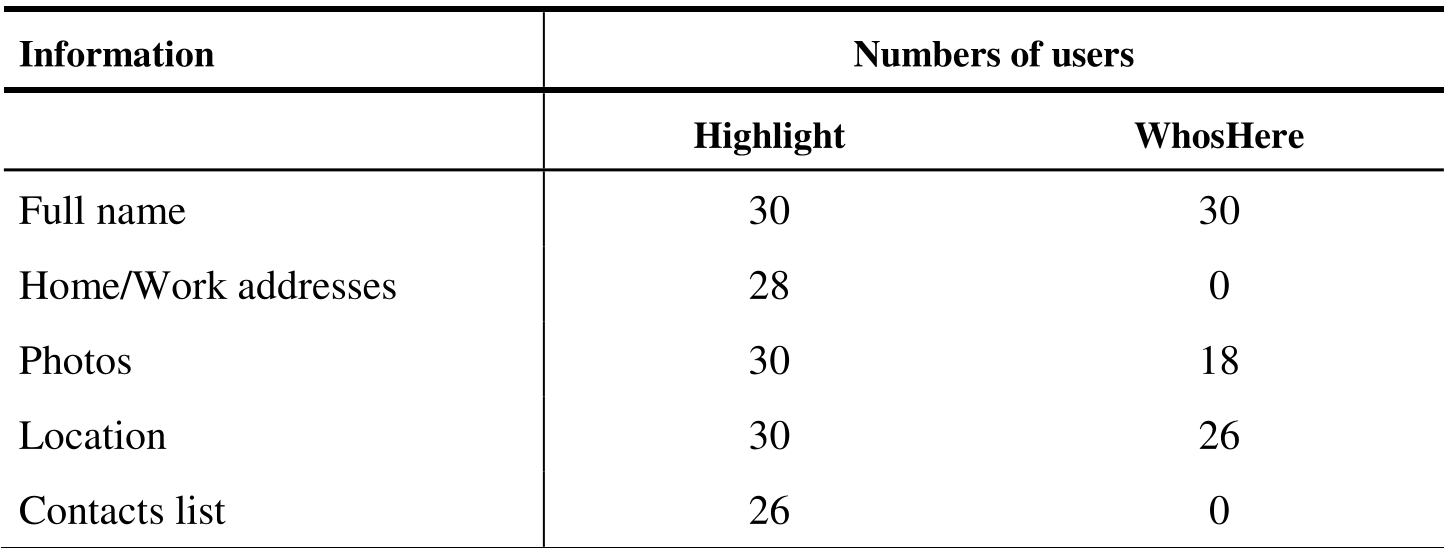 Table 2: Evidence of how "Relative Location" (WhosHere) provides a thin layer of protection compared to the open broadcast of Highlight.
Deep Insight: The "Privacy Self-Management" Paradox
The paper concludes with a biting critique of current legal and corporate "Safe Harbors."
- The Consent Illusion: Most users "consent" to tracking because the app won't function without it.
- The Policy Gap: 68% of young users believe a "Privacy Policy" means their data won't be shared, whereas most policies are actually written to legalize the sharing.
- Geometric Vulnerability: The authors prove that even if an app hides your coordinates, an attacker who can "move" their virtual location (a premium feature in some apps) can triangulate you with basic geometry.
Final Verdict
GSNs offer "coolness" at the cost of "security." While there are positive use cases (emergency services, campus exploration), the current "opt-out" nature of these apps creates a playground for burglars and stalkers. The authors argue that Privacy by Design is the only way forward; waiting for users to master complex privacy settings is a failed strategy.
Future Work: The team intends to move from simple discovery to active "attacks" on GSN infrastructures to force a change in how location data is obfuscated.