
GEOTROPY: Reimagining Georecommendation for Decentralized Social Networks
Geology: Modular Georecommendation in Gossip-Based Social Networks
The paper introduces GEOLOGY, a modular framework for fully distributed georecommendation in gossip-based social networks. It proposes a novel metric called GEOTROPY, which achieves SOTA-level recommendation quality on geodata by combining category-based compaction with a localized Adamic/Adar similarity measure.
TL;DR
Georecommendation (suggesting places you'll love) is a staple of modern apps, but doing it without a central server is notoriously difficult. GEOTROPY, part of the new GEOLOGY framework, solves this by using "gossip" protocols. By abstracting specific locations into categories and using a localized version of the Adamic/Adar metric, it hits a 40% recall rate with 60% less bandwidth than previous distributed methods.
The Problem: Why Geodata is "Different"
In a standard social network, if you subscribe to a "Marathon Running" tag, you provide a clear signal of interest. In a geolocated network, if you check into a park or an airport, so do thousands of others who share nothing else in common with you.
Current decentralized systems often rely on Cosine Similarity or Jaccard Coefficients, but these fail in a geo-context because:
- Low Semantic Weight: High-frequency locations (like SFO Airport) dilute similarity signals.
- The Niche Tail: Most locations are visited by very few people, making it hard to find "neighbors" in a distributed peer-to-peer (P2P) mesh.
Methodology: The GEOLOGY Framework
The authors suggest a modular approach to bridge the gap between privacy-centric decentralization and high-quality recommendations.
1. The Two-Layer Gossip Architecture
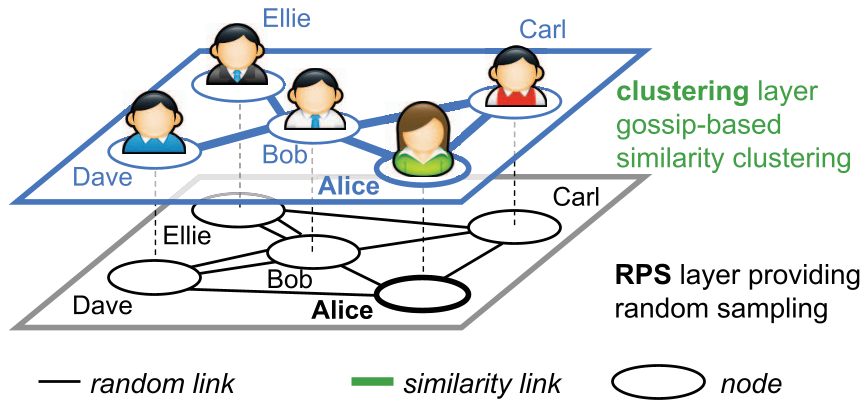
The system organizes users into two layers:
- Random Peer Sampling (RPS): Ensures the network stays connected and resilient against users leaving (churn).
- Clustering Layer: The "intelligence" layer where users find peers with similar tastes to exchange recommendations.
2. The GEOTROPY Innovation
The core of the paper is the GEOTROPY metric. It doesn't just look at where you've been; it looks at the entropy of those places.
- Compaction: Instead of comparing millions of raw coordinates, it maps check-ins to categories (e.g., "Coffee Shop"). This "compacts" the data, making it easier to find matches.
- Local Adamic/Adar: It rewards "rare" matches. If two users both visited a niche "Ethiopian Restaurant" (rare), they are significantly more similar than two users who both visited "Union Square" (common).
- Local Sampling: Crucially, instead of requiring a global list of every user's location to calculate rarity, GEOTROPY estimates it by looking at its immediate gossip neighbors.
Experiments & Results
The team tested GEOTROPY using a real-world Foursquare dataset from the San Francisco Bay Area.
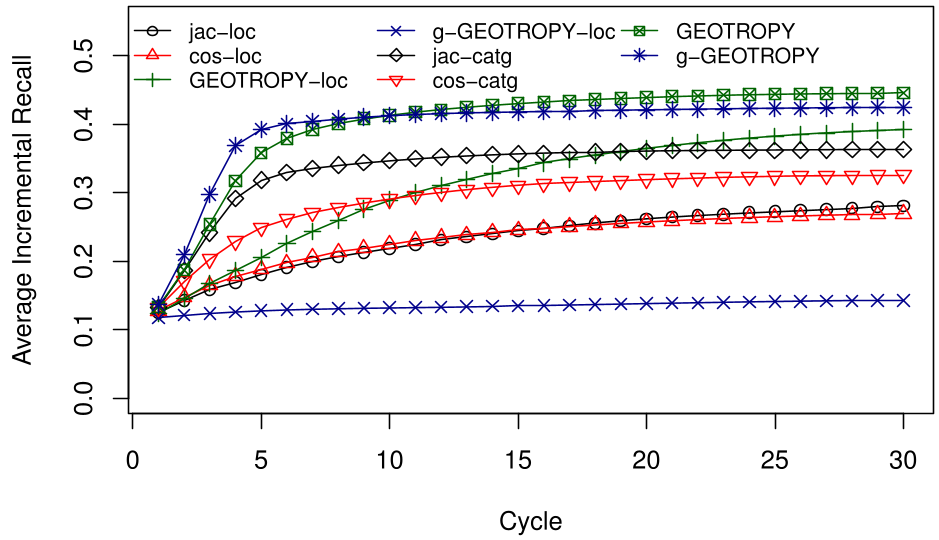
- Superior Recall: GEOTROPY outperformed standard metrics immediately. By the 10th cycle, it correctly predicted 40% of the venues a user would eventually visit.
- Efficiency: Because of the compaction module, GEOTROPY uses significantly less data. As shown in the comparison below, category-based methods (jac-catg, GEOTROPY) are much lighter than location-based ones.
- The Popularity Factor: One of the most striking findings is GEOTROPY's ability to recommend "niche" locations better than predecessors, effectively solving the "long tail" problem of geodata.
Critical Insight & Conclusion
The genius of GEOTROPY lies in its Local Sampling. In a massive P2P network, you cannot know the global frequency of every venue. GEOTROPY proves that the statistical distribution found in a user's local gossip neighborhood is a "good enough" proxy for the global state.
Takeaway: If you are building a privacy-first, distributed recommendation engine, don't try to sync everything. Use semantic compaction (categories) and let the "wisdom of the immediate crowd" (local sampling) do the heavy lifting.
Limitations
While powerful, the current framework assumes a fixed set of categories and focuses on a single metropolitan area. Future work should address how this scales across different regional cultures where venue categorization might be less standardized.