
Geometrical Facial Modeling: Elevating Emotion Recognition through Structural Intelligence
Geometrical facial modeling for emotion recognition
This paper presents a geometrical facial modeling approach for Automatic Emotion Recognition (AER) using four proposed feature sets. By integrating point coordinates, distances, angles, and area-based measurements with Machine Learning classifiers (SVM, MLP, and C4.5), the study achieves a State-of-the-Art accuracy of 94.51% on the Radboud Faces Database (RaFD).
TL;DR
Researchers have developed a highly accurate facial emotion recognition system by shifting focus from raw pixels to "Geometrical Modeling." By calculating the precise distances, angles, and surface areas of facial components, and comparing them against a user's neutral state, the proposed method achieves an impressive 94.51% accuracy using Support Vector Machines (SVM).
Background: Beyond the Pixel
In the quest to make AI "affect-aware," facial expression analysis has long been divided into two camps: Appearance-based (textures, wrinkles) and Geometric-based (shapes, coordinates). While deep learning has recently favored appearance, geometric patterns offer a profound advantage: they are computationally lightweight and capture the "physics" of emotion—the way muscles pull the skin into measurable polygons.
The authors argue that prior geometric approaches failed because they were too simple. Just knowing where a point is doesn't tell you the "intensity" of a smile. To solve this, they introduced area-based measurements to track the volume of facial movements.
Methodology: The Geometry of a Smile
The workflow begins with a modified Face Tracker, reducing the standard 66 landmarks down to a specialized subset of 33 points. These points focus on the high-entropy regions of the face: the mouth, eyes, eyebrows, nose, and chin.
The Four Feature Pillars
- FS1 (Dense Geometry): All possible combinations of distances and angles between the 33 points.
- FS2 (Optimized Geometry): A sparse subset focusing only on critical interfaces (e.g., upper lip to nostrils).
- FS3 & FS4 (The Delta Effect): Crucially, these sets measure the difference between the current expression and a neutral frame. This acts as a "calibration" step, ensuring that someone with naturally slanted eyes isn't permanently classified as "surprised."
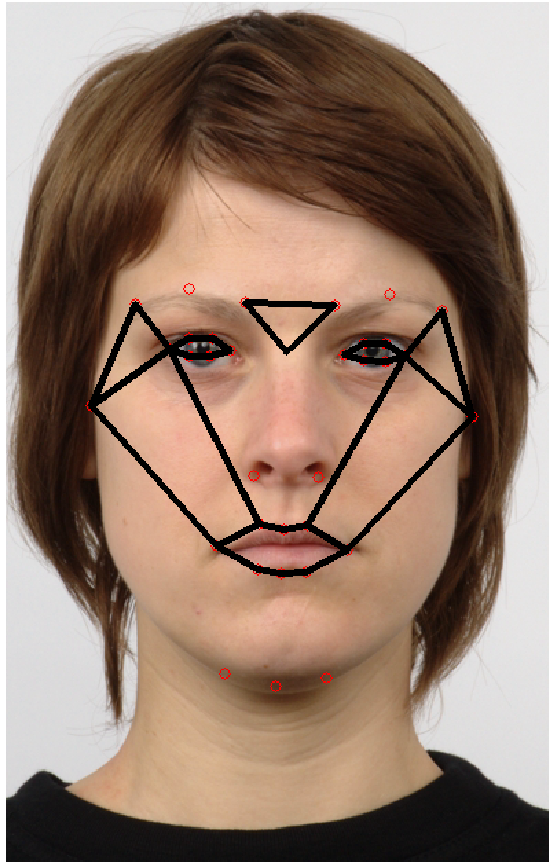 Figure: The graphical representation of landmarks and the 8 area-based polygons used to map emotional muscular movements.
Experiments & Results
The researchers tested three major Machine Learning paradigms: Support Vector Machines (SVM), Multilayer Perceptrons (MLP), and C4.5 Decision Trees.
The SOTA Performance
The results on the Radboud Faces Database (RaFD) were conclusive:
- SVM + FS1-3 (Combined): 94.51% Accuracy
- MLP + FS1-3: 90.03% Accuracy
- C4.5 + FS3: 86.81% Accuracy
The statistical analysis (using Student t-tests) confirmed that SVMs with a Gaussian Kernel are superior for this high-dimensional geometric data. They found that "Happiness," "Neutral," and "Disgust" were the easiest emotions to classify, whereas "Sadness" was occasionally confused with "Anger" due to the subtle downward movement of the lips being harder for the tracker to capture.
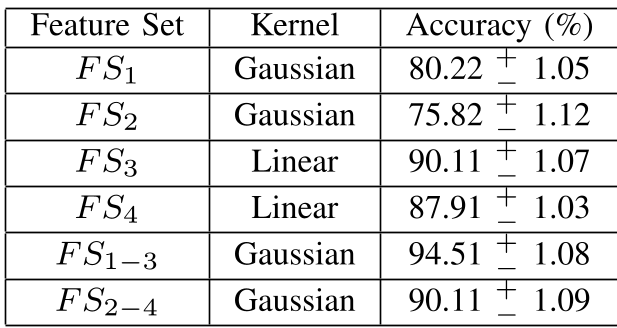 Table: Performance of SVM across different proposed feature sets.
Critical Insights: Why it Works
The success of this method lies in Relativity. By using and (the difference sets), the model learns how a specific face deforms, rather than trying to find a universal "happy coordinate."
Furthermore, the inclusion of area calculations (the black outlined regions in the figures) provides an "Integrative Logic" that individual points lack. It captures the bunching of the cheeks or the widening of the mouth as a holistic change in surface area, which is far more robust to minor tracking noise than a single coordinate.
Conclusion & Future Outlook
This work proves that we don't always need "Black Box" deep learning to achieve SOTA results. Logic-driven geometrical modeling, when combined with proper neutral-state normalization, provides a transparent and highly accurate framework for AER.
Future Work: The authors plan to validate these sets against more challenging datasets like the Extended Cohn-Kanade (CK+), which includes more spontaneous and varied expressions. For developers of social robots or HCI systems, this geometric approach offers a path toward real-time emotion sensing that requires minimal processing power.
Takeaway for the Industry: Calibration is king. If you want to recognize emotions accurately across diverse populations, don't just look at the face—look at how the face changes from its own baseline.