
Geosocial Marketplace: Revolutionizing the Economy of Personal Location Data
An online marketplace for geosocial data
This paper proposes a visionary framework for an online marketplace dedicated to geosocial (spatio-temporal) data. It introduces a structured system where individuals can monetize their GPS trajectories and geo-tagged content, while organizations can acquire high-quality datasets for applications like urban planning and traffic monitoring.
TL;DR
In an era where location data is the "new oil," Yaron Kanza and Hanan Samet propose a groundbreaking blueprint for a Geosocial Marketplace. Unlike current models where tech giants harvest data for free, this framework treats spatio-temporal data as a tradeable asset, allowing users to sell their GPS histories and geo-tagged posts under strict privacy constraints while providing organizations with high-quality, targeted datasets for urban and health analytics.
The "Costly" Reality of Location Sharing
Today, every check-in or GPS trace comes with a hidden bill:
- Energy Overhead: GPS is a notorious battery killer.
- Resource Consumption: Storing and transmitting high-frequency trajectories eats up bandwidth and storage.
- Privacy Erosion: Spatio-temporal traces can act as a fingerprint, revealing intimate details about a user's life.
The authors argue that if users are to bear these costs, they must be incentivized. Current systems lack a bidirectional bridge between the people generating "geosocial" data (triples of Location, Time, and User) and the entities—like traffic monitors or urban planners—that desperately need it.
Architecture of the Marketplace
The proposed system isn't just a simple store; it is a sophisticated ecosystem composed of three primary pillars:
1. The Seller Logic (Agency & Privacy)
Sellers use a mobile application to define their "Public Boundaries." Using a structured language, a user can specify exactly what they are selling:
sql PUBLISH location, time, age, gender WHERE distance(location, Home_Coord) < 5 AND time BETWEEN 10am AND 5pm
Crucially, the module includes filtering functions to prevent the accidental sale of "sensitive" or "rarely visited" locations that could lead to deanonymization.
2. The Buyer Logic (Targeted Acquisition)
Buyers (e.g., a city planner) can request data with surgical precision. They don't just "buy data"; they "acquire continuity":
sql ACQUIRE location, time, age WHERE location IN 'Manhattan' AND collection(continuous, 2h, 5min)
3. The Valuation Engine
How do you price a GPS point? The paper moves beyond "one cent per point" by proposing three metrics:
- Point Count: Simple volume.
- Spatio-temporal Volume: Measuring the "area" and "time gap" covered by the data.
- Information Entropy: Using Shannon’s theory to value "unpredictable" movements higher than routine commutes.
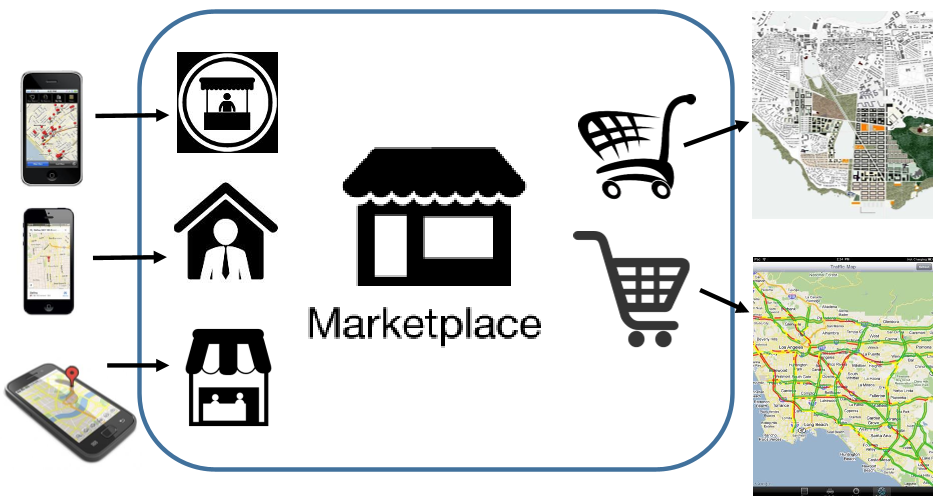 Figure 1: The ecosystem cycle—Users upload data with constraints, while organizations buy based on specific budget and quality needs.
Why This Matters: Beyond Simple Trade
The most profound insight in this work is Heterogeneous Pricing. The value of a data point in a crowded city square where thousands share data is inherently lower than data from a remote road during a natural disaster.
The authors suggest a ranking mechanism that factors in:
- Geographic Scarcity: Low supply increases price.
- Demographic Rarity: Data from specific age groups or professions may command a premium.
- Information Gain: Using Kullback-Leibler divergence to assess how much new information a seller adds to the buyer’s existing dataset.
Critical Analysis & Future Outlook
While this short paper provides a robust visionary framework, it leaves the "Regulator" question open. Who ensures that the data sold isn't "fake"? Although the authors mention encoding to prevent fraud, the rise of sophisticated GPS spoofing remains a challenge.
The Takeaway: This paper was a precursor to the modern "Data Sovereignty" movement. It transforms the user from a passive data source into a deliberate market participant. As we move toward Web 3.0 and decentralized identities, the mechanisms described here—especially the Entropy-based valuation—will likely serve as the mathematical foundation for personal data exchanges.
Further Reading
- Abel (1997) on the original "Spatial Internet Marketplaces."
- Kaza et al. (2014) on discovering urban patterns via geo-tagged posts.
- Kullback & Leibler (1951) for the underlying information theory applied to data exchange.