
Towards Geosocial Recommender Systems: Bridging the Gap Between Space and Society
Towards geosocial recommender systems
The paper proposes a holistic architecture for Geosocial Recommender Systems (GRS) that integrates geographic information, social network data, and recommendation algorithms. It introduces the concept of "geoprofiles" to recommend localized products like real estate and holiday rentals by synthesizing user-generated content (UGC) with authoritative and web-harvested data.
TL;DR
In this seminal architectural proposal, researchers from the University of Twente layout a roadmap for the next generation of Recommender Systems. By moving beyond simple "check-ins," the paper introduces Geosocial Recommender Systems (GRS)—a framework that builds a comprehensive "geoprofile" of locations by harvesting data from the web, social media (like Facebook), and GPS trajectories to recommend complex products like real estate and vacation homes.
Problem & Motivation: The Limitation of Proximity
In 2012, services like Foursquare or TripIt were already popular. However, the authors identified a critical gap: these systems were "rudimentary." They focused almost exclusively on suggesting immediate Points of Interest (POIs) based on where a user was standing.
The authors argued that for high-stakes recommendations—like choosing a holiday cottage—location is more than a coordinate. It involves the "vibe" of the neighborhood, the events happening nearby, and the experiences of people within one’s own social circle. The challenge was two-fold:
- Data Silos: Most systems relied on their own, often sparsely populated, internal social networks.
- Contextual Poverty: Recommendations ignored the broader geographic context (geoprofiles) in favor of simple proximity.
Methodology: The Three-Pillar Architecture
The proposed architecture flows through three distinct phases: Collection, Enrichment, and Selection.
1. The Geoprofile Concept
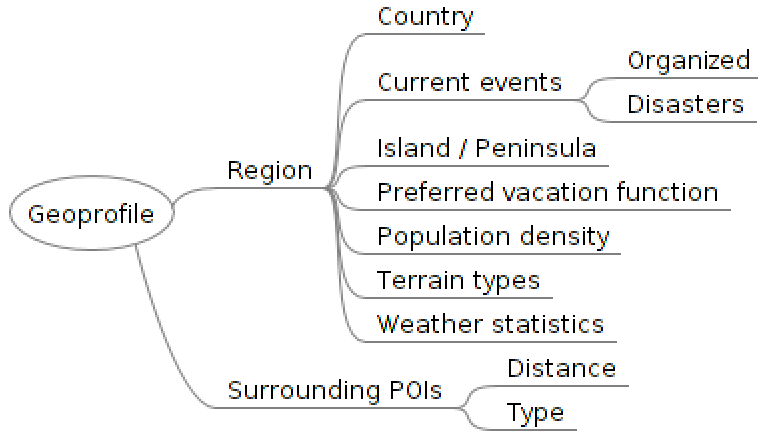
Central to this work is the Geoprofile. Instead of treating a holiday home as an isolated entity, the authors define it through four lenses:
- POIs: Restaurants, parks, and shops within distance.
- Events: Both organized (concerts) and unorganized (festivals).
- Socio-demographics: The "character" of the region.
- Geographic properties: Proximity to water, forests, or hills.
2. Information Flow
The system architecture (Figure 3) acts as a pipeline. Notably, the Social Media Connectors are designed to bridge the gap to platforms like Facebook. By analyzing "likes" or wall posts, the system can derive a user's preferences and even their "hometown" (Figure 4) to better calibrate recommendations without forcing the user to fill out endless surveys.

How It Works: The Selection Logic
The "magic" happens in the Recommendation Selection phase, which uses a double-filtering logic:
- Filtering (): Hard constraints like dates, price range, and availability.
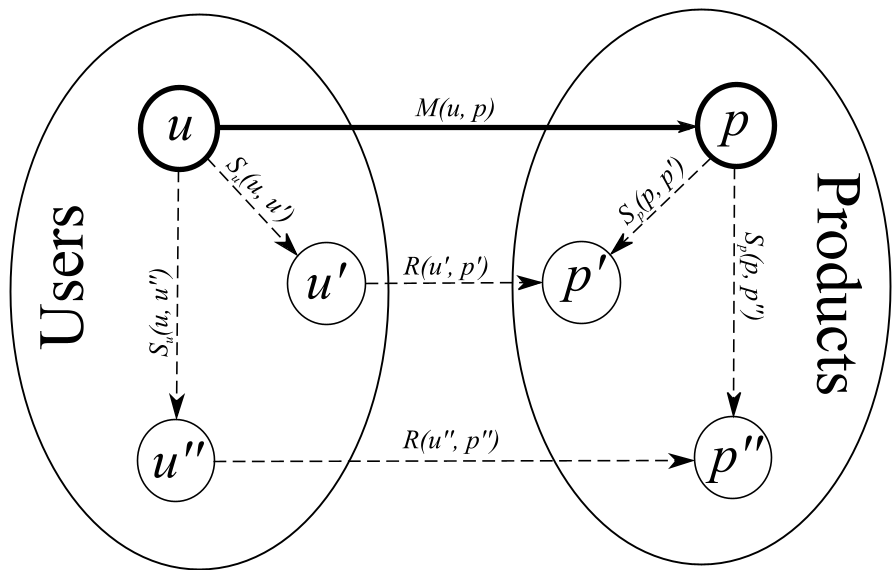
- Profile Matching (): The "soft" recommendation based on collaborative filtering.
The matching function (see Figure 6 below) is particularly elegant. It doesn't just look at whether you liked a house; it looks at the similarity between you and other users (), the similarity between the products (), and the weight of their reviews ().
Experiments & Future Outlook
While this paper serves as an architectural blueprint rather than a benchmark-heavy experimental report, it provides a validation scenario using a European holiday home broker.
By leveraging User Trail Analysis (converting raw GPS pings into semantically meaningful "stay points"), the system can "learn" what kind of locations a user actually enjoys visiting, rather than just what they say they like.
Critical Analysis
- The Cold Start Killer: Reusing social graphs from external SNS platforms is a masterstroke for solving the cold-start problem.
- Data Quality: The authors wisely included a "Quality Assessment" module, recognizing that User Generated Content (UGC) is often noisy, imprecise, or biased.
- Limitation: The paper predates the modern privacy-first era (GDPR). Automating the detection of social media accounts using names and geolocations, as proposed, would face significant regulatory and ethical hurdles today.
Final Takeaway
The shift toward Geosocial Recommender Systems represented a move toward "Human-Centric Search." It recognized that our digital social lives and our physical movements are inextricably linked. For developers and researchers, this work provides a robust framework for building systems that understand not just where we are, but who we are in the context of our surroundings.