
Getting More for Less: The Power of Survival-Based Dynamic Crowdsourcing
Geing More for Less: Optimized Crowdsourcing with Dynamic Tasks and Goals
This paper introduces a Markov Decision Process (MDP) framework to optimize volunteer crowdsourcing by balancing user engagement with data value. Utilizing the Quizz platform, the authors developed "survival models" to predict user dropout and implement dynamic task allocation and goal deployment, achieving a 249% increase in information gain.
TL;DR
Why do users quit crowdsourcing tasks just when they become useful? This paper reveals a counter-intuitive truth: Static goals (like badges) are actually exit signals. By modeling user "survival" (the probability of staying) and dynamically adjusting tasks and goals via a Markov Decision Process, the authors increased data collection efficiency by a staggering 249%.
The Misalignment Trap: Why Crowdsourcing Fails
In the world of volunteer crowdsourcing (think Wikipedia or Duolingo), there is a fundamental conflict of interest:
- The User wants ease, entertainment, and instant success (low cognitive load).
- The Stakeholder needs answers to the hardest, most "boring," or complex tasks (high cognitive load).
Most systems try to bridge this with gamification—badges, progress bars, and levels. However, this paper identifies a "Fixation Effect": once a user sees a goal (e.g., "10 questions remaining"), they stop focusing on the content and start counting down to the exit. The moment the goal is reached, the dropout rate spikes.
Methodology: Predicting the "Survival" of a User
The core innovation lies in treating crowdsourcing as a survival problem. The authors developed models to predict if a user will click "Next" or close the tab.
1. The Survival Models
They utilized several logistic regression variants and a Fitted-Q (FQ) iteration model. Key features included:
- User expertise: Previous accuracy and domain knowledge.
- Task difficulty: Global skip rates and average response times.
- Sequential patterns: How the difficulty of the previous question compares to the current one.
2. Dynamic Task Allocation (TA)
Instead of just serving the most "important" question (the one with the highest entropy), the system calculates the Expected Information Gain: If a task is highly valuable but likely to scare the user away, the system may opt for a "buffer" task that is easier or more interesting to keep the user engaged for a longer total session.
 Figure 1: The Quizz platform interface used for data collection and model validation.
The Goal Paradox: Less is More
The most striking finding of the study involves "Stated Quiz Length."
- Static Goals: In a quiz of 10 questions, dropout rates are low at question 9 but massive at question 11.
- Unspecified Length: Users often contribute more when they don't know how many questions are left, provided they aren't bored.
Dynamic Goal Deployment solves this. The system remains "infinite" and goal-free while the user is engaged. Only when the survival model predicts a high risk of dropout does the system "intervene" by showing a goal: "Just 3 more questions to get your badge!" This re-engages the user to push through the fatigue.
Experimental Results: Quantitative Triumphs
The researchers tested their framework on over 13,000 users.
- Accuracy: Survival models reached 77.5% accuracy in predicting drops.
- Information Gain: The "Logistic-Sequential" (TA-LS) model combined with dynamic goals outperformed static baselines by 249%.
- Efficiency: The dynamic models showed much higher efficiency in "Mixed Quizzes," proving that the system learned to route tasks to the right users based on their evolving interests.
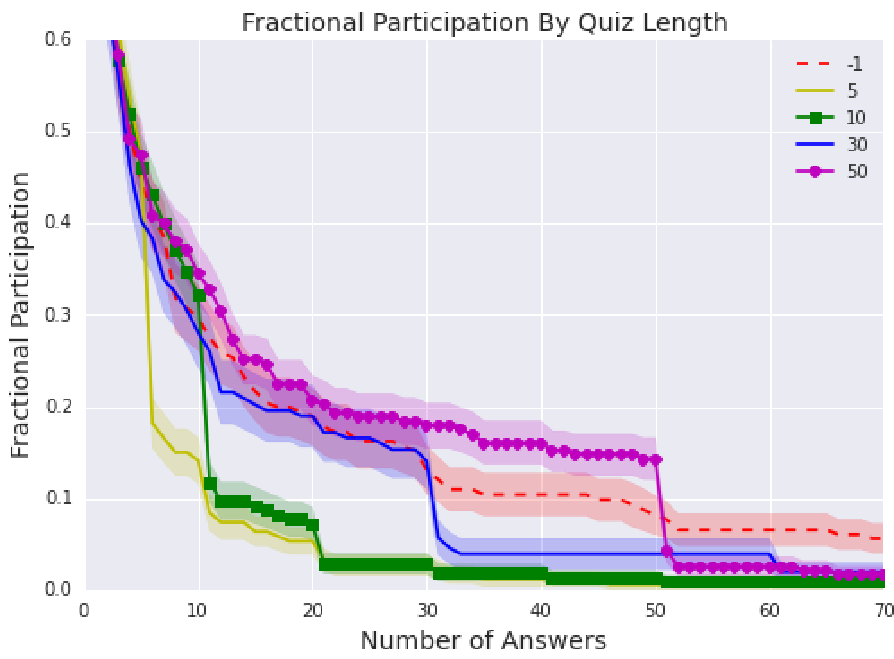 Figure 2: Fractional Participation (FP) curves. Note the "cliff" at stated quiz lengths and the superior tail of the unspecified length ("-1") group.
Analysis: Why "Fitted-Q" Wasn't the Winner
Interestingly, the sophisticated Fitted-Q model—intended to optimize for long-term cumulative reward—actually performed worse than simpler logistic models. The authors attribute this to Calibration. The FQ model was "too eager" to set goals, triggering dropout points too early. This highlights a critical lesson in AI implementation: Calibration is often more important than complexity.
Conclusion and Future Outlook
This paper shifts the focus of crowdsourcing from "finding the right answer" to "managing the human resource." By treating user attention as a finite, predictable trajectory, the system transforms from a static form into a responsive partner.
For developers and researchers, the takeaway is clear: Don't show the finish line until the runner starts slowing down.
Limitations
- Volunteer Bias: The study was conducted on Quizz, a platform where users are inherently seeking entertainment. Results might differ on paid platforms like AMT.
- Calibration Sensitivity: The dynamic goal deployment is highly sensitive to the survival threshold (τ); a slightly off-calibration model can actually increase dropout.