
Exploring the Gibberellin Metabolic Frontier: From Chemical Diversity to Precise Bio-Engineering
Gibberellin Metabolism in Flowering Plants: An Update and Perspectives
This paper provides a comprehensive review of Gibberellin (GA) metabolism in flowering plants, highlighting the discovery of species-specific GA modification enzymes. It specifically identifies the CYP72A and CYP714 P450 families and TwGA13ox (a 2-ODD) as key players in GA 13-hydroxylation, a critical deactivation mechanism for maintaining phytohormone homeostasis.
TL;DR
Gibberellins (GAs) are the chemical architects of plant growth, yet our understanding of their molecular "off-switches" has long been incomplete. This review highlights a pivotal shift in plant biology: the discovery of species-specific enzymes, such as the CYP72A subfamily in Arabidopsis and CYP714 in rice, that perform 13-hydroxylation to deactivate potent growth hormones. By mastering these metabolic pathways, synthetic biologists can now design "tunable" crops with optimized height and stress resistance.
The Motivation: Why GA Homeostasis Matters
For decades, the "Green Revolution" relied on a simple logic: reduce GA levels to create sturdier, high-yielding dwarf rice. However, most plants produce a cocktail of GAs (over 136 identified), but only a few (GA1, GA3, GA4, GA7) are bioactive. The metabolic "Why" remained: Why do some plants favor one bioactive form over another, and how do they selectively shut them down?
The core challenge was identifying the genes responsible for the diversity of GA structures, particularly at the C-13 position, which significantly changes a hormone's potency. For instance, GA4 is often 1000-fold more active than GA1 in specific assays.
Methodology: The GA Metabolic Network
The GA pathway is organized into two primary enzyme classes: Cytochrome P450s (membrane-associated) and 2-ODDs (cytosolic).
The Convergence of Evolution
One of the most profound insights from recent research is Convergent Evolution. Different plant families have evolved entirely different enzyme families to achieve the same result:
- Rice (Poaceae): Employs the CYP714 family to perform 13-hydroxylation.
- Arabidopsis (Brassicaceae): Uses the CYP72A9 enzyme to convert active GA4 into the less active GA1.
- Tripterygium wilfordii: Interestingly, it uses a 2-ODD (TwGA13ox) rather than a P450 for the same task.
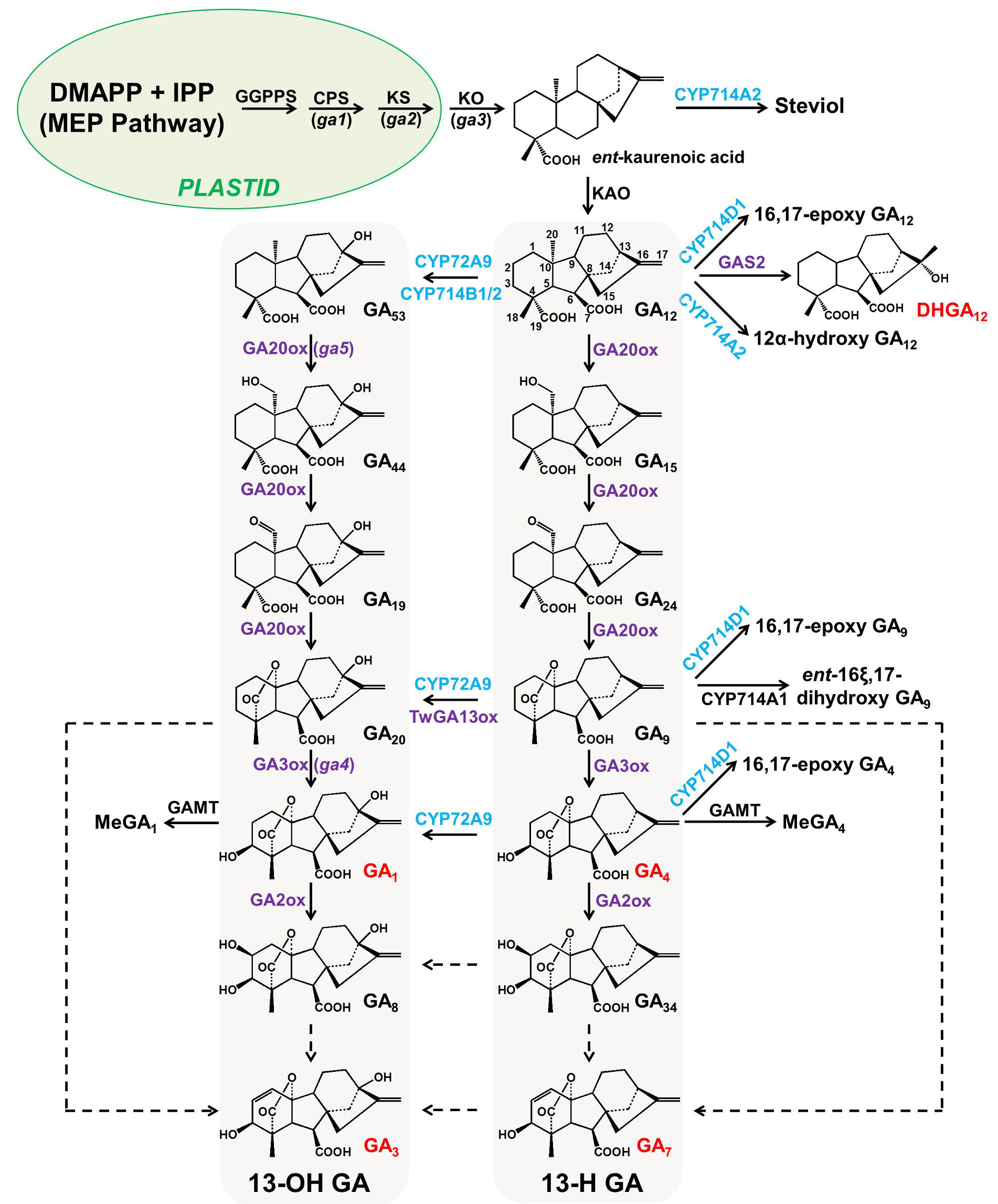
Figure 1: The GA metabolic landscape. Highlighting the divergence between P450-mediated (blue) and 2-ODD-mediated (purple) steps.
Key Experimental Insights
The study of CYP72A9 provided definitive proof of these mechanisms. Mutants lacking this gene showed increased GA4 and reduced GA1, while overexpression resulted in semi-dwarfism due to premature deactivation of bioactive GAs.
Moreover, the review discusses the role of tissue specificity. In rice, deactivation genes are highly expressed in the internodes (the stem), directly impacting plant height. In Arabidopsis, they are predominantly expressed in seeds, influencing primary dormancy.
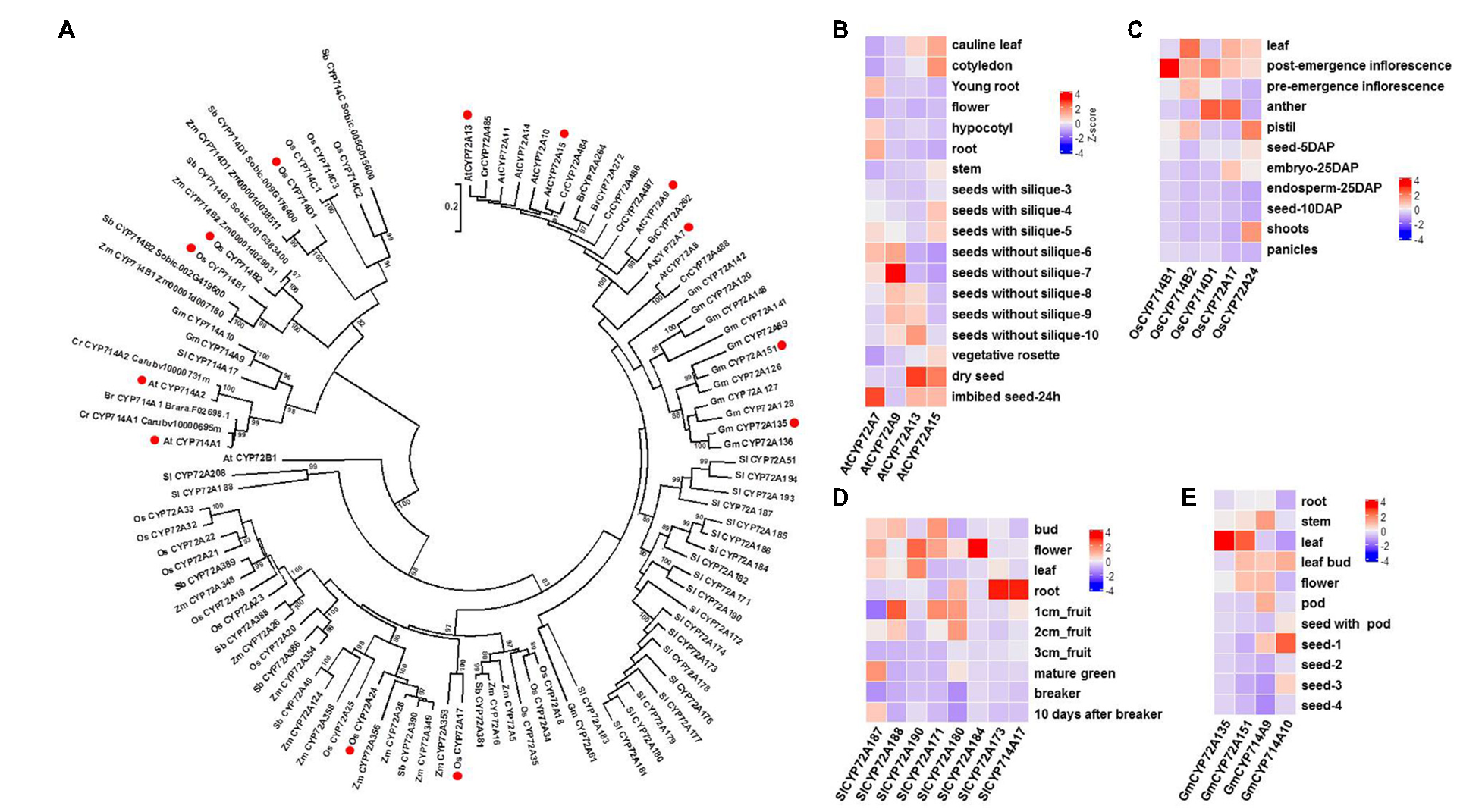
Figure 2: Phylogenetic analysis of the CYP714 and CYP72A families across major plant species, showing the broad potential for similar regulatory mechanisms.
Deep Insight: Toward Synthetic Phyto-Homeostasis
The ultimate takeaway is moving beyond "knock-outs." Instead of simply breaking a GA gene to create a dwarf plant (which can have negative side effects on seed germination), synthetic biology offers a tuning knob.
- Custom Promoters: Replacing native GA promoters with artificial ones that respond to environmental cues (like drought or nutrient levels).
- CRISPR Fine-Tuning: Using base-editing on the downstream metabolic genes (like the CYP714 family) to slightly adjust hormone levels without compromising plant health.
Limitations and Future Work
Despite the progress, several "black boxes" remain. We still haven't genetically characterized the universal plant enzyme for GA3 production—a bioactive form crucial for many developmental processes. Furthermore, the promiscuity of plant enzymes (like the 2-ODD family) means we must be cautious about unintended metabolic crosstalk when engineering these pathways.
In the coming decade, the integration of Mass Spectrometry (LC-MS/MS) for GA profiling and CRISPR-based precision breeding will likely usher in a second, more sophisticated Green Revolution.