
Gibberellin Engineering: Beyond the Green Revolution's Height Constraints
Gibberellin Metabolism and Signaling: Targets for Improving Agronomic Performance of Crops
This review provides a comprehensive analysis of Gibberellin (GA) metabolism and signaling pathways, focusing on their role as the foundation of the "Green Revolution." It highlights the identification of key genes like SD1 and Rht and explores modern strategies for fine-tuning GA to enhance crop yield, nitrogen use efficiency (NUE), and stress tolerance.
TL;DR
Gibberellins (GAs) were the "secret sauce" of the 20th-century Green Revolution, enabling semi-dwarf crops that resisted lodging and yielded more grain. However, this success came at the cost of high nitrogen dependency. This review explores the next generation of GA research: fine-tuning metabolic pathways to decouple growth from nutrient use and stress resilience, ultimately aiming for high-yielding crops that require fewer chemical inputs.
Problem & Motivation: The Nitrogen Paradox
The 1960s Green Revolution transformed global food security by introducing genes like sd1 (rice) and Rht (wheat). These genes interfere with GA—the hormone responsible for stem elongation—creating shorter, sturdier plants.
However, we are now facing a Nitrogen Paradox. These GA-deficient varieties are "nitrogen-hungry"; they require massive fertilizer inputs to achieve their yield potential because the same GA signaling pathways that control height also regulate nutrient uptake. Furthermore, global GA suppression often leads to "pleiotropic" side effects: smaller seeds, reduced fertility, and weakened immunity. The challenge for 21st-century science is to keep the "short stature" while regaining "high efficiency."
Methodology: The Molecular Logic of GA
To fix the Green Revolution, we first must understand the GA engine. The paper details a sophisticated sensory system involving three main players:
- GID1: The soluble receptor that "sniffs out" bioactive GA.
- DELLA Proteins: The "brakes" of the system. In the absence of GA, DELLAs restrain growth and metabolism.
- GID2/SCF Complex: The "trash collector" that degrades DELLA proteins once GA is detected by GID1.
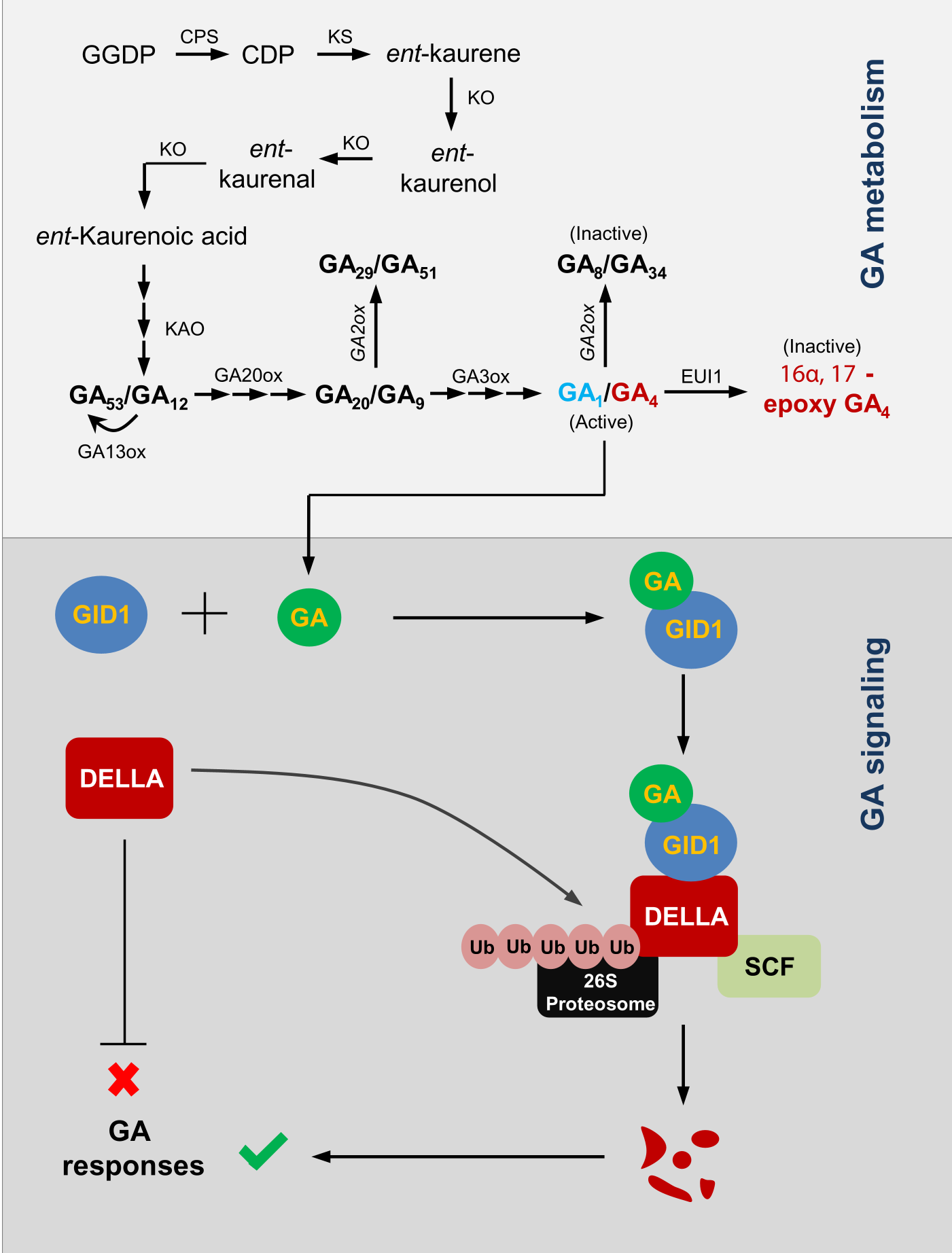 Fig 1: A simplified illustration of GA metabolism and signaling pathways in rice.
The Breakthrough: Decoupling Height and Nitrogen
The most profound insight in this paper is the discovery of Growth-Metabolism Coordination.
- GRF4 (Growth-Regulating Factor 4): This transcription factor acts as a positive regulator of nitrogen metabolism. It competes with the "brakes" (DELLA). By increasing GRF4 levels, scientists have successfully boosted nitrogen use efficiency (NUE) and grain size without making the plants tall and prone to falling (lodging).
- NGR5: This nitrogen-responsive regulator is targeted for degradation by GA. By stabilizing NGR5 in semi-dwarf backgrounds, researchers increased tiller numbers (more grain heads) even under low-nitrogen conditions.
Experiments & Results: Engineering the Future
The review synthesizes several landmark experimental results that prove GA fine-tuning works:
- Nitrogen Use Efficiency: In experiments with the GRF4ngr2 allele, rice and wheat showed a significant increase in NH4+ uptake. The result? Higher yields with lower fertilizer requirements, effectively "fixing" the Green Revolution's biggest flaw.
- Abiotic Stress (Flooding & Salt): The paper highlights how rice adapts to flooding. "Deepwater rice" uses GA to rapidly elongate its stem to stay above water (escape strategy), while "Submergence-tolerant rice" uses DELLAs to stay dormant until the water recedes (quiescence strategy).
- Hybrid Rice production: The EUI1 (Elongated Uppermost Internode) gene is used to solve "panicle enclosure," a defect in male-sterile lines where the grain head stays trapped in the leaf sheath.
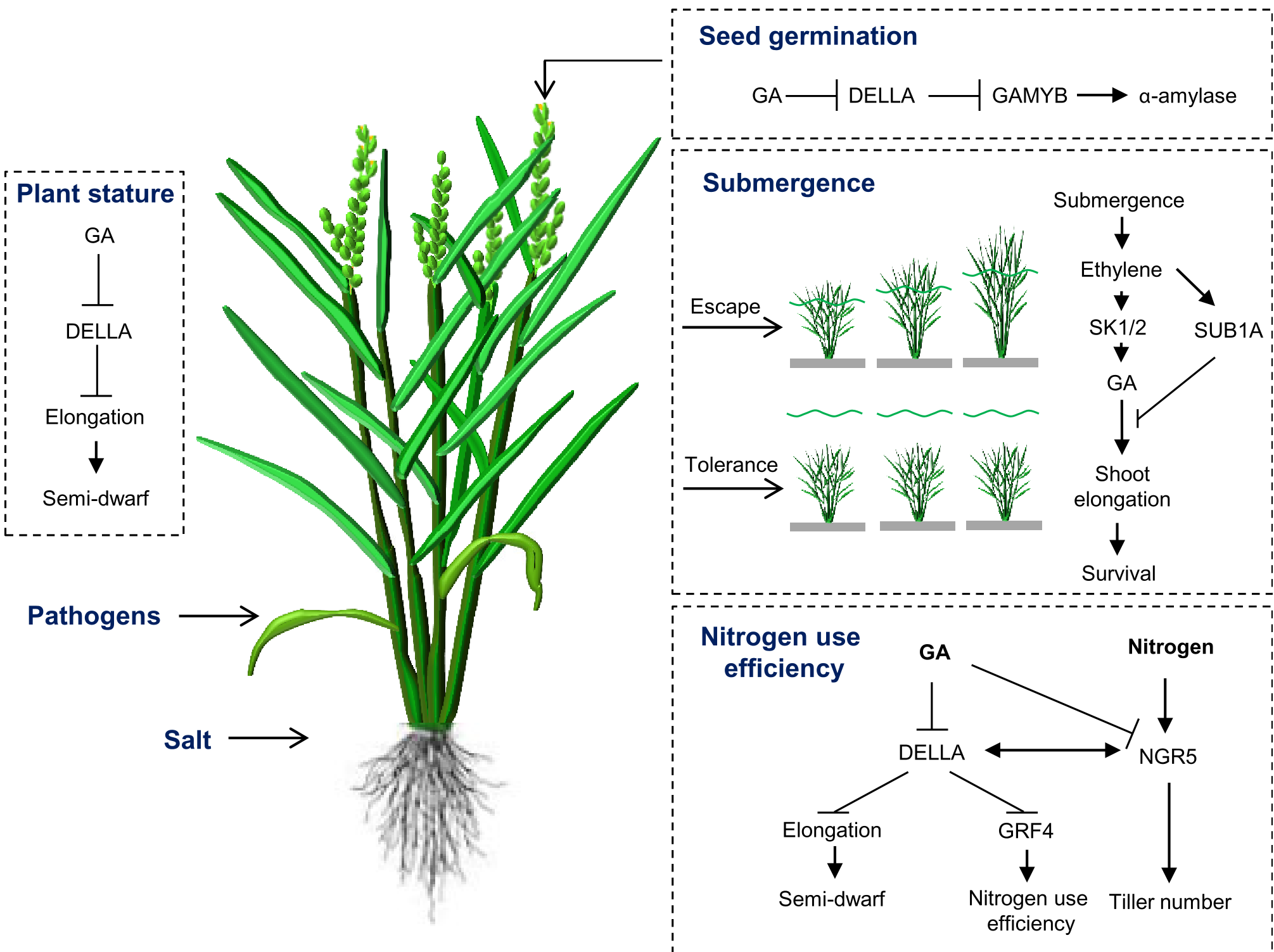 Fig 2: GAs act as a "central hub" for development, affecting stature, nutrients, and stress tolerance.
Deep Insight & Conclusion: The "Spatial" Frontier
The core takeaway from this review is that context is everything. We can no longer afford to shut down GA throughout the entire plant.
Future Outlook:
- Precision Editing: Using CRISPR/Cas9 to target specific promoters, allowing GA to be active in the grain (for size) but inactive in the stem (for height).
- Mobility: GA is a mobile signal. Understanding how it moves from roots to shoots will allow us to create "smart" plants that adjust their growth based on soil nutrient levels in real-time.
Conclusion: Gibberellin research has moved from the "Hammer" era (total suppression) to the "Scalpel" era (precise modulation). By targeting the intersection of growth and metabolism, we can finally achieve a sustainable Green Revolution that feeds the world without depleting the planet.