
Gibberellins: Precision Engineering for the Next Green Revolution
Gibberellins: extending the Green Revolution
This review synthesized recent advancements in Gibberellin (GA) research across grass crops, specifically maize, rice, and wheat. It articulates a strategy for a "Second Green Revolution" by leveraging targeted, tissue-specific regulation of GA pathways to optimize plant ideotypes and nutrient-use efficiency (NUE).
TL;DR
The classic "Green Revolution" relied on blunt genetic tools to shorten plants and prevent lodging, but often at the cost of nutrient efficiency and reproductive health. This review argues for a Second Green Revolution powered by precision GA (Gibberellin) modulation. By using tissue-specific promoters and CRISPR-mediated regulatory editing, researchers can now design "ideotypes"—crops with optimized heights, upright leaves for better light capture, and superior nutrient uptake.
The "Side-Effect" Problem in Modern Agriculture
The 1960s Green Revolution transformed global food security by introducing semi-dwarf genes in wheat and rice. These plants didn't fall over (lodge) under heavy fertilization. However, the approach was fundamentally flawed in two ways:
- Pleiotropy: In crops like maize, lowering GA levels throughout the plant causes "perfect flowers" to appear where they shouldn't (ears), leading to moisture traps and disease.
- Nutrient Greed: Many semi-dwarf varieties lost their ability to efficiently use nitrogen because the DELLA proteins (which accumulate when GA is low) actively repress nitrogen-metabolizing genes.
Methodology: From Blunt Force to Surgical Precision
The core of modern GA research is the DELLA-GID1-GA signaling module. Bioactive GAs trigger the degradation of DELLA proteins, which are the "brakes" of plant growth.
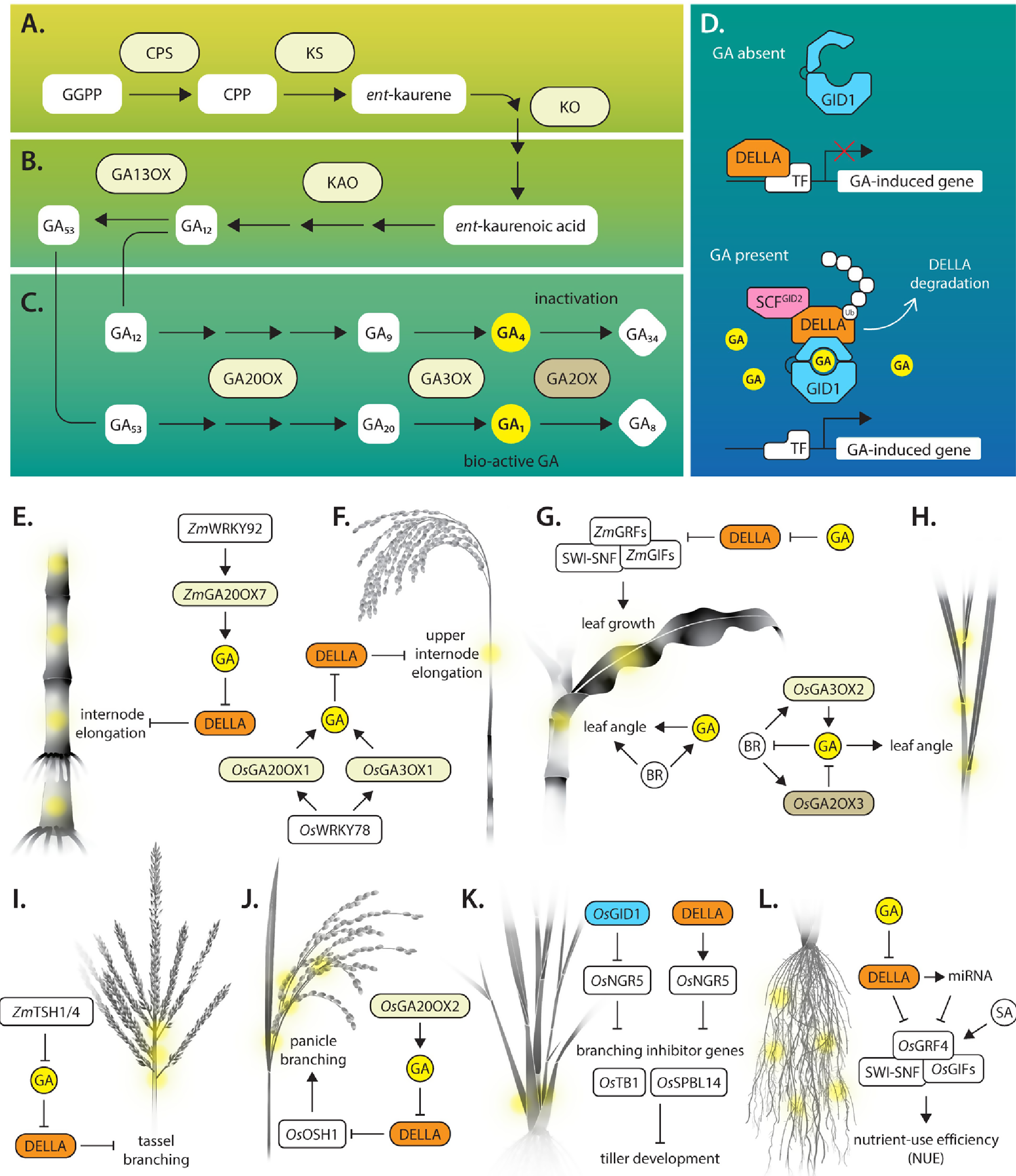
Strategies for the New Ideotype:
- Tissue-Specific Silencing: Instead of shrinking the whole plant, researchers use stem-specific promoters to repress GA only in the internodes. This has already been proven in "short corn" prototypes that maintain healthy reproductive organs while standing firm against storms.
- The GRF4 Breakthrough: One of the most significant recent findings is the role of Growth-Regulating Factor 4 (GRF4). GRF4 promotes nitrogen uptake. Normally, DELLA proteins neutralize GRF4. By selecting for variants where GRF4 can "out-compete" DELLA, scientists have created plants that are both short and nitrogen-efficient.
- Anisotropic Growth Control: GA dictates leaf shape by controlling "anisotropy"—the direction in which cells expand. High GA leads to long, narrow, upright leaves, which is the "Goldilocks" architecture for high-density planting.
Experimental Evidence: Success in the Field
Research in maize has shown that knocking out specific enzymes like ZmGA20OX3 and ZmGA20OX5 achieves a semi-dwarf phenotype with thicker stems and no yield loss. In rice, stacking alleles like OsGRF4 with OsNGR5 (a nitrogen-responsive chromatin modulator) has pushed yield boundaries in low-fertilizer conditions.
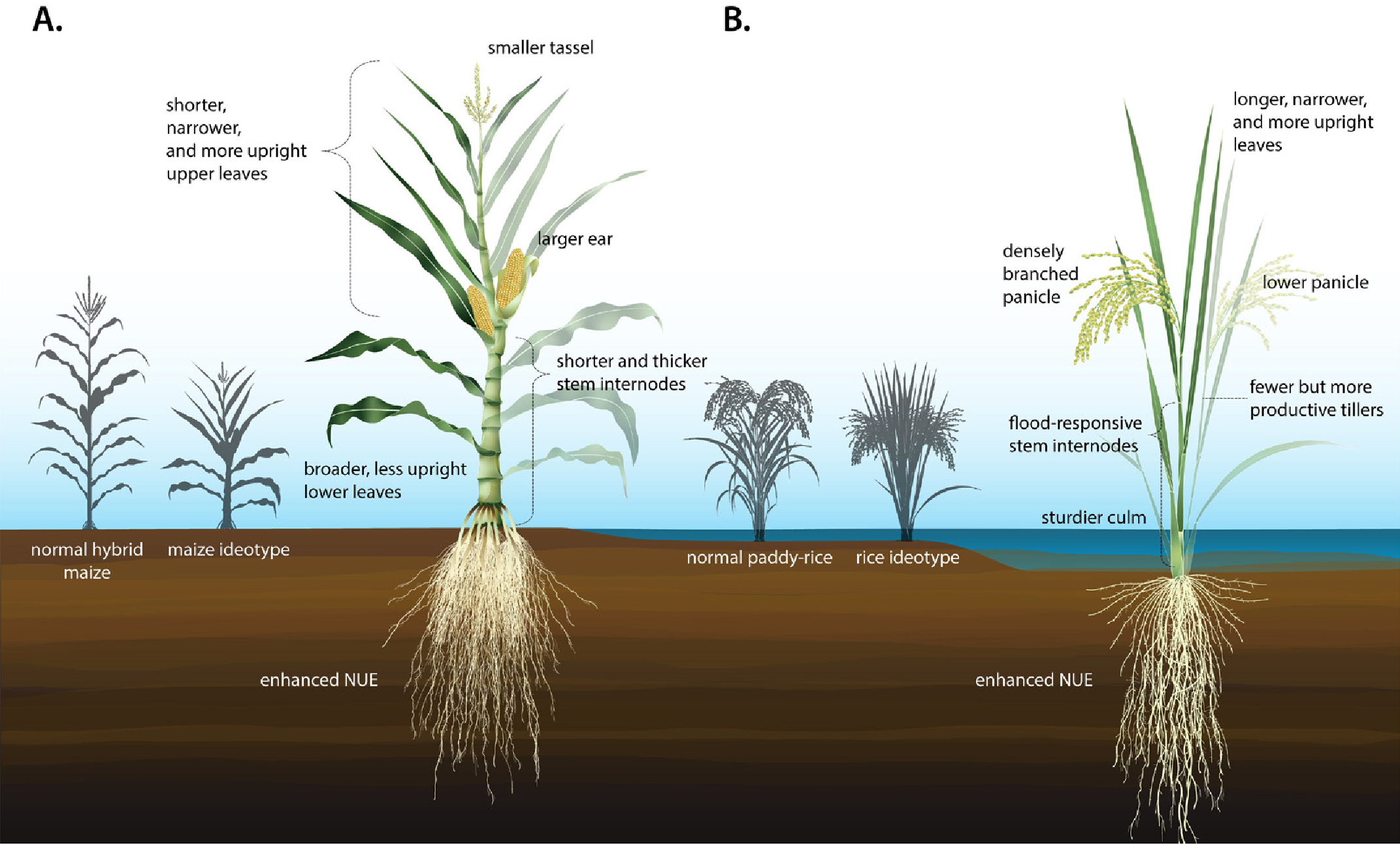 Figure: Proposed ideotypes compared to traditional breeding lines. Note the optimized root systems for nutrient foraging and the upright canopy for maximal photosynthesis.
Critical Insight: The Blueprint for 2026 and Beyond
The authors conclude that we are moving toward a "Green Balance." This isn't just about making plants shorter; it's about:
- Root Architecure: Engineering "nutritropism" where roots actively seek out phosphorus and nitrogen.
- Uncoupling Traits: Separating the height-control mechanism from the flowering-time mechanism (which, surprisingly, are not linked in maize).
- Climate Adaptation: Using GA pathways to help deep-water rice elongate rapidly during floods while keeping paddy rice sturdy.
Conclusion: As we face a changing climate and the need for sustainable farming, the GA pathway remains our most powerful lever. The "Second Green Revolution" won't be defined by more fertilizer, but by more intelligent plants.