
Deciphering the Data Science Job Market: An NLP-Driven Guide to Skills and Curriculum Alignment
Glassdoor Job Description Analytics – Analyzing Data Science Professional Roles and Skills
This research presents an NLP-driven analysis of Glassdoor job listings to identify core technical and soft skills for Data Science professionals across three major global hubs: Singapore, Hong Kong, and London. The study develops a domain-specific lexicon to categorize requirements for Data Analysts, Data Engineers, and Data Scientists, ultimately proposing a curriculum recommendation framework for educational institutions.
TL;DR
Bridging the gap between the classroom and the high-stakes world of Data Science requires more than just teaching "math." This study utilizes Natural Language Processing (NLP) to mine thousands of Glassdoor JDs, uncovering the precise technical stacks and soft skills required by Data Scientists, Analysts, and Engineers in London, Singapore, and Hong Kong.
The Misalignment Crisis in Data Science
As industries undergo digital transformation, the demand for data talent has outpaced the supply of STEM graduates. The core problem is relevance. University programs often teach foundational theory but lag behind the "tool-fatigue" of the industry. Professionals are left wondering: Should I learn Spark or SAS? Do I need Deep Learning for a Data Engineering role?
The authors argue that static surveys are no longer enough to answer these questions; we need to analyze the "source of truth"—the job descriptions (JDs) themselves.
Methodology: Beyond Simple Word Clouds
The researchers didn't just count words; they built a structured pipeline to extract meaning:
- Role Segregation: Categorizing JDs into Data Analyst (DA), Data Engineer (DE), and Data Scientist (DS).
- Lexicon Creation: Industry experts curated a 300-term lexicon covering five domains: Machine Learning, Big Data, Data Management, Visualization, and Coding.
- TF-IDF N-gram Modeling: This statistical approach helped identify words that are not just frequent, but distinctive to specific roles or regions.
 Fig 1: The NLP pipeline utilized to transform raw Glassdoor text into actionable insights.
Key Insights: One Title, Different Realities
1. The Role Divide
While "Machine Learning" is a buzzword found everywhere, the underlying requirements differ:
- Data Scientist: Heavy emphasis on Deep Learning, Keras, and TensorFlow.
- Data Engineer: Focused on infrastructure—AWS, Data Pipelines, and distributed systems (Hadoop/Spark).
- Data Analyst: Centered on business intelligence—Power BI, SAS, and cross-functional team communication.
2. The Geographic Signature
The study reveals a fascinating cultural divergence in job requirements across cities:
- Singapore & Hong Kong: Highly technical JDs focusing on "Hard Skills" like Data Analytics and Big Data.
- London: A visible shift toward the "Working Environment." Terms like "Equally opportunity employer," "Team-oriented," and "Communication" rank significantly higher, suggesting a more mature or culture-centric hiring market.
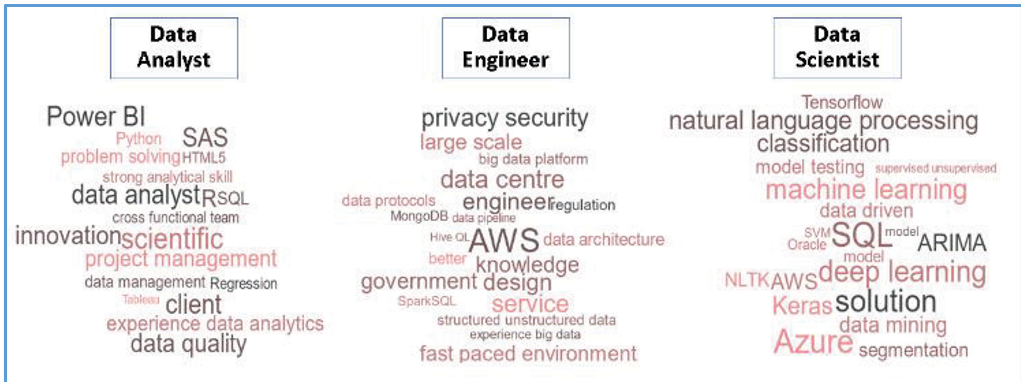 Fig 2: TF-IDF analysis showing the unique "tech-fingerprints" of different job roles.
Industry-Ready Recommendations
Based on the data, the authors propose a Competency Model. It isn't enough to just write code; a professional must be able to "frame the business problem as an analytics challenge."
The paper concludes with a roadmap for course designers, mapping specific tools to curriculum topics. For example, a Big Data course must integrate Scala and Kafka, while a Visualization course should prioritize Tableau and D3.js to remain competitive.
Final Takeaway: A Dynamic Curriculum
This work highlights that Data Science is not a monolith. The skills required in the financial hub of Hong Kong may differ from the tech-startup scene in London. For educational institutions and job seekers alike, the message is clear: Specialization and tool-proficiency are the new baselines for success.
Limitations & Future Work
The study is limited by its reliance on a single data source (Glassdoor) and a specific timeframe. Future iterations could benefit from analyzing a wider array of roles—such as "Machine Learning Researcher" or "Data Storyteller"—and utilizing unsupervised clustering to discover emerging skill clusters that experts might miss.