GLM-5V-Turbo: Bridging the Gap Between Perception and Multimodal Agency
GLM-5V-Turbo: Toward a Native Foundation Model for Multimodal Agents GLM-5V-Turbo Team
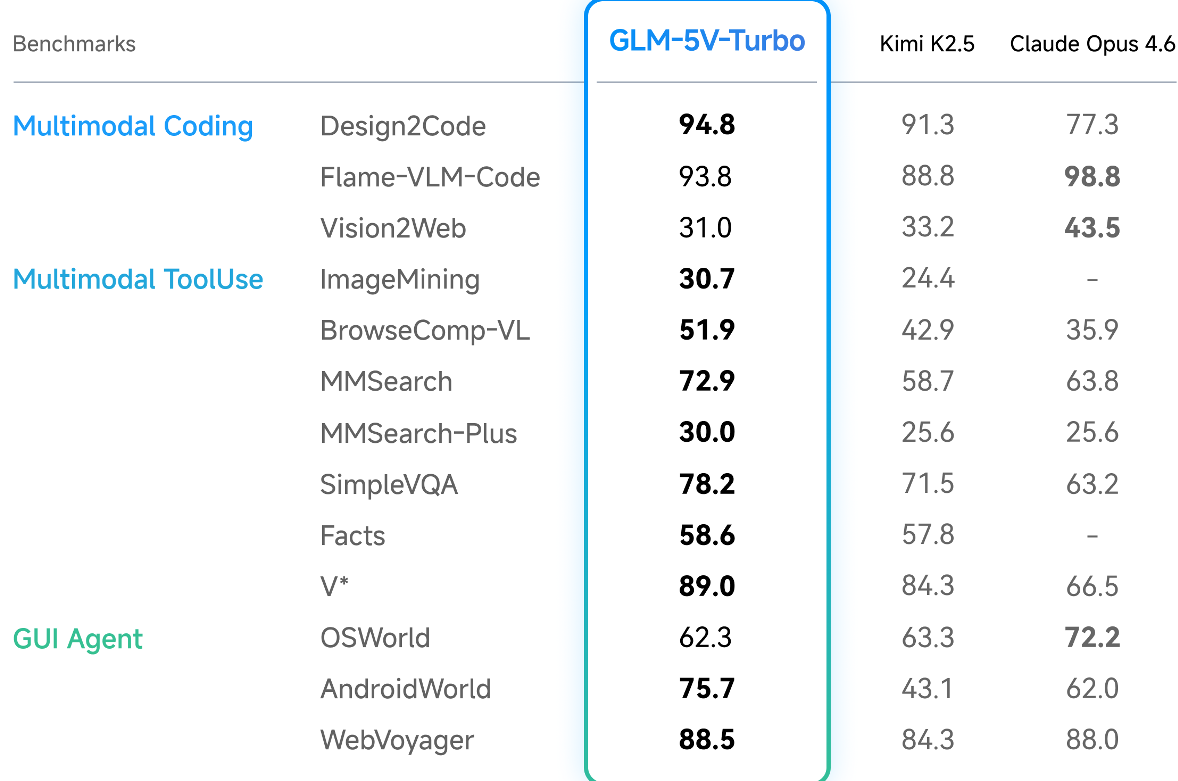
GLM-5V-Turbo is a native multimodal foundation model designed for agentic tasks, integrating CogViT for fine-grained perception and Multimodal Multi-Token Prediction (MMTP) for efficient reasoning. It achieves SOTA performance across multimodal coding (94.8 on Design2Code) and GUI automation (75.7 on AndroidWorld) while preserving top-tier text-only coding capabilities.
TL;DR
GLM-5V-Turbo represents a shift from "LLMs with vision" to Native Multimodal Agents. By integrating a custom vision encoder (CogViT), a novel multi-token prediction architecture (MMTP), and a massive-scale hierarchical RL framework, the model masters complex GUI navigation, multimodal coding, and deep research tasks without degrading its original text-coding prowess.
Problem & Motivation: The Perception Bottleneck
In the quest for autonomous agents, researchers have realized a hard truth: high-level reasoning failures often start with low-level perception errors. If a model can't precisely locate a button on a GUI or misinterprets a trend line in a chart, its subsequent "planning" is doomed.
Existing solutions often struggle with:
- Inefficient Modality Integration: Passing raw visual embeddings into lightweight prediction heads often causes optimization instability.
- Training Stability at Scale: Multimodal RL is notoriously difficult due to varying sequence lengths and the complexity of verifying long-horizon actions.
GLM-5V-Turbo addresses these by treating multimodal perception as a first-class citizen in the reasoning loop.
Methodology: The Architecture for Agency
1. CogViT: The Specialized Vision Eye
Unlike off-the-shelf ViTs, CogViT is tailored for fine-grained understanding. It uses a two-stage recipe:
- Stage 1: Distillation-based masked modeling using SigLIP2 (semantics) and DINOv3 (texture) as teachers.
- Stage 2: Contrastive alignment using an 8-billion bilingual image-text corpus and the NaFlex scheme to handle variable aspect ratios natively.
2. MMTP: Efficient Multimodal Reasoning
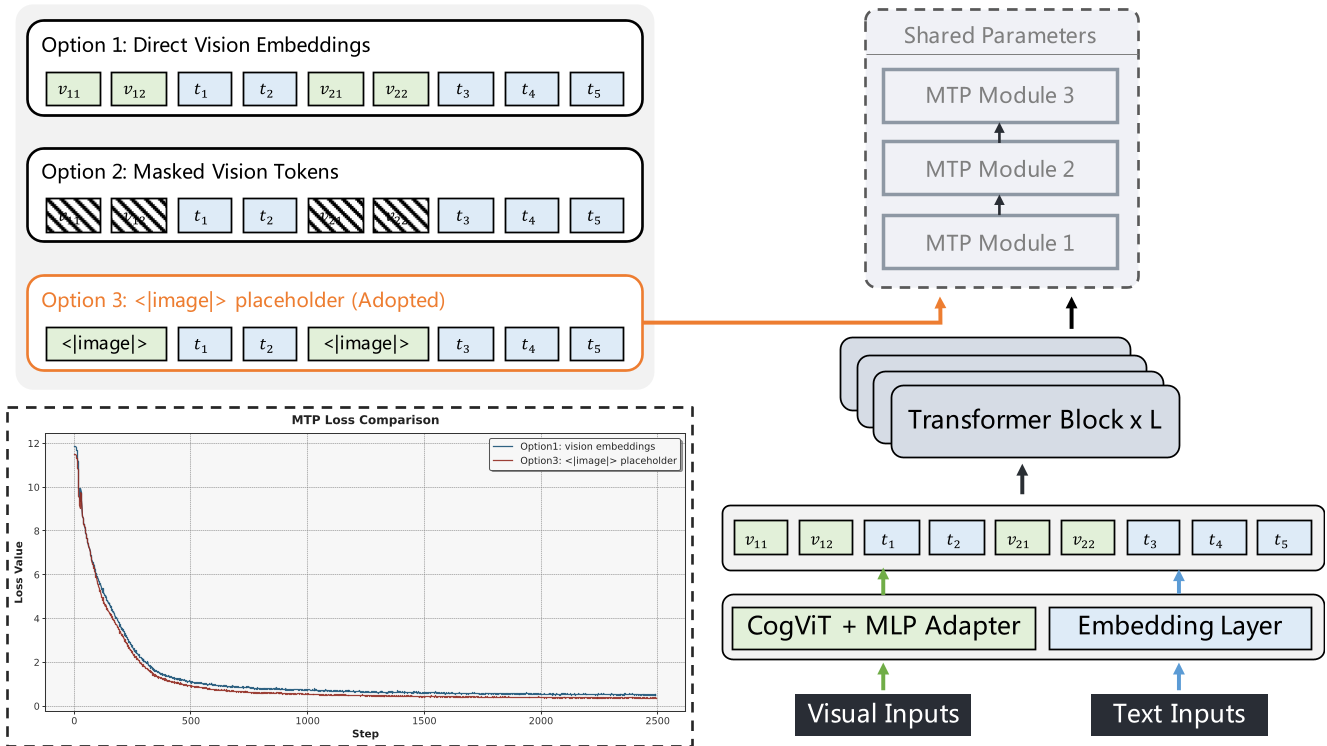
To handle multimodal inputs within a Multi-Token Prediction (MTP) framework, the authors proposed Multimodal Multi-Token Prediction (MMTP). They settled on a clever "Option 3" design:
- Instead of passing raw visual embeddings (which burdens communication) or masking them entirely, they use a shared learnable <|image|> special token.
- This preserves spatial/positional info while ensuring the MTP head isn't overwhelmed by visual features it hasn't the capacity to model.
3. Scaling Multimodal RL
The team rebuilt the training stack to handle 30+ task categories simultaneously. Key innovations include:
- Unified VLM RL Gym: A consistent interface for single and multi-step tasks.
- Topology-aware Partitioning: Aligning sequence parallelism with data loading to eliminate GPU memory bottlenecks when processing high-resolution images or long videos.
Experiments & SOTA Results
GLM-5V-Turbo doesn't just improve on vision; it dominates agentic benchmarks:
- Multimodal Coding: Achieved 94.8 on Design2Code, significantly outperforming Claude Opus 4.6 (77.3).
- GUI Automation: Reached 75.7 on AndroidWorld, creating a new baseline for open-ended environment interaction.
- Deep Research: On the new ImageMining benchmark (which forces models to "think with images"), it scored 30.7, proving it can use tools like cropping and localized search to solve complex queries.
Deep Insight: Three Lenses for Agent Development
The authors share three critical "lenses" from their development process:
- Perception is Foundation: SVG coding and grounding tasks are excellent "proxies" for teaching a model to really see.
- Hierarchical Optimization: It's more efficient to train a model on "lower-level" skills (like clicking a button) before forcing it to solve "long-horizon" goals (like booking a flight).
- The Harness Matters: An agent's capability is co-shaped by the model and its "harness" (toolchain, memory mechanism, verification loop).
Conclusion & Future Outlook
GLM-5V-Turbo successfully moves the needle toward native multimodal intelligence. However, challenges remain in agentic strategy emergence (moving beyond human-provided trajectories) and multimodal context management, as images/videos consume context windows far faster than text.
For developers and researchers, the message is clear: the future of AI isn't just a smarter chatbot—it's an actor that perceives and operates within our visual world.