
GLMLE: Breaking the Scalability Barrier of ERGMs with Graph Limits
GLMLE: graph-limit enabled fast computation for fitting exponential random graph models to large social networks
The paper introduces GLMLE, a computationally efficient framework for fitting Exponential Random Graph Models (ERGMs) to large social networks. By leveraging graph limit theory and two-dimensional simple function approximations, it avoids the traditional reliance on expensive MCMC sampling, achieving Scalable Maximum Likelihood Estimation for networks with tens of thousands of nodes.
TL;DR
Estimating Exponential Random Graph Models (ERGMs) has long been a "computational nightmare" for large-scale networks due to the intractable normalizing constant. This paper introduces GLMLE, a method that replaces stochastic MCMC sampling with deterministic optimization based on Graph Limit Theory. It enables the fitting of complex structural models to networks with nearly 100,000 nodes—a feat previously deemed impossible.
The "Degeneracy" Trap in Network Modeling
ERGMs are powerful because they model local dependencies (like "a friend of my friend is my friend") directly. However, the likelihood function includes a normalizing constant that requires summing over all possible graphs—an astronomical combinations.
Current SOTA methods like MCMCMLE use Markov chains to approximate this sum. But as grows, these chains often get stuck in "degenerate" states (producing only empty or complete graphs). When the network size hits the "Big Data" scale, MCMC either fails to converge or leads to massive bias.
Methodology: From Discrete Graphs to Continuous Graphons
The core insight of GLMLE is to stop treating the network as a discrete adjacency matrix and start treating it as a continuous function , known as a Graphon.
1. The Variational Approximation
Building on Chatterjee and Diaconis (2013), the authors approximate the normalizing constant using a Large Deviation Principle: Here, represents the graph statistics (edges, stars, triangles) in the continuous limit, and is an entropy-like rate function.
2. Simple Function Approximation
To make this supremum computable, the paper approximates the unknown graphon using a grid of blocks (simple functions). This reduces an infinite-dimensional problem to a finite optimization with parameters.
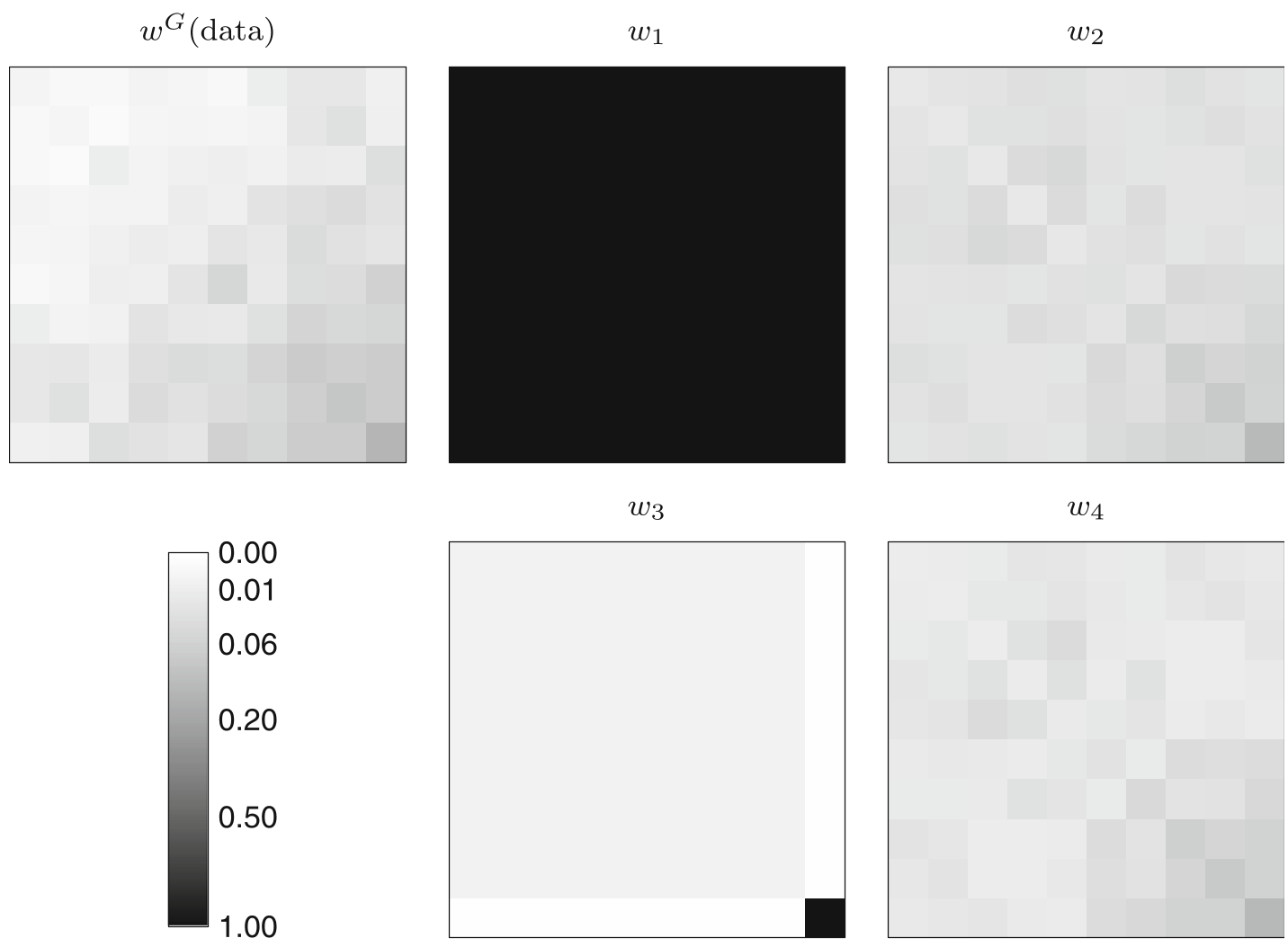 Visualizing the estimated graph limits (graphons) for different ERGM specifications.
Experiments: Superiority in Scaling
The authors compared GLMLE against the standard R package ergm.
- Accuracy: As shown in Table 2, for , MCMCMLE's variance exploded (particularly for the triangle parameter ), while GLMLE remained stable with low bias.
- Complexity: GLMLE's complexity is dominated by , where is the grid resolution (typically ), making it remarkably independent of the total node count once sufficient statistics are calculated.
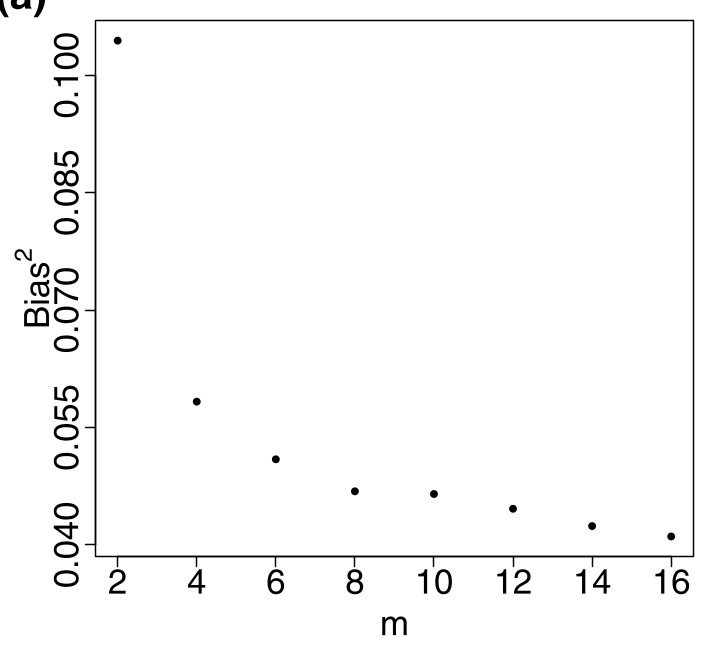 Comparison of Bias, MSE, and Running Time. As m increases, GLMLE converges to a highly stable estimate with polynomial time growth.
Real-World Case: The Slashdot Zoo
The authors applied GLMLE to the Slashdot friend/foe network ().
- MCMCMLE Result: Crashed/Failed to run.
- GLMLE Result: Estimated the parameters in 124 seconds. The results revealed a "transitivity shift" between two timestamps (Nov 2008 vs Feb 2009), providing empirical evidence of how social connectivity evolves in massive online communities.
Critical Insight: The Dense Graph Limitation
The primary academic caveat is that Graph Limit theory currently focuses on dense graphs (where the number of edges grows as ). While real social networks are often sparse, the authors argue that for a fixed large , a sparse graph can be viewed through the lens of a "low-density" graphon. This "engineering intuition" allows the method to work effectively on empirical datasets where theoretical assumptions might be slightly stretched.
Conclusion
GLMLE is a landmark contribution for computational social science. It provides a deterministic, scalable, and theoretically grounded alternative to MCMC. By moving the heavy lifting from sampling to nonlinear optimization, it finally brings ERGMs into the era of Big Data.