
Beyond Friendships: Mastering Recommendations via Global and Local Social Influence
Global and Local Influence-based Social Recommendation
The paper introduces GLSIR (Global and Local Influence-based Social Recommendation), a matrix factorization framework that leverages implicit social influence rather than just explicit social links. It achieves SOTA performance on travel recommendation datasets by integrating both global influential nodes (celebrities) and local influential nodes (community stars) as regularization terms.
TL;DR
GLSIR (Global and Local Influence-based Social Recommendation) shifts the focus of social recommenders from who you know (explicit links) to who influences you (implicit impact). By identifying "Web Celebrities" (Global) and "Community Stars" (Local), the model embeds these influence weights into Matrix Factorization, outperforming traditional friendship-based models by up to 15% in accuracy.
Background & Motivation: The Failure of Explicit Links
Most social recommenders assume that if User A is friends with User B, their tastes must align. However, this logic is flawed in modern contexts due to three major factors:
- Sparsity: People find friends on social apps, not rating platforms.
- Unavailability: Privacy settings often hide friendship graphs.
- Ambiguity: A "friendship" is a binary 0/1, failing to capture the strength of influence.
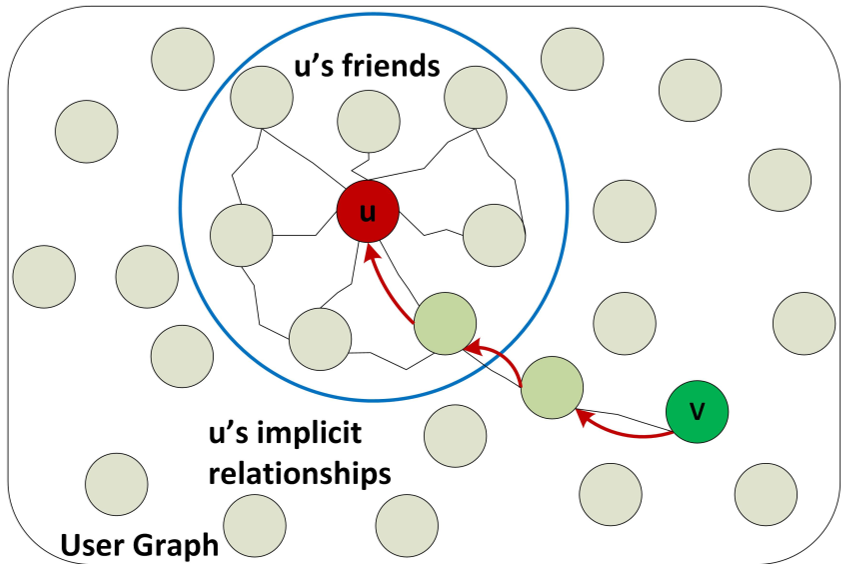
The authors argue that Social Influence—the implicit power one user has over another's decisions—is the real driver behind modern consumption.
Methodology: The Dual Influence Engine
The core of GLSIR lies in its duality. It recognizes that our behavior is shaped by two distinct types of entities:
1. Global Influence Model (GIM)
Think of these as "Web Celebrities" (e.g., Steve Jobs). They set general trends across the entire network. The GIM seeks a seed set that maximizes the expected influence spread across the whole graph.
2. Local Influence Model (LIM)
These are "Community Stars"—experts in specific domains (e.g., a local food critic). LIM identifies the specific nodes that have the highest reach probability for a specific target user .
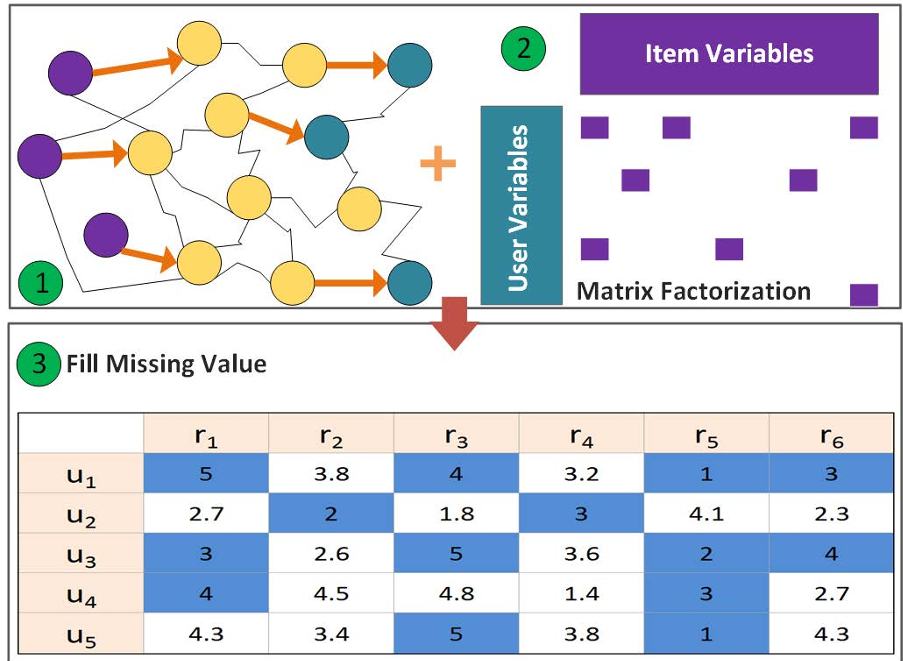
3. Integration via Matrix Factorization
The results from GIM and LIM are fused into a regularization term. The objective function doesn't just minimize the rating error; it also forces a user's latent feature vector to be closer to their influencers' vectors , weighted by the influence strength .
Experimental Battleground: Mafengwo Dataset
The model was tested on Mafengwo (MFW), a travel recommendation site where social connections are often between strangers who influence each other's travel choices.
SOTA Comparison
As shown in the results below, GLSIR significantly beats SRPCC (a leading friendship-based model) and standard NMF (Collaborative Filtering).
| Metric/Method | NMF | SRPCC | GLSIR |
|---|---|---|---|
| MAE (80% Training) | 0.5830 | 0.5619 | 0.5129 |
| MAE (40% Training) | 0.5936 | 0.5752 | 0.5297 |
The 5-15% gain in accuracy proves that modeling the process of influence is far more powerful than simply looking at the existence of a link.
Critical Insight: Why it Works
The beauty of GLSIR is its handling of Traceable Edges. While User A might not be a direct "friend" of User C, influence can flow from C B A. By using Monte Carlo simulations and the Independent Cascade Model, GLSIR extracts these multi-hop relationships that typical social regularization ignores.
Conclusion & Limitations
GLSIR successfully bridges the gap between Social Network Analysis (SNA) and Recommender Systems. Its primary limitation is the computational cost of Monte Carlo simulations on massive graphs, though this is mitigated by the offline nature of influencer discovery. Future work could look into dynamic influence—how a "Community Star" today might become a "Web Celebrity" tomorrow.