
Small Ripples, Big Waves: How a Tiny Clique of Migrants Can Catalyze Global Cooperation
Global Network Cooperation Catalysed by a Small Prosocial Migrant Clique
The paper investigates the emergence of cooperation in social networks using the Public Goods Game (PGG). It introduces a novel "Migrant Clique" mechanism where a tiny group of connected cooperators (1-3 individuals) joins a defector-dominated network, catalyzing a global transition to cooperation.
TL;DR
In the study of evolutionary game theory, we often wonder how cooperation survives in a world that rewards selfishness. This paper demonstrates a fascinating phenomenon: a tiny group of just 2 or 3 cooperating migrants can invade a massive network of "defectors" and flip the entire population's behavior. By introducing "noise" and "back-up" support, these migrants break the deterministic cycle of selfishness.
Context: The Social Dilemma
The Public Goods Game (PGG) is a classic model for the "Tragedy of the Commons." If everyone contributes to a public pot, everyone wins. However, if you are the only one who doesn't contribute while others do, you get the highest personal payoff. Evolutionarily, this usually means cooperators get wiped out.
Most research assumes a single, static network. This paper argues that reality is messier: populations are fragmented, they grow, they shrink, and—critically—they migrate.
The "Back-up" Mechanism: Why Migration Works
The authors propose that the secret to the migrants' success isn't just their strategy, but their structure. A lone cooperator entering a den of thieves (defectors) is quickly converted. However, a clique (a fully connected small group) provides mutual support.
- The Logic: Members of the clique play PGGs with each other. This "internal" cooperation provides a fitness buffer.
- The Catalyst: When one member of this clique connects to the external defector network, their high "internal" fitness makes them an attractive model for neighbors to imitate during strategy updating.
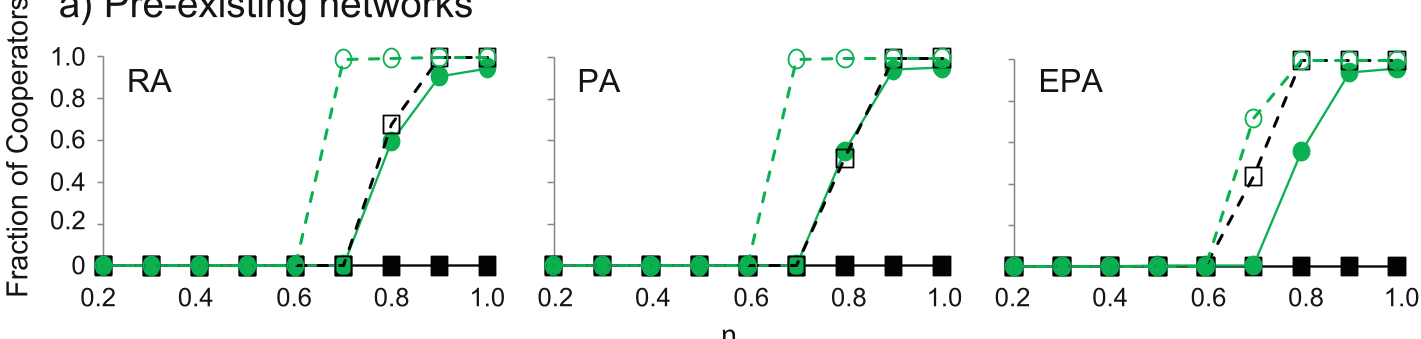 Figure 1: Comparison of different network growth mechanisms (RA, PA, EPA) and the impact of the migrant clique (Green lines) vs. control (Black lines).
Methodology: Disrupting the Status Quo
The researchers tested this across several network types:
- Static Networks: Fixed size and topology.
- Fluctuating Networks: Undergo "Environmental" pruning where the least fit nodes are periodically removed.
- Migrant Injection: At generation 300, a 3-node cooperator clique is introduced.
The mathematical core relies on the reward multiplier (). If the reward is too low, everyone defects. If it's too high, cooperation is easy. The study focuses on the mid-range (), where the dilemma is toughest and the impact of migration is most "catalytic."
Experimental Insights: Consistency is Key
The most striking finding is the synergy between Fluctuation and Migration.
- Fluctuation alone: Usually leads to cooperation but is highly unpredictable in terms of when it happens.
- Migration alone: Can trigger cooperation but the level of final cooperation varies (some replicates stagnate).
- The Combo: Results in a rapid, uniform transition across all test cases.
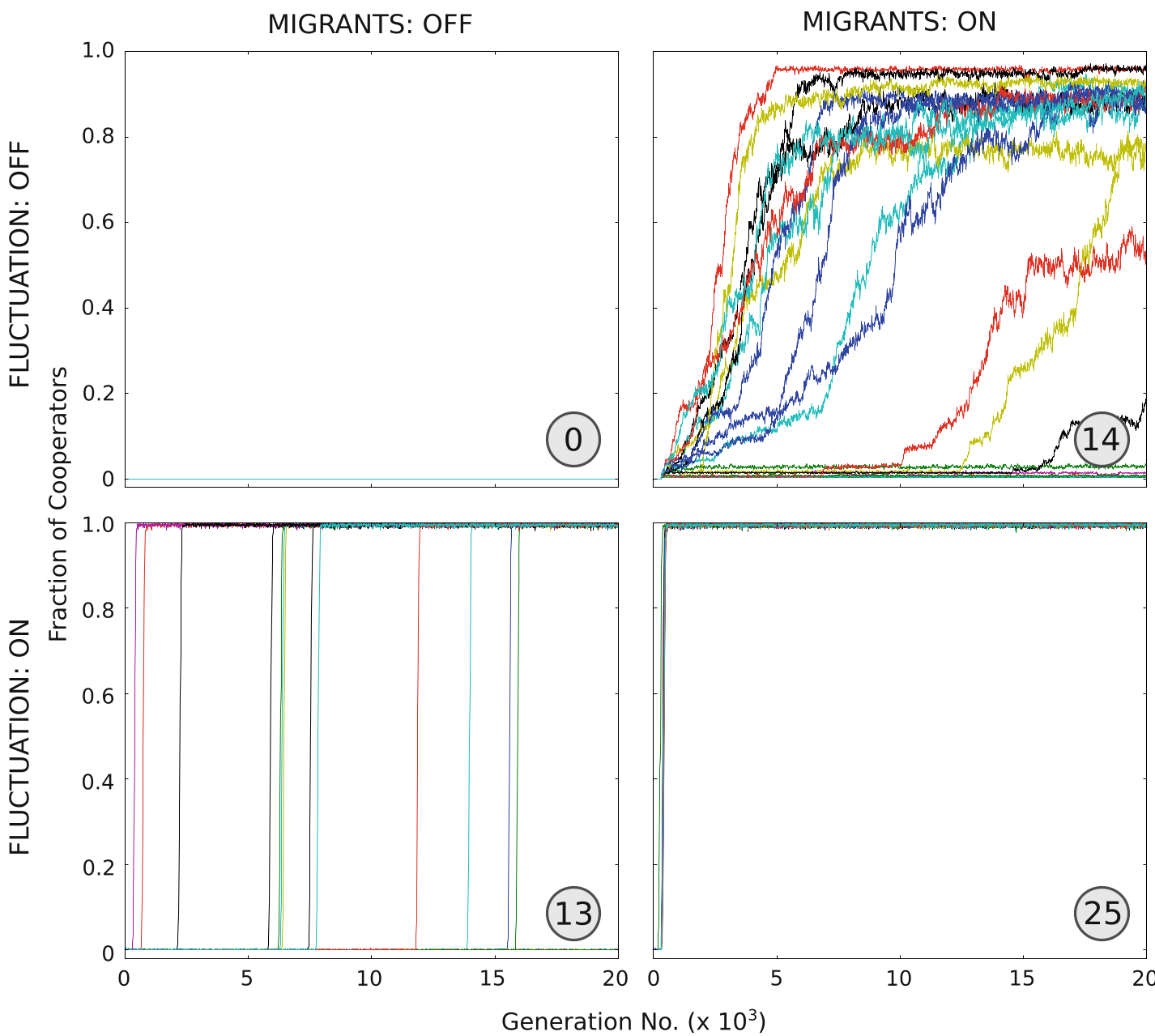 Figure 2: Time plots showing that Migration + Fluctuation (bottom right) produces the most consistent and rapid shift to cooperation compared to either method alone.
Critical Analysis & Takeaways
The paper makes a powerful argument against over-determinism in social modeling.
The "Back-up" Intuition
The effectiveness of the clique hinges on the fact that the "back-up" migrants are initially immune to the host network's influence. They are not yet connected to defectors, so their payoffs remain high, effectively "financing" the invasion of the cooperator strategy.
Limitations
The study assumes migrants come from an "already cooperative" network. It doesn't fully explain how that original network became cooperative in the first place, though it hints that the same fluctuation/noise mechanisms might be responsible.
Future Outlook
This work has profound implications for:
- Social Policy: How small, highly-connected groups can influence large-scale behavioral change.
- AI Safety: Designing multi-agent systems where cooperative stability is maintained through periodic "perturbations" or the introduction of curated subgroups.
Final Thought: If you want to change a selfish system, don't send a lone hero; send a small, tight-knit team.