
Beyond Local Density: Global Reinforcement of Social Networks via Anchored Coreness
Global Reinforcement of Social Networks: The Anchored Coreness Problem
This paper introduces the Anchored Coreness (AC) problem, a global approach to reinforcing social network stability by anchoring a subset of vertices to maximize the total coreness gain across all users. Unlike previous local-view methods, the proposed GAC algorithm utilizes a core component tree and novel result-reusing mechanisms to achieve state-of-the-art efficiency in maximizing network-wide user engagement.
TL;DR
Social network stability isn't just about protecting a specific "inner circle"—it's about the engagement of every user across the board. This paper moves from the Anchored k-Core (local) to the Anchored Coreness (global) problem. By anchoring a few key users, the authors maximize the total "coreness gain" of the entire network. They introduce GAC, an algorithm that uses a Core Component Tree to make this computationally feasible for massive graphs like LiveJournal.
Background: Why k-Core Matters
In social network theory, a k-core is the maximal subgraph where every vertex has at least neighbors. A user's coreness is the highest for which they belong to a k-core. Research (including studies on the collapse of Friendster) has shown that coreness is the "best practice" metric for user engagement. When a high-coreness user leaves, it triggers a "contagious departure," potentially collapsing the network.
The Problem: Local vs. Global View
Previous state-of-the-art methods focused on the Anchored k-Core (AK) problem: choosing anchors to make the -core as large as possible for one specific .
The Flaws of the Local View:
- Arbitrary Thresholds: Choosing a "good" is nearly impossible without perfect data.
- Limited Impact: AK usually only helps users at the level.
- Global Blindness: Collapses can start anywhere, not just in one specific core.
The authors propose Anchored Coreness (AC): Basically, they want to lift the "engagement floor" for everyone.
Methodology: The Core Component Tree & GAC
Calculating the coreness gain for every possible anchor set is NP-hard. Even a greedy approach (picking the best anchor one by one) is too slow (). The authors solve this with three main insights:
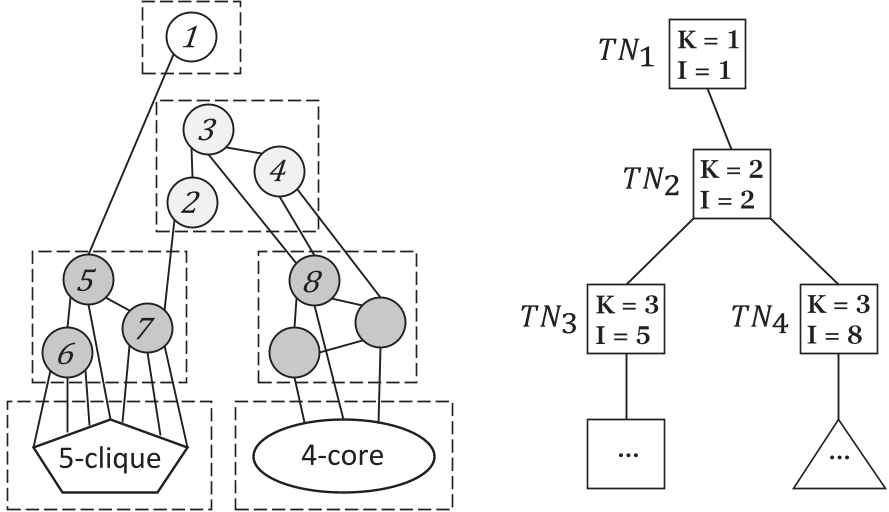
1. The Core Component Tree (T)
The algorithm maps the graph into a hierarchical tree where each node represents a connected k-core component. This allows the algorithm to reuse results. If anchoring user doesn't affect the structure of tree node , the followers in that node don't need to be re-calculated in the next iteration.
2. Upstair Paths & Candidate Followers
Not everyone can be a "follower" (someone whose coreness increases). The authors prove that coreness can only increase by at most 1 per anchor and only if there's an Upstair Path—a path where shell-layer indices strictly increase. This prunes the search space dramatically.
3. Upper Bound Pruning
Before running the heavy math, GAC calculates an upper bound of potential followers for each vertex. It then processes candidates in decreasing order of this bound, skipping any vertex that couldn't possibly beat the current best candidate.
Experimental Results
The authors tested GAC against standard heuristics (Degree-based, Random, Successive Degree) and the previous OLAK algorithm.
- Effectiveness: GAC consistently outperformed OLAK, capturing up to 2x more coreness gain because it wasn't restricted to a single value.
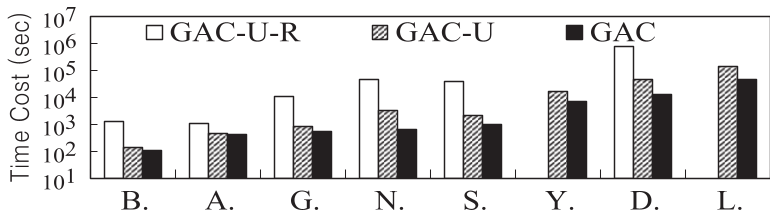
- Efficiency: On the LiveJournal dataset (3.9M nodes, 34M edges), the baseline was too slow to finish. GAC, with its result-reusing and pruning, finished significantly faster, proving its scalability.
Deep Insight & Conclusion
This work shifts the paradigm of network maintenance from "protecting the core" to "reinforcing the hierarchy." By using the Core Component Tree, the authors demonstrate that complex graph problems can be decomposed into independent units for optimization.
Takeaway: If you are a platform owner, don't just subsidize your top "power users" (the inner k-cores). Instead, look for "anchors" who have the potential to pull their surrounding clusters upward through the coreness levels. This global reinforcement creates a more resilient and engaged community.
Limitations
While highly efficient, the algorithm is currently designed for undirected and unweighted graphs. Real-world social networks often have directed "influencer-follower" relationships and varying tie strengths, which would require an extension of the k-core theory to k-truss or D-core components.