
Beyond Single Ties: Decoding Social Influence through Layered Spectral Embeddings
Global Similarity in Social Networks with Typed Edges
The paper introduces a novel spectral embedding method for social networks with typed edges (multi-layer graphs), where qualitative differences in relationships—such as business vs. friendship—are preserved. By constructing a layered cn x cn adjacency matrix and utilizing directed-graph spectral techniques, the authors create a unified geometric representation that facilitates edge and edge-type prediction.
TL;DR
Most social network models treat all connections as identical "pipes," ignoring that a "friend" edge functions differently than a "colleague" edge. This paper proposes a layered spectral embedding framework that allows qualitatively different relationships to interact. By representing each relationship type as a layer in a larger directed graph, the authors provide a mathematically grounded way to perform edge prediction across different contexts, famously debunking certain power-broker theories of the 15th-century Medici family.
Problem & Motivation: The Identity Crisis in Social Networks
In standard Social Network Analysis (SNA), we are often forced to choose between two subpar options:
- Flattening: Merging business and personal ties into a single weight, losing the nuance of why people are connected.
- Isolation: Analyzing the "Professional Network" and "Social Network" separately, which misses the cross-pollination of influence (e.g., a business tip shared at a birthday party).
The authors argue that moving between these roles—what they call "changing gears"—incurs a cost. The challenge is to find a geometric embedding where the distance between nodes reflects this complex, multi-modal reality.
Methodology: The Layered Architecture
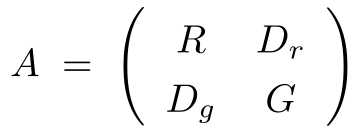
The core innovation lies in the construction of a adjacency matrix suffixing the node set for edge types.
1. The Multi-Layer Construct
Imagine two layers: Red (Marriage) and Green (Business). Each family exists in both layers. The authors connect the "Red-Medici" to the "Green-Medici" with a vertical edge. The weight of this edge isn't arbitrary—it is proportional to the node's degree in that specific layer. This mimics a Lazy Random Walk: a walker spends half their time exploring the current relationship type and the other half transitioning to a different "role."
2. Symmetrizing the Directed Flow
Because the "Social" importance of a family might outweigh its "Business" importance, the transitions between layers are asymmetric. The authors employ directed-graph spectral techniques:
- They calculate the Stationary Distribution ()—the global importance of each node/role.
- They use this to symmetrize the matrix , ensuring that the embedding accounts for how easily a walker can reach a node, not just how many local edges it has.
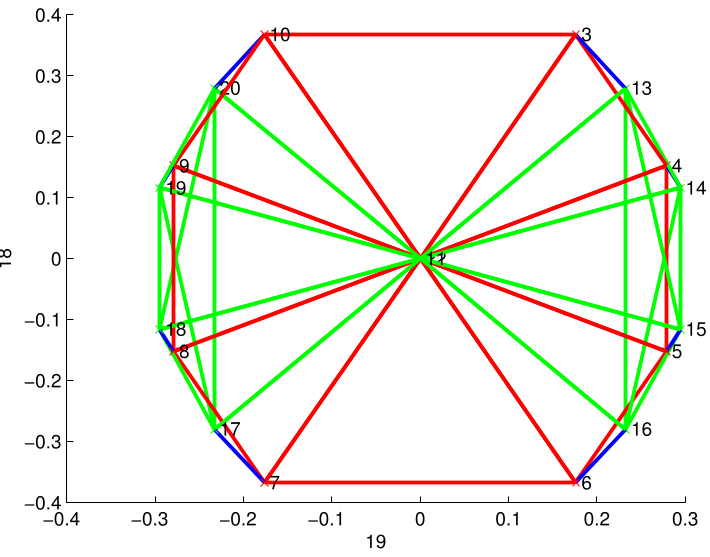 Fig 1: A visualization showing how a red-edge circle and green-edge cliques distort each other in a shared embedding space.
Experiments: The Florentine "Power Broker" Myth
The researchers applied this to the famous Padgett dataset of 15th-century Florentine families. Historical theory often posits that the Medici rose to power by being the "bridge" between the elite oligarchs (marriage) and the nouveau riche (business).
The Findings:
The combined embedding (Figure 4) tells a different story. Instead of being "central" gatekeepers, the Medici were at one extreme end of the social spectrum. Their power likely came from intense consolidation within a specific block rather than acting as a neutral intermediary between two distinct clusters.
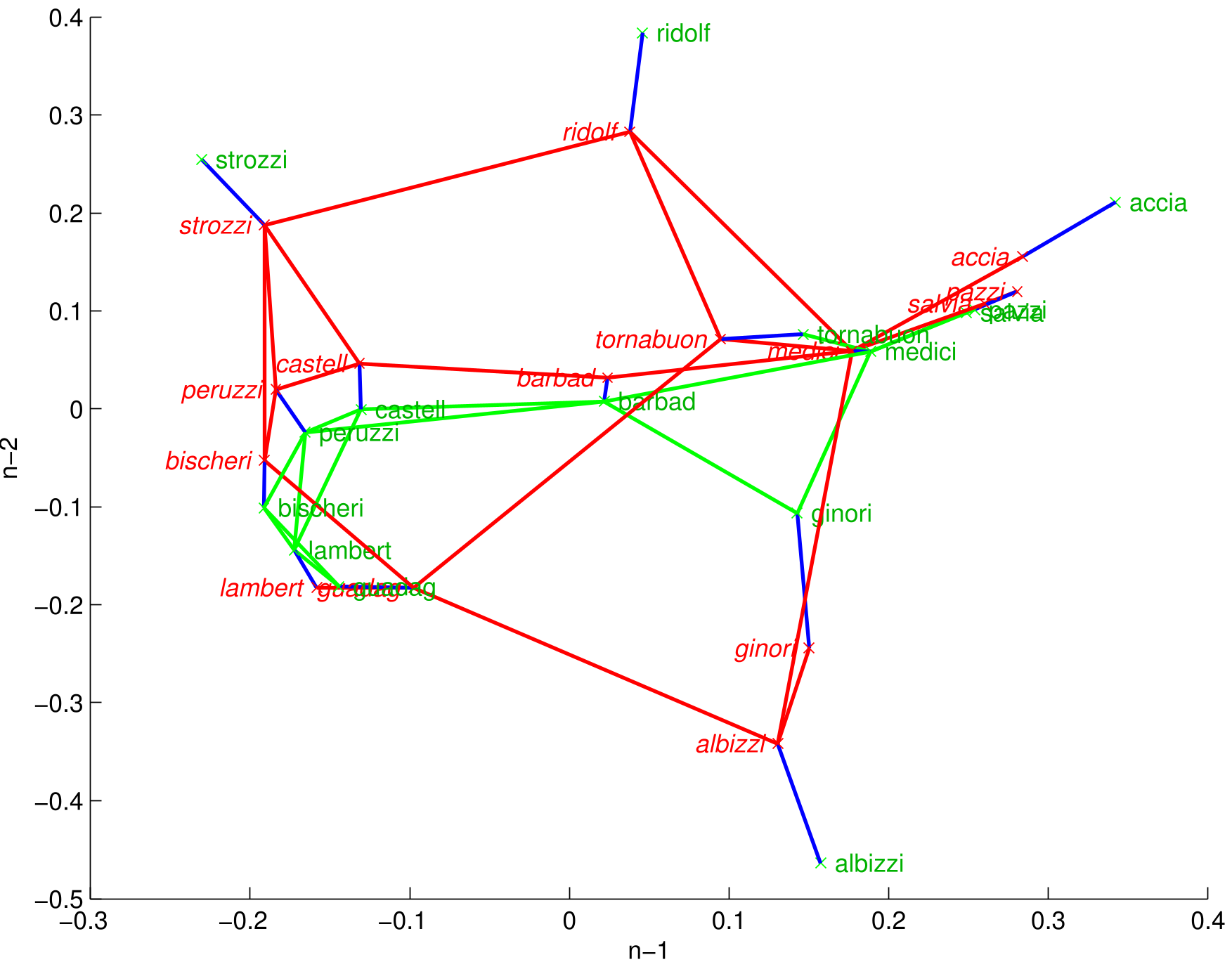 Fig 4: The final embedding. Blue lines indicate the "role difference" for each family. Longer lines mean the family acts very differently in business vs. social settings.
Zero-Shot Edge Prediction
Can we predict the future? The model can calculate which unconnected families are "geometrically close." It predicted that the Strozzi and Medici were likely candidates for a marriage tie despite having no current link. History bears this out—the families eventually formed a marriage alliance years later to settle their rivalry.
Critical Analysis & Conclusion
This paper offers a robust, scalable solution (linear growth in complexity) to the multi-view graph problem. By grounding the "inter-layer" connections in random walk theory rather than manual parameter tuning, it removes much of the bias found in earlier spectral methods.
Limitations: The model currently assumes a fixed cost for "changing roles." In reality, transitioning from a "friend" to a "business partner" might be easier for some nodes than others based on psychological or cultural factors not captured in the graph topology.
The Takeaway: For modern tech stacks (like recommendation engines on multi-service platforms like Meta or Google), this paper proves that embedding multiple relationship "subgraphs" into a single manifold using directed importance is the key to accurate link prediction.