
Quenching the Chattering: Quasi-Optimal Control for Planar Saturated Systems
A family of global stabilizers for Quasi-optimal control of planar linear saturated systems
The paper introduces a family of nonlinear state feedback global stabilizers for planar linear systems subject to input saturation. By utilizing a Lipschitz continuous control law that smoothly blends time-optimal "bang-bang" behavior with local linear feedback, the researchers achieve quasi-optimal performance while maintaining global asymptotic stability and local exponential stability.
Executive Summary
TL;DR: In the world of control theory, the "Bang-Bang" principle is the gold standard for speed (time-optimality), but its discontinuous nature is a nightmare for real-world hardware. This paper presents a family of nonlinear Lipschitz state feedback laws that deliver the performance of time-optimal control without the structural fragility of discontinuous switching. By blending optimal switching surfaces with local linear stability, it achieves Global Asymptotic Stability (GAS) and Local Exponential Stability (LES) for planar systems.
Context: This work occupies the sweet spot between high-speed optimal control and robust linear control, specifically targeting ANCBI (Asymptotically Null-Controllable with Bounded Inputs) planar systems.
The Problem: Speed vs. Robustness
When a system has input limits (saturation), the fastest way to stabilize it is usually to slam the actuator to its limits—Time-Optimal Control. However, this typically results in a discontinuous switching law .
The Catch:
- Noise Sensitivity: Small measurements errors near the switching surface cause high-frequency oscillation (chattering).
- Local Behavior: Bang-bang control provides no "tail" performance; it doesn't gracefully settle into the origin.
- Robustness: Discontinuous laws lack the smooth Lyapunov converse properties required for traditional robustness guarantees.
Methodology: The "Blending" Insight
The core innovation lies in the definition of the feedback function . Instead of a hard signum function, the authors use a Lipschitz blending strategy.
1. Global Strategy (Large Scale)
For large states, the controller follows the optimal switching curve (e.g., the parabolic curve of a double integrator).
2. Local Strategy (Small Scale)
Near the origin, the controller transitions to a linear law designed for critical damping. This ensures that once the state is close to the target, it converges exponentially and smoothly.
3. Mathematical Formula & Architecture
The general form for a double integrator is:

Note: The operator acts as the bridge. When is large, the quadratic term dominates (optimality); when is small, the linear term dominates (stability).
Experiments: Performance Comparison
The authors validated their approach on two classic benchmarks: the Double Integrator and the Harmonic Oscillator.
Key Findings:
- Time Recovery: As the gain increases, the state trajectories become indistinguishable from the theoretical minimum-time "bang-bang" path.
- Fuel Efficiency: By adjusting the switching logic, the same framework produces "Quasi Fuel-Optimal" responses, creating a "dead-zone" (bang-off-bang) where the actuator rests to save energy.
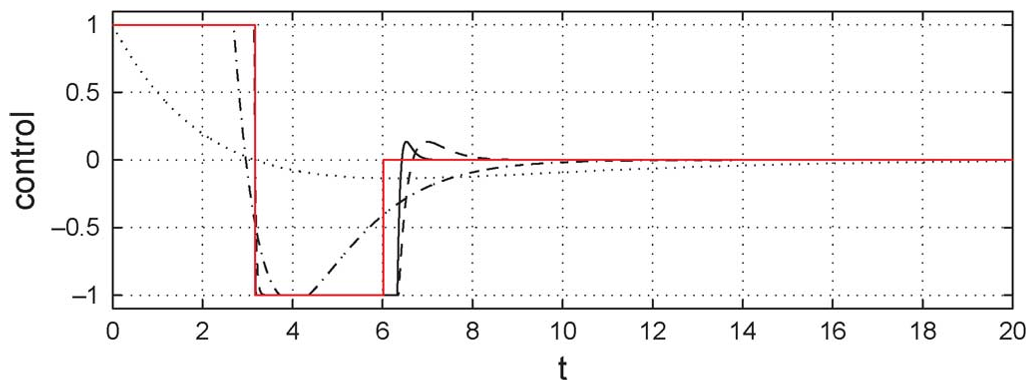 Fig: State trajectories for the quasi-time-optimal strategy showing smooth but aggressive convergence.
Critical Analysis & Deep Insight
Why does this work? (Bendixson Criterion)
The paper doesn't just show simulations; it proves stability for a wide variety of nonlinear functions . The beauty of the proof lies in the Bendixson Criterion. For planar systems, to prove convergence to the origin, one must prove that no periodic orbits (limit cycles) exist. By enforcing a gradient condition on , the authors ensure the "divergence" of the system flow is strictly negative, mathematically forbidding any trajectory from looping forever.
Limitations
- Dimensionality: The proof relies heavily on planar (2D) geometry. Extending this to 3D or higher remains a significant theoretical hurdle because the Bendixson criterion does not generalize.
- Model Dependence: While robust to parameter shifts, the design still requires knowledge of the optimal switching surface shape.
Future Outlook
This approach is highly relevant for Low-SWaP (Size, Weight, and Power) embedded systems. If you are controlling a micro-drone or a satellite reaction wheel, you need every bit of speed (optimality) but can't afford the computational overhead of MPC or the mechanical wear of chattering. This "Quasi-Optimal" approach is the "Happy Medium."
Conclusion: Forni, Galeani, and Zaccarian have provided a bridge between the "ideal but impractical" bang-bang control and the "safe but slow" linear control. It is a elegant lesson in using nonlinear geometry to solve practical saturated-input problems.