
Beyond Boundaries: Detecting "Globalness" in the Social Graph
Globalness Detection in Online Social Network
The paper introduces a novel "Globalness Detection" framework to identify nodes in Online Social Networks (OSNs) that transcend specific geographic or categorical boundaries. By leveraging a four-stage operational flow and anchor-node-based distance metrics, the authors achieve 89% precision and 88% recall in classifying Facebook public pages as either "local" or "global."
TL;DR
While AI excels at distinguishing a cat from a dog, it struggles with the "fuzzy" middle ground—the items that belong everywhere and nowhere at once. This paper introduces a Globalness Detection Framework that identifies Facebook pages which, despite being located in a specific spot (like NYC), behave like global entities. Using a unique "anchor node" strategy and Random Forests, the authors achieved an 89% precision rate in identifying these digital nomads of the social network.
The Motivation: When Categories Fail
In social informatics, classification is rarely binary. A restaurant in California isn't just a "business"; it's a hub of cultural and geographic intersections. Current SOTA models often ignore "vague items"—nodes that sit on the boundary of categories.
The authors argue that these Global Nodes (e.g., major commercial brands like Tabasco or immigrant community pages) provide more unique value than polarized local nodes. The challenge? How do you mathematically define "globalness" when it isn't a measurable physiological variable?
Methodology: The Four-Stage Operational Flow
The researchers treat globalness as a property of relationships rather than attributes. They don't just look at what a page says, but who it likes and who likes it back.
1. The Strategy
The core of the methodology rests on the State Distance Vector (SDV). By calculating the hop-distance from a page to "Anchor Nodes" (highly local pages like "Only In Delaware"), they can see if a page is tightly clustered within its state or if it has "shortcuts" to the rest of the world.
 Figure 1: The operational flow for detecting global nodes using distance-based classification.
2. Feature Engineering: SDV and SNP
- SDV (State Distance Vector): Captures inward and outward hop distances to representative seeds.
- SNP (State Neighborhood Probability): Acts as a noise filter, looking at the geographic distribution of a node’s immediate neighbors to see if it leans toward a specific region.
Experimental Results: The Melting Pot Effect
The framework was tested on a massive dataset of ~38 million Facebook pages. The results confirmed demographic intuitions:
- Illinois (IL): Found to be the hub of the Midwest, with 31.56% global nodes, significantly outperforming neighbors like Indiana and Iowa.
- The US "Melting Pots": New York (4.72%) and California (>2%) displayed the highest global page ratios, reflecting their status as international cultural and economic centers.
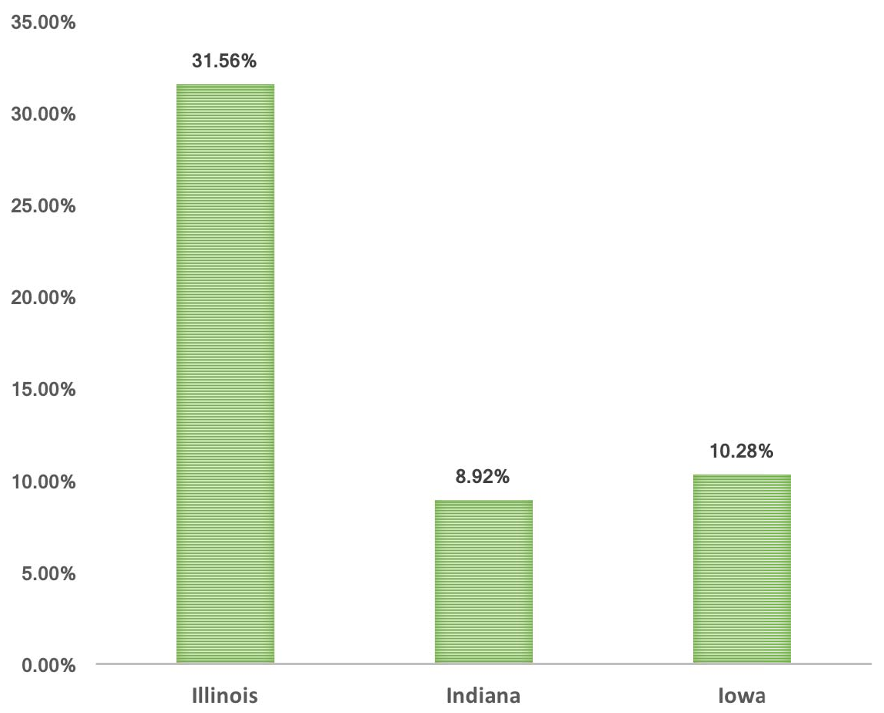 Figure 2: Heatmap showing the concentration of global nodes across the United States.
The Random Forest model emerged as the winner for classification, proving that the combination of hop-distance and neighborhood probability creates a robust signature for global behavior.
Critical Insights & Future Outlook
This research shifts the focus from what a node is to how a node connects.
Value for Marketing: Marketers can use this to distinguish between "Local Loyalists" and "Global Influencers," ensuring that cultural nuances are respected in ad targeting. Limitations: The method relies on the quality of "Anchor Nodes." While the authors showed stability using both "OnlyInYourState" pages and University pages, the selection of these seeds remains a manual heuristic that could be automated in future iterations.
Ultimately, "Globalness Detection" provides a lens to see the "neutral" and "bridge" nodes that hold the social fabric together, moving AI closer to understanding the complexity of human society.