
Sequential Pricing in Social Networks: Balancing Viral Awareness with Revenue Extraction
Globecom 2013 -Symposium on Selected Areas in Communications Sequential Pricing For Social Networks With Multi-State Diffusion
This paper introduces a sequential pricing framework for revenue maximization (REVMAX) in online social networks, utilizing a novel Multi-State Diffusion Model (MSDM). The core contribution is the Dynamic Programming Based Heuristic (DPBH), which optimizes a sequence of public prices to maximize cumulative revenue by balancing awareness propagation and product adoption.
TL;DR
While most researchers focus on how many people hear about a product (Influence Maximization), this paper focuses on how much money a seller can actually make (Revenue Maximization). By modeling the transition from "Awareness" to "Adoption" and using a Dynamic Programming Based Heuristic (DPBH), the authors provide a strategy for setting a sequence of public prices that maximizes profit without the need for controversial price discrimination.
Problem & Motivation: The Gap Between Influence and Profit
In the world of Online Social Networks (OSN), viral marketing is often treated as a pure reach problem. However, visibility does not equal sales. The authors identify three major flaws in current SOTA approaches:
- Price Discrimination Issues: Previous "Influence and Exploit" (IE) strategies gave products away for free to influencers and then charged others high prices. This often leads to consumer resentment and is legally or practically difficult to implement.
- State Simplification: Most models assume that if you are "active," you have bought the product. In reality, there is a massive gap between being aware of a product and adopting it.
- Static Pricing: Real-world marketing involves stages. Sellers lower prices over time to capture different segments of the market.
Methodology: The Multi-State Diffusion Model (MSDM)
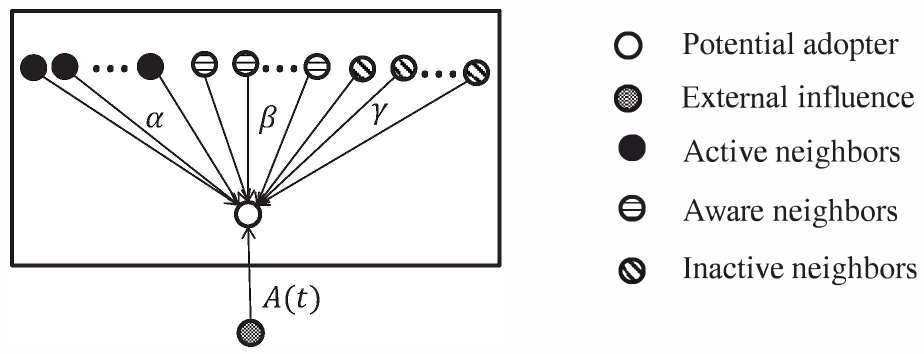
The authors propose a transition model (INACTIVE AWARE ADOPT) where awareness is a probability function of neighbor states and external advertising, while adoption is a deterministic decision based on whether the current public price is lower than the user's internal valuation .
The Pricing Strategy
The core challenge is finding the optimal sequence of prices. The authors prove that this problem has an optimal substructure, meaning the best solution for stages can be found by looking at the best solution for stages.
The DPBH (Dynamic Programming Based Heuristic) works by:
- Discretizing the price range into a candidate set.
- Simulating diffusion to estimate the expected number of buyers at each price level.
- Using the recurrence relation to find the sequence.
Experiments & Results
The researchers tested their algorithm on real-world collaboration networks (arXiv and DBLP).
1. The Diminishing Returns of Pricing
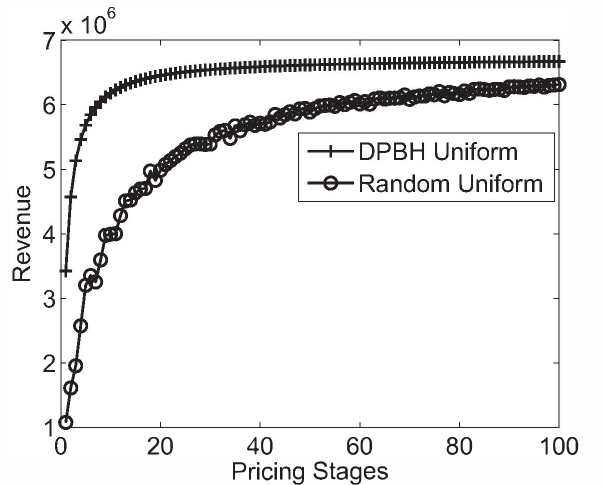
One of the most striking findings is that you don't need infinite pricing stages to maximize revenue. As shown in the figures below, the revenue curve flattens significantly after 20-30 stages. This suggests that a seller can capture the vast majority of market value with a relatively small number of strategic price drops.

2. Adoption vs. Revenue Paradox
The study reveals a critical insight: maximizing adoption is not the same as maximizing revenue. In some experimental setups, a random pricing strategy actually resulted in more people adopting the product, but at such low prices that the total revenue was far inferior to the DPBH approach.
Critical Insight & Conclusion
This paper shifts the focus from "how to make a product go viral" to "how to price a viral product." By accounting for the different stages of consumer behavior (Awareness vs. Adoption), the authors offer a mathematically grounded way to manage product life cycles in social networks.
Future Directions: The current model assumes the cost of the digital good is zero. While true for some software, future iterations should incorporate marginal costs and the possibility of repeat purchases, which would significantly alter the long-term optimal pricing sequence.