
GMTL: Revolutionizing Multi-Social-Temporal Prediction in Online Games
GMTL: A GART Based Multi-task Learning Model for Multi-Social-Temporal Prediction in Online Games
The paper introduces GMTL, a Multi-Task Learning model based on Graph Attention Recurrent Networks (GART) for predicting social time series and temporal link weights in online games. It leverages a Multi-Graph Attention Network (MGAT) to capture multi-relational social dependencies and a Bi-LSTM to model temporal dynamics, achieving SOTA performance on NetEase's MMORPG datasets.
TL;DR
Predicting player behavior in MMORPGs is notoriously difficult due to the complex interplay between time, social ties, and diverse activities. NetEase researchers have introduced GMTL (GART-based Multi-Task Learning), a deep learning framework that treats social connections and player attributes as a unified, evolving graph. By combining Multi-Graph Attention (MGAT) with Bi-LSTMs, they achieved a significant leap in predicting everything from player churn to virtual economic shifts.
Background & Motivation: The Chaos of Virtual Worlds
Online games like JusticePC are not just software; they are "breathing" virtual societies. In these environments, data is Multi-Social-Temporal (MST). A player's "Online Time" isn't just a number—it's influenced by their friends (Social Correlation), their previous habits (Temporal Correlation), and their wealth or equipment level (Collaborative Correlation).
Prior works like ARIMA or standard LSTMs failed because they viewed players in isolation. Conversely, traditional Graph Neural Networks (GNNs) often focus on static snapshots, ignoring the fact that a player's social circle and stats change by the minute.
Methodology: How GMTL Works
The core innovation lies in the GART (Graph Attention Recurrent Network) architecture, which is integrated into a multi-task learning pipeline.
1. Enclosing Subgraph Construction
To maintain computational efficiency, GMTL doesn't look at the entire game graph. Instead, it extracts an "enclosing subgraph" (h-hop) around target nodes. This localizes the context, capturing immediate social peers and their multi-relational attributes (trading, chatting, teaming).
2. MGAT: Multi-Graph Attention
Standard GAT (Graph Attention Networks) usually handle one type of edge. In games, a "transaction" edge means something very different from a "friendship" edge. GMTL's MGAT incorporates:
- Edge Types: Differentiates between 4 social networks (Transaction, Friendship, Team, Chat).
- Edge Weights: Quantifies the strength of these interactions.
3. Temporal & Task Fusion
The MGAT output flows into a Bi-LSTM to capture long-term and short-term trends. Finally, the model uses a shared representation to perform two tasks simultaneously:
- Social Time Series Prediction: Predicting future attributes (Online time, Virtual Money, Scores).
- Temporal Link Weight Prediction: Predicting the strength of future connections.
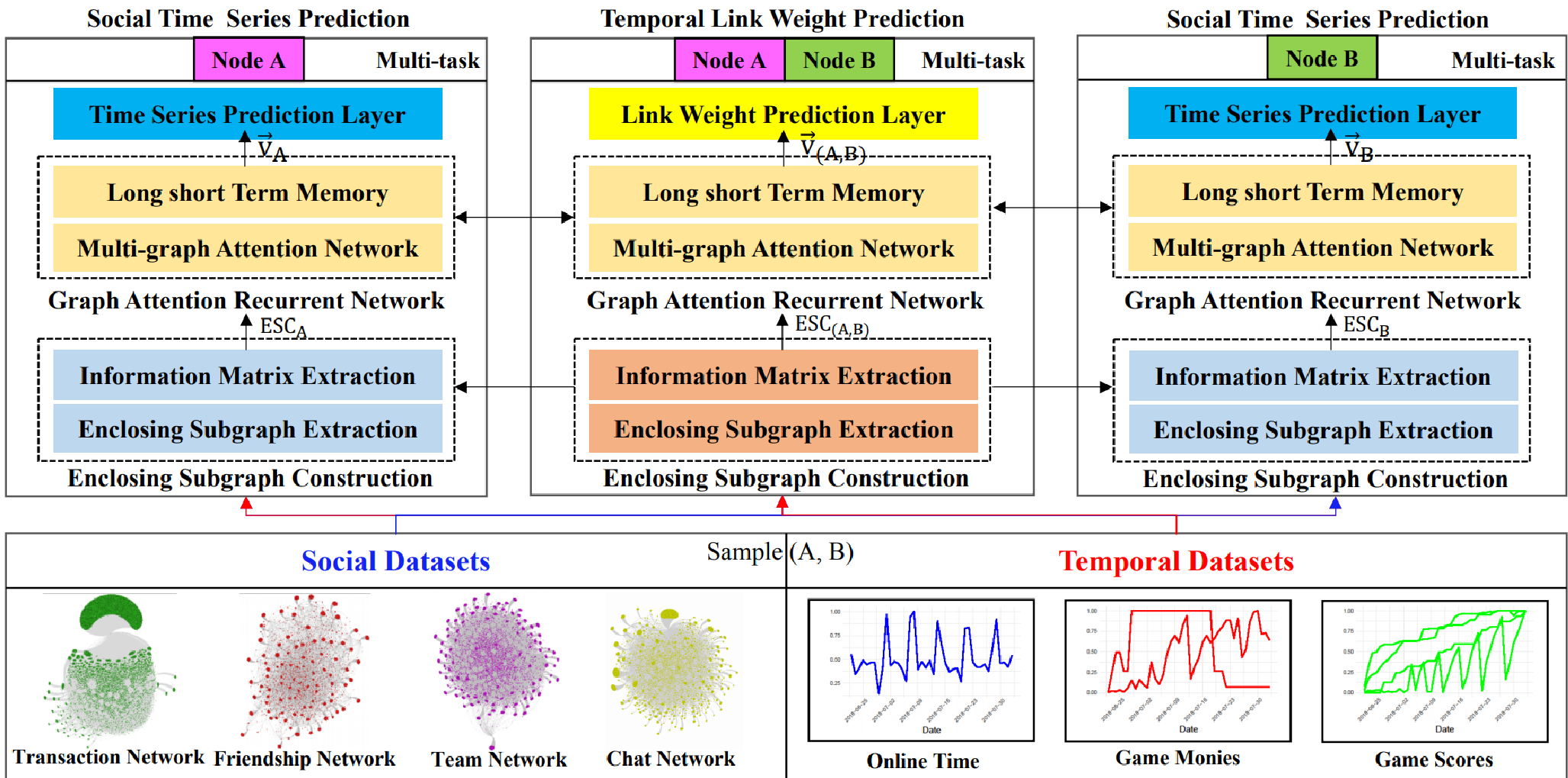 Figure: The proposed GMTL Model shows the flow from multi-relational subgraphs to joint task prediction.
Experimental Battleground: SOTA Performance
The model was tested against heavyweights like GBRT and DNE. The results were clear: GMTL dominates.
- Social Prediction: In "Online Time" forecasting, GMTL achieved an RMSE of 5417, nearly 25% better than a standard LSTM (7052).
- Link Prediction: For "Friendship" link weight, the MAPE was reduced to a staggering 0.51%, compared to ~5% for deep learning baselines.
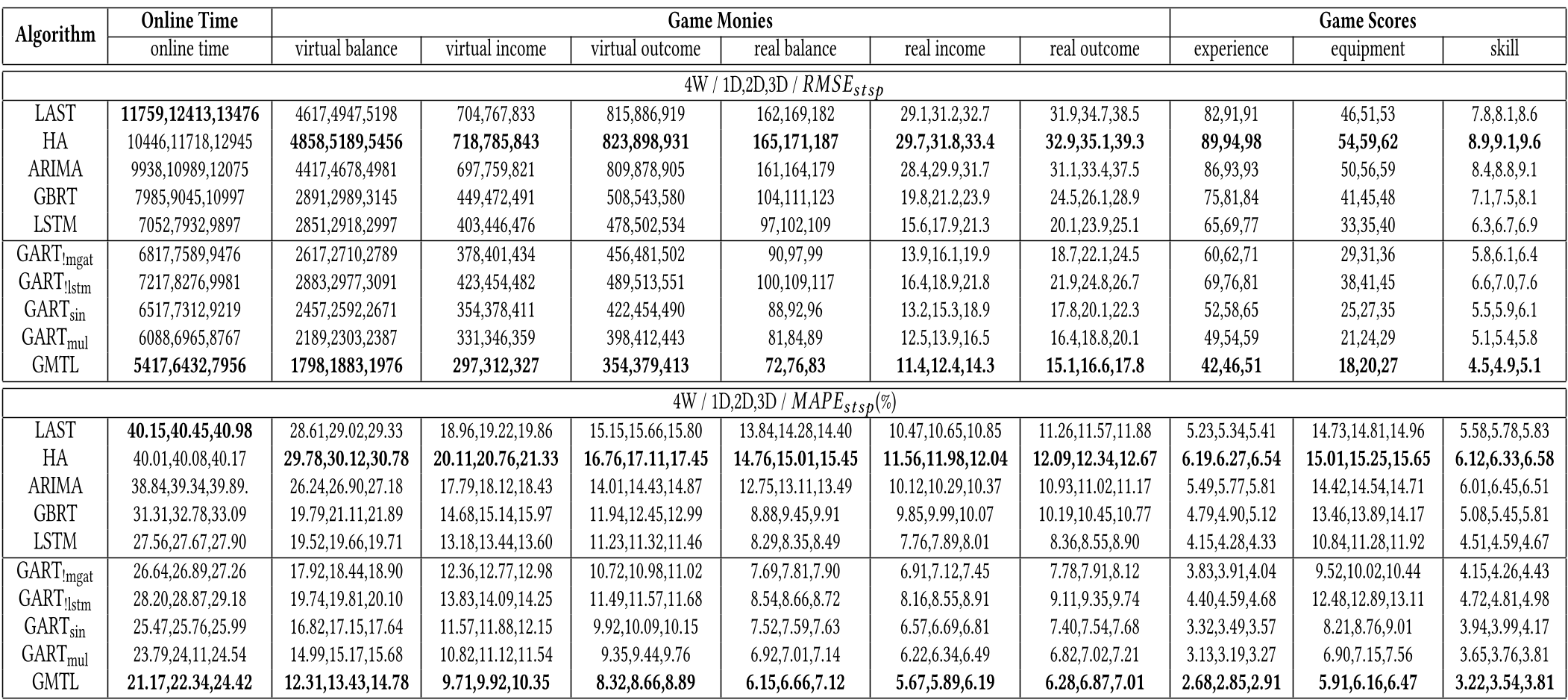 Table: Comparison of social time series prediction performance across various attributes.
Business Impact: From Theory to NetEase Games
GMTL isn't just a research paper; it's a deployed system. NetEase uses it for:
- Churn Prevention: Predicting when a player's activity will drop and sending targeted retention gifts.
- Economic Health: Detecting "Smurfs" and illegal real-money trading by flagging abnormal transaction weight predictions.
- Social Engagement: Powering the "People You May Know" feature with higher conversion rates by predicting which friendships are likely to strengthen.
Critical Insight & Conclusion
The genius of GMTL is its recognition of Inductive Bias in social data. By forcing the model to learn attribute changes and link changes together, the shared hidden layers capture the "hidden rules" of the game's society—e.g., a player who starts trading frequently with a new group is likely to join their team next week.
While highly effective, the model's reliance on enclosing subgraphs suggests a trade-off between local accuracy and global structural awareness. Future iterations might benefit from integrating global graph embeddings to capture meta-trends in the game's economy.
The Takeaway: For anyone dealing with dynamic, relational time-series data, GMTL proves that multi-task learning on graphs is no longer an option—it's a necessity.